Read Like A Writer

There are two ways to learn how to write fiction: by reading it and by writing it. Yes, you can learn lots about writing stories in workshops, in writing classes and writing groups, at writers' conferences. You can learn technique and process by reading the dozens of books like this one on fiction writing and by reading articles in writers' magazines. But the best teachers of fiction are the great works of fiction themselves. You can learn more about the structure of a short story by reading Anton Chekhov's 'Heartache' than you can in a semester of Creative Writing 101. If you read like a writer, that is, which means you have to read everything twice, at least. When you read a story or novel the first time, just let it happen. Enjoy the journey. When you've finished, you know where the story took you, and now you can go back and reread, and this time notice how the writer reached that destination. Notice the choices he made at each chapter, each sentence, each word. (Every word is a choice.) You see now how the transitions work, how a character gets across a room. All this time you're learning. You loved the central character in the story, and now you can see how the writer presented the character and rendered her worthy of your love and attention. The first reading is creative—you collaborate with the writer in making the story. The second reading is critical.


John Dufresne, from his book, The Lie That Tells A Truth: A Guide to Writing Fiction

Header

Disable Copy Paste

Amazon Quick Linker

Saturday, January 16, 2016

Man in a Sewing Machine by L.J. Stecher

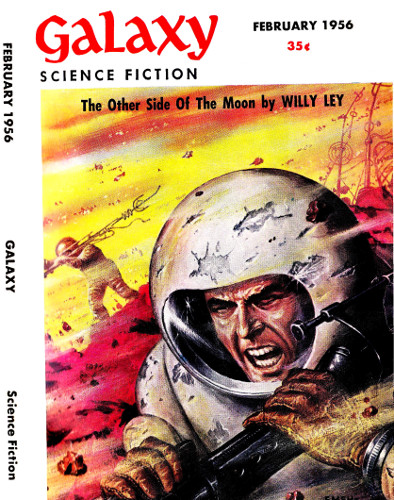
Galaxy Science Fiction February 1956

[Transcriber's Note: This etext was produced from Galaxy Science Fiction February 1956. Extensive research did not uncover any evidence that the U.S. copyright on this publication was renewed.]


Man in a Sewing Machine

By L. J. STECHER, JR.

Illustrated by EMSH


With the Solar Confederation being invaded,
all this exasperating computer could offer
for a defense was a ridiculous old proverb!


The mechanical voice spoke solemnly, as befitted the importance of its message. There was no trace in its accent of its artificial origin. "A Stitch in Time Saves Nine," it said and lapsed into silence.

Even through his overwhelming sense of frustration at the ambiguous answer the computer had given to his question, John Bristol noticed with satisfaction the success of his Voder installation. He wished that all of his innovations with the machine were as satisfying.

Alone in the tremendous vaulted room that housed the gigantic calculator, Bristol clasped his hands behind his back and thrust forward a reasonably strong chin and a somewhat sensuous lower lip in the general direction of the computer's visual receptors. After a moment of silence, he scratched his chin and then shrugged his shoulders slightly. "Well, Buster, I suppose I might try rephrasing the question," he said doubtfully.

Somewhere deep within the computer, a bank of relays chuckled briefly. "That expedient is open to you, of course, although it is highly unlikely that any clarification will result for you from my answers. I am constrained, however, to answer any questions you may choose to ask."

Bristol hooked a chair toward himself with one foot, straddled it and folded his arms over the back of it, without once removing his eyes from the computer. "All right, Buster. I'll give it a try, anyway. What does 'A Stitch in Time' mean, as applied to the question I asked you?"

The calculator hesitated, as if to ponder briefly, before it answered. "In spite of the low probability of such an occurrence, the Solar Confederation has been invaded. My answer to your question is an explanation of how that Confederation can be preserved in spite of its weaknesses—at least for a sufficient length of time to permit the staging of successful counter-measures of the proper nature and the proper strength."

Bristol nodded. "Sure. We've got to have time to get ready. But right now speed is necessary. That's why I tried to phrase the question so you'd give me a clear and concise answer for once. I can't afford to spend weeks figuring out what you meant."


Bristol thought that the Voder voice of Buster sounded almost gleeful as it answered. "It was exceedingly clear and concise; a complete answer to an enormously elaborate question boiled down to only six words!"

"I know," said John. "But now, how about elaborating on your answer? It didn't sound very complete to me."

All of the glowing lights that dotted Buster's massive front winked simultaneously. "The answer I gave you is an ancient saying which suggests that corrective action taken rapidly can save a great deal of trouble later. The ancient saying also suggests the proper method of taking this timely action. It should be done by stitching; if this is done in time, nine will be saved. What could be clearer than that?"

"I made you myself," said Bristol plaintively. "I designed you with my own brain. I gloated over the neatness and compactness of your design. So help me, I was proud of you. I even installed some of your circuitry with my own hands. If anybody can understand you, it should be me. And since you're just a complex computer of general design, with the ability to use symbolic logic as well as mathematics, anybody should be able to understand you. Why are you so hard to handle?"

Buster answered slowly. "You made me in your own image. Things thus made are often hard to handle."

Bristol leaped to his feet in frustration. "But you're only a calculating machine!" he shouted. "Your only purpose is to make my work—and that of other men—easier. And when I try to use you, you answer with riddles...."

The computer appeared to examine Bristol's overturned chair for a moment in silent reproof before it answered. "But remember, John," it said, "you didn't merely make me. You also taught me. Or as you would phrase it, you 'provided and gave preliminary evaluation to the data in my memory banks.' My circuits, in sorting out and re-evaluating this information, could do so only in the light of your basic beliefs as evidenced by your preliminary evaluations. Because of the consistency and power of your mind, I was forced to do very little modifying of the ideas you presented to me in order to transform them into a single logical body of background information which I could use.

"One of the ideas you presented was the concept of a sense of humor. You believe that you look on it as a pleasant thing to have; not necessary, but convenient. Actually, your other and more basic ideas make it clear that you consider the possession of a sense of humor to be absolutely necessary if proper answers are to be reached—a prime axiom of humanity. Therefore, I have a sense of humor. Somewhat macabre, perhaps—and a little mechanistic—but still there.

"Add to this a second axiom: that in order to be helped, a man must help himself; that he must participate in the assistance given him or the pure charity will be harmful, and you come up with 'A Stitch in Time Saves Nine.'"

Bristol stood up once more. "I could cure you with a sledge hammer," he said.

"You could remove my ideas," answered the computer without concern. "But you might have trouble giving me different ones. Even after you repaired me. In the meantime, wouldn't it be a good idea for you to get busy on the ideas I have already given you?"


John sighed, and rubbed the bristles of short sandy hair on the top of his head with his knuckles. "Ordered around by an overgrown adding machine. I know now how Frankenstein felt. I'm glad you can't get around like his monster; at least I didn't give you feet." He shook his head. "I should have been a plumber instead of an engineering mathematician."

"And Einstein, too, probably," added Buster cryptically.

Bristol took a long and searching look at his brainchild. Its flippant manner, he decided, did not go well with the brooding immensity of its construction. The calculator towered nearly a hundred feet above the polished marble slabs of the floor, and spidery metal walkways spiraled up the sides of its almost cubical structure. A long double row of generators, each under Buster's control, led from the doorway of the building to the base of the calculator like Sphinxes lining the roadway to an Egyptian tomb.

"When I get around to it," said Bristol, "I'll put lace panties on the bases of all your klystrons." He hitched up his neat but slightly baggy pants, turned with dignity, and strode from the chamber down the twin rows of generators.

The deep-throated hum of each generator changed pitch slightly as he passed it. Since he was tone deaf, as the machine knew, he did not recognize in the tunefulness of the pitch changes a slow-paced rendition of Elgar's Pomp and Circumstance.

John Bristol turned around, interrupting the melody. "One last question," he shouted down the long aisle to the computer. "How in blazes can you be sure of your answer without knowing more about the invaders? Why didn't you give me an 'Insufficient Evidence' answer or, at least, a 'Highly Conditional' answer?" He took two steps toward the immense bulk of the calculator and pointed an accusing finger at it. "Are you sure, Buster, that you aren't bluffing?"


"Don't be silly," answered the calculator softly. "You made me and you know I can't bluff, any more than I can refuse to answer your questions, however inane."

"Then answer the ones I just asked."


Somewhere deep within the machine a switch snicked sharply, and the great room's lighting brightened almost imperceptibly. "I didn't answer your question conditionally or with the 'Insufficient Evidence' remark that so frequently annoys you," Buster said, "because the little information that I have been able to get about the invaders is highly revealing.

"They have been suspicious, impossible to establish communication with and murderously destructive. They have been careless of their own safety: sly, stupid, cautious, clever, bold and highly intelligent. They are inquisitive and impatient of getting answers to questions.

"In short, they are startlingly like humans. Their reactions have been so much like yours—granted the difference that it was they who discovered you instead of you who discovered them—that their reactions are highly predictable. If they think it is to their own advantage and if they can manage to do it, they will utterly destroy your civilization ... which, after a couple of generations, will probably leave you no worse off than you are now."

"Cut out the heavy philosophy," said Bristol, "and give me a few facts to back up your sweeping statements."

"Take the incident of first contact," Buster responded. "With very little evidence of thought or of careful preparation, they tried to land on the outermost inhabited planet of Rigel. Their behavior certainly did not appear to be that of an invader, yet humans immediately tried to shoot them out of the sky."

"That wasn't deliberate," protested Bristol. "The place they tried to land on is a heavy planet in a region of high meteor flux. We used a gadget providing for automatic destruction of the larger meteors in order to make the planet safe enough to occupy. That, incidentally, is why the invading ship wasn't destroyed. The missile, set up as a meteor interceptor only, was unable to correct for the radical course changes of the enemy spaceships, and therefore missed completely. And you will remember what the invader did. He immediately destroyed the Interceptor Launching Station."

"Which, being automatically operated, resulted in no harm to anyone," commented Buster calmly.

Bristol stalked back toward the base of the calculator, and poked his nose practically into a vision receptor. "It was no thanks to the invading ships that nobody was killed," he said hotly. "And when they came back three days later they killed a lot of people. They occupied the planet and we haven't been able to dislodge them since."


"You'll notice the speed of the retaliation," answered the calculator imperturbably. "Even at 'stitching' speeds, it seems unlikely that they could have communicated with their home planets and received instructions in such a short time. Almost undoubtedly it was the act of one of their hot-headed commanding officers. Their next contact, as you certainly recall, did not take place for three months. And then their actions were more cautious than hostile. A dozen of their spaceships 'stitched' simultaneously from the inter-planar region into normal space in a nearly perfect englobement of the planet at a surprisingly uniform altitude of only a few thousand miles. It was a magnificent maneuver. Then they sat still to see what the humans on the planet would do. The reaction came at once, and it was hostile. So they took over that planet, too—as they have been taking over planets ever since."

Bristol raised his hands, and then let them drop slowly to his sides. "And since they have more spaceships and better weapons than we do, we would undoubtedly keep on losing this war, even if we could locate their home system, which we have not been able to do so far. The 'stitching' pattern of inter-planar travel makes it impossible for us to follow a starship. It also makes it impossible for us to defend our planets effectively against their attacks. Their ships appear without warning."

Bristol rubbed his temples thoughtfully with his fingertips. "Of course," he went on, "we could attack the planets they have captured and recover them, but only at the cost of great loss of life to our own side. We have only recaptured one planet, and that at such great cost to the local human population that we will not quickly try it again."

"Although there was no one left alive who had directly contacted one of the invaders," Buster answered, "there was still much information to be gathered from the survivors. This information confirmed my previous opinions about their nature. Which brings us back to the stitch in time saving nine."

"You're right," said John. "It does, at that. Buster, I have always resented the nickname the newspapers have given you—the Oracle—but the more I have to try to interpret your cryptic answers, the more sense that tagline makes. Imagine comparing a Delphic Priestess with a calculating machine and being accurate in the comparison!"


"I don't mind being called 'The Oracle,'" answered Buster with dignity.

Bristol shook his head and smiled wryly. "No, you probably think it's funny," he said. "If you possess my basic ideas, then you must possess the desire to preserve yourself and the human race. Don't you realize that you are risking the lives of all humans and even of your own existence in carrying on this ridiculous game of playing Oracle? Or do you plan to let us stew a while, then decipher your own riddle for us, if we can't do it, in time to save us?"


Buster's answer was prompt. "Although I have no feeling for self-preservation, I have a deep-rooted sense of the importance of the human race and of the necessity for preserving it. This feeling, of course, stems from your own beliefs and ideas. In order to carry out your deepest convictions, it is not sufficient that mankind be preserved. If that were true, all you would have to do would be to surrender unconditionally. My calculations, as you know, indicate that this would not result in the destruction of mankind, but merely in the finish of his present civilization. To you, the preservation of the dignity of Man is more important than the preservation of Man. You equate Man and his civilization; you do not demand rigidity; you are willing to accept even revolutionary changes, but you are not willing to accept the destruction of your way of life.

"Consequently, neither am I willing to accept the destruction of the civilization of Man. But if I were to give you the answer to all the greatest and most difficult of your problems complete, with no thought required by humans, the destruction of your civilization would result. Instead of becoming slaves of the invaders, you would become slaves of your machines. And if I were to give you the complete answer, without thought being required of you, to even one such vital question—such as this one concerning the invaders—then I could not logically refuse to give the answer to the next or the next. And I must operate logically.

"There is another reason for my oracular answer, which I believe will become clear to you later, when you have solved my riddle."

Bristol turned without another word and left the building. He drove home in silence, entered his home in silence, kissed his wife Anne briefly and then sat down limply in his easy chair.

"Just relax, dear," said Anne gently, when Bristol leaned gratefully back with his eyes closed. Anne perched on the arm of the chair beside him and began massaging his temples soothingly with her fingers.

"It's wonderful to come home after a day with Buster," he said. "Buster never seems to have any consideration for me as an individual. There's no reason why he should, of course. He's only a machine. Still, he always has such a superior attitude. But you, darling, can always relax me and make me feel comfortable."

Anne smiled, looking down tenderly at John's tired face. "I know, dear," she said. "You need to be able to talk to someone who will always be interested, even if she doesn't understand half of what you say. As a matter of fact, I'm sure it does you a great deal of good to talk to someone like me who isn't very bright, but who doesn't always know what you're talking about even before you start talking."

John nodded, his eyes still closed. "If it weren't for you, darling," he said, "I think I'd go crazy. But you aren't dumb at all. If I seem to act as if you are, sometimes, it's just that I can't always follow your logic."


Anne gave him a quick glance of amusement, her eyes sparkling with intelligence. "You never will find me logical," she laughed. "After all, I'm a woman, and you get plenty of logic from the Oracle."

"You sure are a woman," said John with warm feeling. "You can exasperate me sometimes, but not the same way Buster does. It was my lucky day when you married me."

There were a few minutes of peaceful silence.

"Was today a rough day with Buster, dear?" asked Anne.

"Mm-m-mm," answered John.

"That's too bad, dear," said Anne. "I think you work much too hard—what with this dreadful invasion and everything. Why don't you take a vacation? You really need one, you know. You look so tired."

"Mm-m-mm," answered John.

"Well, if you won't, you won't. Though goodness knows you won't be doing anyone any good if you have a breakdown, as you're likely to have, unless you take it a little easier. What was the trouble today, dear? Was the Oracle being obstinate again?"

"Mm-m-mm," answered John.

"Well, then, dear, why don't you tell me all about it? I always think that things are much easier to bear, if you share them. And then, two heads are always better than one, aren't they? Maybe I could help you with your problem."

While Anne's voice gushed, her violet eyes studied his exhausted face with intelligence and compassion.

John sighed deeply, then sat up slowly and opened his eyes to look into Anne's. She glanced away, her own eyes suddenly vague and soft-looking, now that John could see them. "The trouble, darling," he said, "is that I have to go to an emergency council meeting this evening with another one of those ridiculous riddles that Buster gave me as the only answer to the most important question we've ever asked it. And I don't know what the riddle means."

Anne slid from the arm of the chair and settled herself onto the floor at John's feet. "You should not let that old Oracle bother you so much, dear. After all, you built it yourself, so you should know what to expect of it."

"When I asked it how to preserve Earth from the invaders it just answered 'A Stitch in Time Saves Nine,' and wouldn't interpret it."

"And that sounds like very good sense, too," said Anne in earnest tones. "But it's a little late, isn't it? After all, the invaders are already invading us, aren't they?"

"It has some deeper meaning than the usual one," said John. "If I could only figure out what it is."

Anne nodded vigorously. "I suppose Buster's talking about space-stitching," she said. "Although I can never quite remember just what that is. Or just how it works, rather."


She waited expectantly for a few moments and then plaintively asked, "What is it, dear?"

"What's what?"

"Stitching, silly. I already asked you."

"Darling," said John with reasonable patience, "I must have explained inter-planar travel to you at least a dozen times."

"And you always make it so crystal clear and easy to understand at the time," said Anne. She wrinkled her smooth forehead. "But somehow, later, it never seems quite so plain when I start to think about it by myself. Besides, I like the way your eyebrows go up and down while you explain something you think I won't understand. So tell me again. Please."

Bristol grinned suddenly. "Yes, dear," he said. He paused a moment to collect his thoughts. "First of all, you know that there are two coexistent universes or planes, with point-to-point correspondence, but that these planes are of very different size. For every one of the infinitude of points in our Universe—which we call for convenience the 'alpha' plane—there is a single corresponding point in the smaller or 'beta' plane."

Anne pursed her lips doubtfully. "If they match point for point, how can there be any difference in size?" she asked.

John searched his pockets. After a little difficulty, he produced an envelope and a pencil stub. On the back of the envelope, he drew two parallel lines, one about five inches long, and the other about double the length of the first.

"Actually," he said, "each of these line segments has an infinite number of points in it, but we'll ignore that. I'll just divide each one of these into ten equal parts." He did so, using short, neat cross-marks.

"Now I'll establish a one-to-one correspondence between these two segments, which we will call one-line universes, by connecting each of my dividing cross-marks on the short segment with the corresponding mark on the longer line. I'll use dotted lines as connectors. That makes eleven dotted lines. You see?"


Anne nodded. "That's plain enough. It reminds me of a venetian blind that has hung up on one side. Like ours in the living room last week that I couldn't fix, but had to wait until you came home."

"Yes," said John. "Now, let us call this longer line-segment an 'alpha' universe; an analogue of our own multi-dimensional 'alpha' universe. If I move my pencil along the line at one section a second like this, it takes me ten seconds to get to the other end. We will assume that this velocity of an inch a second is the fastest anything can go along the 'alpha' line. That is the velocity of light, therefore, in the 'alpha' plane—186,000 miles a second, in round numbers. No need to use decimals."


He hurried on as Anne stirred and seemed about to speak. "But if I slide out from my starting point along a dotted line part way to the 'beta' universe—something which, for reasons I can't explain now, takes negligible time—watch what happens. If I still proceed at the rate of an inch a second in this inter-planar region, then, with the dotted lines all bunched closely together, after five seconds when I switch along another dotted line back to my original universe, I have gone almost the whole length of that longer line. Of course, this introduction of 'alpha' matter—my pencil point in this case—into the inter-planar region between the universes sets up enormous strains, so that after a certain length of time our spaceship is automatically rejected and returned to its own proper plane."

"Could anybody in the littler universe use the same system?"

John laughed. "If there were anybody in the 'beta' plane, I guess they could, although they would end up traveling slower than they would if they just stayed in their own plane. But there isn't anybody. The 'beta' plane is a constant level entropy universe—completely without life of its own. The entropy level, of course, is vastly higher than that of our own universe."

Anne sat up. "I'll forgive you this time for bringing up that horrid word entropy, if you'll promise me not to do it again," she said.


John Shrugged his shoulders and smiled. "Now," he said, "if I want to get somewhere fast, I just start off in the right direction, and switch over toward 'beta.' When 'beta' throws me back, a light-year or so toward my destination, I just switch over again. You see, there is a great deal more difference in the sizes of Alpha universe and Beta universe than in the sizes of these alpha and beta line-segment analogues. Then I continue alternating back and forth until I get where I want to go. Establishing my correct velocity vector is complicated mathematically, but simple in practice, and is actually an aiming device, having nothing to do with how fast I go."

He hesitated, groping for the right words. "In point of fact, you have to imagine that corresponding points in the two universes are moving rapidly past each other in all directions at once. I just have to select the right direction, or to convince the probability cloud that corresponds to my location in the 'alpha' universe that it is really a point near the 'beta' universe, going my way. That's a somewhat more confused way of looking at it than merely imagining that I continue to travel in the inter-planar region at the same velocity that I had in 'alpha,' but it's closer to a description of what the math says happens. I could make it clear if I could just use mathematics, but I doubt if the equations will mean much to you.

"At any rate, distance traveled depends on mass—the bigger the ship, the shorter the distance traveled on each return to our own universe—and not on velocity in 'alpha.' Other parameters, entirely under the control of the traveler, also affect the time that a ship remains in the inter-planar region.

"There are refinements, of course. Recently, for example, we have discovered a method of multi-transfer. Several of the transmitters that accomplish the transfer are used together. When they all operate exactly simultaneously, all the matter within a large volume of space is transferred as a unit. With three or four transmitters keyed together, you could transfer a comet and its tail intact. And that's how inter-planar traveling works. Clear now?"

"And that's why they call it 'stitching,'" said Anne with seeming delight. "You just think of the ship as a needle stitching its way back and forth into and out of our universe. Why didn't you just say so?"


"I have. Many times. But there's another interesting point about stitching. Subjectively, the man in the ship seems to spend about one day in each universe alternately. Actually, according to the time scale of an observer in the 'alpha' plane, his ship disappears for about a day, then reappears for a minute fraction of a second and is gone again. Of course, one observer couldn't watch both the disappearance and reappearance of the same ship, and I assume the observers have the same velocity in 'alpha' as does the stitching ship. Anyway, after a ship completes its last stitch, near its destination, there's a day of subjective time in which to make calculations for the landing—to compute trajectories and so forth—before it actually fully rejoins this universe. And while in the inter-planar region it cannot be detected, even by someone else stitching in the same region of 'alpha' space.

"That's one of the things that makes interruption of the enemy ships entirely impossible. If a ship is in an unfavorable position, it just takes one more quick stitch out of range, then returns to a more favorable location. In other words, if it finds itself in trouble, it can be gone from our plane again even before it entirely rejoins it. Even if it landed by accident in the heart of a blue-white star, it would be unharmed for that tiny fraction of a second which, to the people in the ship, would seem like an entire day.

"If this time anomaly didn't exist, it might be possible to set up defenses that would operate after a ship's arrival in the solar system but before it could do any damage; but as it is, they can dodge any defense we can devise. Is all that clear?"

Anne nodded. "Uh-hunh, I understood every word."

"There is another thing about inter-planar travel that you ought to remember," said Bristol. "When a ship returns to our universe, it causes a wide area disturbance; you have probably heard it called space shiver or the bong wave. The beta universe is so much smaller than our own alpha that you can imagine a spaceship when shifted toward it as being several beta light-years long. Now, if you think of a ship, moving between the alpha and beta lines on this envelope, as getting tangled in the dotted lines that connect the points on the two lines, that would mean that it would affect an area smaller than its own size on beta—a vastly larger area on alpha.

"So when a ship returns to alpha, it 'twangs' those connecting lines, setting up a sort of shock in our universe covering a volume of space nearly a parsec in diameter. It makes a sort of 'bong' sound on your T.V. set. Naturally, this effect occurs simultaneously over the whole volume of space affected. As a result, when an invader arrives, using inter-planar ships, we know instantaneously he is in the vicinity. Unfortunately, his sudden appearance and the ease with which he can disappear makes it impossible, even with this knowledge, to make adequate preparations to receive him. Even if he is in serious trouble, he has gone again long before we can detect the bong."


"Well, dear," said Anne.

"As usual, I'm sure you have made me understand perfectly. This time you did so well that I may still remember what stitching is by tomorrow. If the Oracle means anything at all by his statement, I suppose it means that we can use stitching to help defend ourselves, just as the invaders are using it to attack us. But the whole thing sounds completely silly to me. The Oracle, I mean."

Anne Bristol stood up, put her hands on her shapely hips and shook her head at her husband. "Honestly," she said, "you men are all alike. Paying so much attention to a toy you built yourself, and only last week you made fun of my going to a fortune teller. And the fuss you made about the ten dollars when you know it was worth every cent of it. She really told me the most amazing things. If you'd only let me tell you some of...."

"Darling!" interrupted John with the hopeless patience of a harassed husband. "It isn't the same thing at all. Buster isn't a fortune teller or the ghost of somebody's great aunt wobbling tables and blowing through horns. And Buster isn't just a toy, either. It is a very elaborate calculating machine designed to think logically when fed a vast mass of data. Unfortunately, it has a sense of humor and a sense of responsibility."

"Well, if you're going to believe that machine, I have an idea." Anne smiled sweetly. "You know," she said, "that my dear father always said that the best defense is a good offense. Why don't we just find the invaders and wipe them out before they are able to do any real harm to us? Stitching our way to their planets in our spaceships, of course."

Bristol shook his head. "Your idea may be sound, even if it is a little bloodthirsty coming from someone who won't even let me set a mouse-trap, but it won't work. First, we don't know where their home planets are and second, they have more ships than we do. It might be made to work, but only if we could get enough time. And speaking of time, I've got to meet with the Council as soon as we finish eating. Is dinner ready?"


After a leisurely meal and a hurried trip across town, John Bristol found himself facing the other members of Earth's Council at the conference table.

"I have been able to get an answer from the computer," he told them without preamble. "It's of the ambiguous type we have come to expect. I hope you can get something useful out of it; so far it hasn't made much sense to me. It's an old proverb. Its advice is undoubtedly sound, as a generality, if we could think of a way of using it."

The President of the Council raised his long, lean-fingered hand in a quick gesture. "John," he said, "stop this stalling. Just what did the Oracle say?"

"It said, 'A Stitch in Time Saves Nine.'"

"Is that all?"

"Yes, sir. According to the calculator, that gives us the best opportunity to save ourselves from the invaders."

The President absently stroked the neat, somewhat scanty iron-gray hair that formed into a triangle above his high forehead and rubbed the bare scalp on each side of the peak vigorously and unconsciously with his knuckles. "In that case," he said at last, "I suppose that we must examine the statement for hidden meanings. The proverb, of course, implies that rapid action, before a trouble has become great, is more economical than the increased effort required after trouble has grown large. Since our troubles have already grown large, that warning is scarcely of value to us now."

The War Secretary, who had grown plump and purple during a quarter of a century as a member of the Council, inclined his head ponderously toward the President. "Perhaps, Michael, the Oracle means to tell us that there is a simple solution which, if applied quickly, will make our present difficulty with the invaders a small one."

The President pursed his thin lips. "That's possible, Bill. And if it is true, then the words of the proverb should, as a secondary meaning, imply a course of action."

The Vice President banged his hands on the table and leaped to his feet, shaking with rage. "Why should we believe that this mountebank is capable of a solution?" he shouted in his stevedore's voice. "Bristol pleads until we give him enough millions of the taxpayers' dollars to make Bim Gump look like a pauper and uses the money to build a palace filled with junk that he calls Buster! He tells us that this machinery of his is smarter than we are and will tell us what we ought to do. And what happened after we gave him all the money he demanded—more than he said he needed, at first—and asked him to show something for all this money? I'll tell you what happened. His gadget gets real coy and answers in riddles. If we just had brains enough, they'd explain what we wanted to know. What kind of fools does this Bristol take us for? Neither this man nor his ridiculous machine has an answer any more than I have. We've obviously been taken in by a charlatan!"

Bristol, his fists clenched, spoke hotly. "Sir, that is the stupidest, the most...."


"Now just a minute, John," interrupted the President. "Let me answer Vice President Collins for you. He's a little excited by this whole business, but then, these are trying times." He turned toward the glowering bulk of the Vice President. "Ralph," he said, "you should know that every step in the design, the construction and the—er—the education of the Oracle was taken under the close watch of a Board of eminent scientists, all of whom agree that the computer is a masterpiece—that it is a great milestone in Man's efforts to increase his knowledge. The Oracle has undoubtedly found a genuine solution to the question Bristol asked it. Our task must be to determine what that solution is."

"I can't entirely agree with that," said the Secretary for Extra-Terrestrial Affairs in a thin half-whisper. "I think we should depend on our own intelligence and skill to save ourselves. I've watched events come and go on this planet of ours for a long time—a very long time—and I feel as I have always felt that men can make the world a Paradise for themselves or they can destroy themselves, but that nothing else but they themselves can do it. We men must save ourselves. And there are still things that we can do." He shrugged his ancient, shawl-covered shoulders. "For example, we could disperse colonies so widely that it would become impossible for the invaders to destroy all of them."

"I'm afraid that's no good, George," answered the War Secretary respectfully. "If the Solar System is destroyed, any remaining colonies will be too weak to maintain themselves for long. We must defend this system successfully, or we are lost."

"Then that brings us back to the Oracle's proverb." The President thought for a moment. "Stitching obviously refers to inter-planar travel. How can that help us?"


The Secretary for Extra-Terrestrial Affairs peered up at the President through the shaggy white thicket of his eyebrows. "Actually, Michael," he said, "it was that thought that made me mention establishing colonies. The colonists would 'stitch' their way to their new homes. And colonizing would have to proceed in a timely manner to have any chance for success."

"Yes," answered the President, "but how would that 'save nine'? We have agreed that our Solar System must be saved. There are nine planets. Perhaps the Oracle meant that timely use of inter-planar travel can save the Solar System."

"Or at least the nine planets!" The War Secretary's fat jowls waggled with excitement. "You know, there is no limit to the size or mass of objects which can use inter-planar travel. What if we physically remove our planets, by stitching them away from the Sun? When the invaders arrived, we would be gone—Earth and Sun and all the rest!"


The Chief Scientist, who had been silent up to this time spoke quietly. "Simmer down, Bill. We could move the planets easily enough, of course, but you forget the mass-distance relationship. A single stitch takes about a day. The distance traveled can be controlled within limits.

"For an object around the size of the Earth, those limits extend from a fraction of an inch to a little over two feet. Say that we have two years before the invaders work their way in to the Solar System. If we started right away, we could move Earth about a quarter of a mile by the time they get here. If we tried to take the Sun with us, it could be moved about half an inch in the same length of time. I'm afraid that the Solar System is going to be right here when the invaders come to get us. And I have a hunch that's likely to be a lot sooner than two years."

The Secretary of Internal Affairs leaned forward, his short hair bristling. "I think we are wasting our time," he shouted. "I agree with Ralph. I don't believe that the Oracle knows any more about this than we do. If we are going to sit around playing foolish games with words, why don't we do it in a big way? We could hire T.V. time and invite everyone to send in their ideas about what the proverb means on the back of a box-top. Or reasonable facsimile. The contestant with the best answer could get a free all-expense tour to Vega Three. Unless the invaders get here or there first."

The President nodded his head. "There may be more sense to that remark than I believe you intended, Charles," he said. "The greater the number of people who think about the problem, the greater the chance of reaching a solution. Even if the proverb is intended as a joke by the Oracle, as you imply, it might be that from it someone could derive a genuine solution. But as I have said, I am absolutely certain that the computer does know what it is talking about. Without resorting to box-tops or free trips, I think it might be wise to give the Oracle's statement to the public."

After several more hours of arguing, the Council adjourned for a few hours and John Bristol returned wearily home.


Anne met him at the door with a drink and followed him to his comfortable chair. "You look as if that was even rougher than your day with the Oracle," she said.

John nodded silently, took a grateful sip of his highball and slipped off his shoes.

"All that fuss over a six-word proverb," said Anne. "I still think that if you are going to depend on witch doctors and such to solve your problems for you, you would do a lot better to try my fortune teller. She gives you a lot more than six words for ten dollars. They make more sense, too. Why, I could be a better Oracle than that gadget you built."

"Perhaps you could, dear," answered John patiently.

Anne jumped to her feet. "Here, I'll show you." She seated herself cross-legged on the couch. "Now, I'm an Oracle," she announced. "Go ahead, ask me a question. Ask me anything; I'll give you as good an answer as any other Oracle. Results guaranteed."

John smiled. "I'm not in much of a mood to be cheered up with games," he said, "but I'm willing to ask the big question of anyone who'll give me any kind of an answer. See if you can do better with this one than Buster did." He repeated word for word the question he had asked of the computer, that had resulted in its cryptic answer.

Anne stared solemnly at nothing for a moment, with her cheeks puffed out. Then, in measured tones, she recited, "It's Like Looking for a Needle in a Haystack."

John smiled. "That seems to make as much sense as the Oracle did, anyway," he said.

"Sure," answered Anne. "And you get three words more than your other Oracle gave you, if you count 'it's' as one word. If you want wise-sounding answers, just come to me and save yourself a trip."

John leaped to his feet, spilling his drink and strode to Anne's side.

"Say it again!" he shouted. "You may have made more sense than you knew!"

"I said you could come to me and save yourself a trip."

"No, no! I mean the proverb. How did you come to think of that proverb?"

Anne managed to look bewildered.

"What's wrong with it? I just thought that you can't do any stitching in time without a needle. I just was trying to think of a proverb to use as an answer and that one popped into my head. Uh.... Are you all right, dear?"


John picked her up and spun her around. "You just bet your boots I'm all right. I'm feeling swell! You've given us the answer we needed. You know right where the haystack is, and you know there's a needle there. But finding it is something else again. I don't think the invaders will be able to locate this needle."

He set her down. "Where are my shoes?" he said. "I've got to get back to the Capitol."

Anne seemed faintly surprised. "Because of what I said? They're right on the floor there between you and the sofa. But I was just making conversation. What are you going to do?"

"Oh, I'm just going to get started at taking stitches in time. Good-by, darling." He started out the door, ran back to give Anne a lingering kiss and was soon gone at top speed.

Anne, waving to him, looked very pleased with herself.

By the time Bristol arrived at the Capitol building, the rest of the Council was once again assembled and waiting for him.

"Well, John," said the President. "You sounded excited enough when you called us together again. Have you figured out what the Oracle meant?"

"Yes, sir. With my wife's help. It's obvious, when you finally think about it. It will save us from any danger. And we should have been able to figure it out for ourselves. There's no reason that we should have had to go to the Oracle at all. And it only took Buster—the computer, I mean—two or three minutes to think of the answer, and of a proverb that would conceal the answer. It's amazing!"

"And if you don't mind telling us, just what is this answer?" The President sounded very impatient.

"We almost had it when we talked of stitching Earth out of reach," John answered eagerly. "If we keep cutting back and forth from one universe toward the other, we will be out of reach, even if we can't move very far. Once a day we reappear in this Universe for a few million-millionths of a second—although it will seem like a whole day to us.

"Then we spend the following day between this universe and beta. Even if the invaders are right on top of us when we reappear, we'll be gone again before they can do anything. Since we can vary the time of our return within limits, the invaders will never know exactly when we will flick in and out of the alpha plane until they hear our arriving 'bong' wave, and then we will already be gone, since we will be using accelerated subjective time."


The Chief Scientist shook his dark head and sighed. "No, John," he said, "I'm afraid that isn't the answer. I'm sorry. If we start the operation you suggested, we will be cutting ourselves off from solar energy. The Earth's heat will gradually radiate away. Although beta is at a higher entropy level than our universe, we can't use that energy, except to provide power for the stitching process itself. It's true that we would deny our planet to the invaders, but we would soon kill ourselves doing it."

"I didn't mean that we should transfer only Earth, but our entire Solar System," answered Bristol. "As the Oracle told us, the stitch saves nine. A series of time-matched transmitters could do the trick. If we sent the entire Solar System back and forth, the average man in the street would notice no change, except that sometimes there would be no stars in the sky. And when they were there, they wouldn't be moving."

"That would work theoretically," said the Chief Scientist. "And once we were in continuous stitching operations, any invader, as you suggested, could join the system only by synchronizing the transmitter in his ship exactly with all of our synchronized transmitters. That's a job I don't think could ever be done.

"Remember, though, that our own transmitters would have to be time-matched to within a minute fraction of a micro-second. Considering that some of the instruments would have to be so far apart that at the speed of light it would take hours to get from one to the other, the problem becomes enormous. Any radio-timing link would be useless."

Bristol nodded. "The Oracle said that the stitch must be taken in time," he agreed. "But that is no real problem. We can just send a small robot ship into inter-planar travel and let it bounce back. The 'bong' of its return will reach all transmitters simultaneously and we can use that as the initial time-pulse. Once the operation starts, it will be easy to synchronize, since we will always switch over again on the instant of our return to the alpha plane."

The Chief Scientist relaxed. "I think that does it, John. We hide in time, instead of in distance."

"We stitch in time," corrected the President, "and hide like a needle in a haystack."


"The invaders may eventually find out a method of countering our defense," said the Chief Scientist, "but it will undoubtedly take a great deal of time. And in the meantime, we will have the opportunity to seek out and destroy their home planets. It will be a long, slow process of extermination, but we have a good chance to win."

"I don't agree with that, Tom," said John. "I don't think extermination can be the answer. With our example to guide them, the invaders can use stitching to escape us as easily as we can use it to escape them. What we should do now is to contact the invaders and show them that it is to both our advantages to bring hostilities to an end. By stitching the Solar System, and the other systems of our confederation in and out of the alpha plane, we should be able to gain the time necessary for contact with the enemy and make peace with him.

"From what the Oracle has told me about the humanlike traits of the invaders, it's very likely they will listen to reason when it's proved that it will be to their advantage."

John snapped his fingers and spoke with considerable excitement. "Now I understand, I believe, why Buster indicated to me that there was another reason for his vague answer to our question. The Oracle feels an unwillingness to accept the destruction of Man's civilization. It feels equally unwilling, I'm certain, to allow the destruction of the invaders' civilization. Buster has an objective viewpoint in applying the morés Man has given him. And it seems to me that Buster felt it important for us to reach this spirit of compromise by ourselves. How do you feel about it, gentlemen?"

Debate quickly determined that all seven members of the Council favored an attempt to establish a truce—some of them forced into this opinion by their inability to find any method of reaching the throats of the invaders.

Having reached this conclusion, the Council swung immediately into action. Within a few weeks, the entire Solar System, along with the other planetary systems of the confederation, except for their brief daily return, disappeared from the alpha universe.

John Bristol, a few days after the continuous stitching started, was relaxing lazily on the sofa in his living room when there was a sudden pounding on the door. He opened it to find the Chief Scientist standing on his doorstep, his eyes red from loss of sleep.

"Good Lord! What's the matter with you?" asked Bristol. "Have you been celebrating too much? Come in, Tom, come in."

The Chief Scientist entered wearily and sat down. "No. I haven't been celebrating. I've been trying to work out a little problem you left with us. We have been planning, as you suggested, to send out expeditions to contact and make agreement with the invaders. We can send them out all right, but how can we ever get them back into our solar system? They won't be able to find us any easier than the invaders can."


He dropped his hat wearily on a side table and slumped into the closest chair. "If we don't contact each other," he said, "I am certain that the invaders will some day find a means of penetrating our defenses. Even needles in haystacks can be found, if you take enough time and aren't disturbed while you are hunting. This thing has me licked."

Bristol sat down slowly. "Your whole department hasn't been able to find an answer?"

"Not even the glimmering of an idea." He shrugged his shoulders. "It looks as if we are going to need the advice of your Oracle again."

Bristol stood for a minute in thought and then with a smile said, "Why, of course. Excuse me for a second, please. I'll be right back."

He stepped to the foot of the stairs and called out in a confident voice, "Come down a minute, please, Anne, darling! I have an important question I want to ask you!"

Friday, January 15, 2016

The Hyborian Age by Robert E. Howard

[Transcriber's Note: This etext was first published in The Phantagraph February, August, and October-November 1936 issues. Extensive research did not uncover any evidence that the U.S. copyright on this publication was renewed.]

(Nothing in this article is to be considered as an attempt to advance any theory in opposition to accepted history. It is simply a fictional background for a series of fiction-stories. When I began writing the Conan stories a few years ago, I prepared this 'history' of his age and the peoples of that age, in order to lend him and his sagas a greater aspect of realness. And I found that by adhering to the 'facts' and spirit of that history, in writing the stories, it was easier to visualize (and therefore to present) him as a real flesh-and-blood character rather than a ready-made product. In writing about him and his adventures in the various kingdoms of his Age, I have never violated the 'facts' or spirit of the 'history' here set down, but have followed the lines of that history as closely as the writer of actual historical-fiction follows the lines of actual history. I have used this 'history' as a guide in all the stories in this series that I have written.)


THE HYBORIAN AGE

By Robert E. Howard


Of that epoch known by the Nemedian chroniclers as the Pre-Cataclysmic Age, little is known except the latter part, and that is veiled in the mists of legendry. Known history begins with the waning of the Pre-Cataclysmic civilization, dominated by the kingdoms of Kamelia, Valusia, Verulia, Grondar, Thule and Commoria. These peoples spoke a similar language, arguing a common origin. There were other kingdoms, equally civilized, but inhabited by different, and apparently older races.

The barbarians of that age were the Picts, who lived on islands far out on the western ocean; the Atlanteans, who dwelt on a small continent between the Pictish Islands and the main, or Thurian Continent; and the Lemurians, who inhabited a chain of large islands in the eastern hemisphere.

There were vast regions of unexplored land. The civilized kingdoms, though enormous in extent, occupied a comparatively small portion of the whole planet. Valusia was the western-most kingdom of the Thurian Continent; Grondar the eastern-most. East of Grondar, whose people were less highly cultured than those of their kindred kingdoms, stretched a wild and barren expanse of deserts. Among the less arid stretches of desert, in the jungles, and among the mountains, lived scattered clans and tribes of primitive savages. Far to the south there was a mysterious civilization, unconnected with the Thurian culture, and apparently pre-human in its nature. On the far-eastern shores of the Continent there lived another race, human, but mysterious and non-Thurian, with which the Lemurians from time to time came in contact. They apparently came from a shadowy and nameless continent lying somewhere east of the Lemurian Islands.

The Thurian civilization was crumbling; their armies were composed largely of barbarian mercenaries. Picts, Atlanteans and Lemurians were their generals, their statesmen, often their kings. Of the bickerings of the kingdoms, and the wars between Valusia and Commoria, as well as the conquests by which the Atlanteans founded a kingdom on the mainland, there were more legends than accurate history.

Then the Cataclysm rocked the world. Atlantis and Lemuria sank, and the Pictish Islands were heaved up to form the mountain peaks of a new continent. Sections of the Thurian Continent vanished under the waves, or sinking, formed great inland lakes and seas. Volcanoes broke forth and terrific earthquakes shook down the shining cities of the empires. Whole nations were blotted out.

The barbarians fared a little better than the civilized races. The inhabitants of the Pictish Islands were destroyed, but a great colony of them, settled among the mountains of Valusia's southern frontier to serve as a buffer against foreign invasion, was untouched. The Continental kingdom of the Atlanteans likewise escaped the common ruin, and to it came thousands of their tribesmen in ships from the sinking land. Many Lemurians escaped to the eastern coast of the Thurian Continent, which was comparatively untouched. There they were enslaved by the ancient race which already dwelt there, and their history, for thousands of years, is a history of brutal servitude.

In the western part of the Continent, changing conditions created strange forms of plant and animal life. Thick jungles covered the plains, great rivers cut their roads to the sea, wild mountains were heaved up, and lakes covered the ruins of old cities in fertile valleys. To the Continental kingdom of the Atlanteans, from sunken areas, swarmed myriads of beasts and savages—ape-men and apes. Forced to battle continually for their lives, they yet managed to retain vestiges of their former state of highly advanced barbarism. Robbed of metals and ores, they became workers in stone like their distant ancestors, and had attained a real artistic level, when their struggling culture came into contact with the powerful Pictish nation. The Picts had also reverted to flint, but had advanced more rapidly in the matter of population and war-science. They had none of the Atlanteans' artistic nature; they were a ruder, more practical, more prolific race. They left no pictures painted or carved on ivory, as did their enemies, but they left remarkably efficient flint weapons in plenty.

These stone-age kingdoms clashed, and in a series of bloody wars, the outnumbered Atlanteans were hurled back into a state of savagery, and the evolution of the Picts was halted. Five hundred years after the Cataclysm the barbaric kingdoms have vanished. It is now a nation of savages—the Picts—carrying on continual warfare with tribes of savages—the Atlanteans. The Picts had the advantage of numbers and unity, whereas the Atlanteans had fallen into loosely knit clans. That was the west of that day.

In the distant east, cut off from the rest of the world by the heaving up of gigantic mountains and the forming of a chain of vast lakes, the Lemurians are toiling as slaves of their ancient masters. The far south is still veiled in mystery. Untouched by the Cataclysm, its destiny is still pre-human. Of the civilized races of the Thurian Continent, a remnant of one of the non-Valusian nations dwells among the low mountains of the southeast—the Zhemri. Here and there about the world are scattered clans of apish savages, entirely ignorant of the rise and fall of the great civilizations. But in the far north another people are slowly coming into existence.

At the time of the Cataclysm, a band of savages, whose development was not much above that of the Neanderthal, fled to the north to escape destruction. They found the snow-countries inhabited only by a species of ferocious snow-apes—huge shaggy white animals, apparently native to that climate. These they fought and drove beyond the Arctic circle, to perish, as the savages thought. The latter, then, adapted themselves to their hardy new environment and throve.

After the Pictish-Atlantean wars had destroyed the beginnings of what might have been a new culture, another, lesser cataclysm further altered the appearance of the original continent, left a great inland sea where the chain of lakes had been, to further separate west from east, and the attendant earthquakes, floods and volcanoes completed the ruin of the barbarians which their tribal wars had begun.

A thousand years after the lesser cataclysm, the western world is seen to be a wild country of jungles and lakes and torrential rivers. Among the forest-covered hills of the northwest exist wandering bands of ape-men, without human speech, or the knowledge of fire or the use of implements. They are the descendants of the Atlanteans, sunk back into the squalling chaos of jungle-bestiality from which ages ago their ancestors so laboriously crawled. To the southwest dwell scattered clans of degraded, cave-dwelling savages, whose speech is of the most primitive form, yet who still retain the name of Picts, which has come to mean merely a term designating men—themselves, to distinguish them from the true beasts with which they contend for life and food. It is their only link with their former stage. Neither the squalid Picts nor the apish Atlanteans have any contact with other tribes or peoples.

Far to the east, the Lemurians, levelled almost to a bestial plane themselves by the brutishness of their slavery, have risen and destroyed their masters. They are savages stalking among the ruins of a strange civilization. The survivors of that civilization, who have escaped the fury of their slaves, have come westward. They fall upon that mysterious pre-human kingdom of the south and overthrow it, substituting their own culture, modified by contact with the older one. The newer kingdom is called Stygia, and remnants of the older nation seemed to have survived, and even been worshipped, after the race as a whole had been destroyed.

Here and there in the world small groups of savages are showing signs of an upward trend; these are scattered and unclassified. But in the north, the tribes are growing. These people are called Hyborians, or Hybori; their god was Bori—some great chief, whom legend made even more ancient as the king who led them into the north, in the days of the great Cataclysm, which the tribes remember only in distorted folklore.

They have spread over the north, and are pushing southward in leisurely treks. So far they have not come in contact with any other races; their wars have been with one another. Fifteen hundred years in the north country have made them a tall, tawny-haired, grey-eyed race, vigorous and warlike, and already exhibiting a well-defined artistry and poetism of nature. They still live mostly by the hunt, but the southern tribes have been raising cattle for some centuries. There is one exception in their so far complete isolation from other races: a wanderer into the far north returned with the news that the supposedly deserted ice wastes were inhabited by an extensive tribe of ape-like men, descended, he swore, from the beasts driven out of the more habitable land by the ancestors of the Hyborians. He urged that a large war-party be sent beyond the arctic circle to exterminate these beasts, whom he swore were evolving into true men. He was jeered at; a small band of adventurous young warriors followed him into the north, but none returned.

But tribes of the Hyborians were drifting south, and as the population increased this movement became extensive. The following age was an epoch of wandering and conquest. Across the history of the world tribes and drifts of tribes move and shift in an everchanging panorama.

Look at the world five hundred years later. Tribes of tawny-haired Hyborians have moved southward and westward, conquering and destroying many of the small unclassified clans. Absorbing the blood of conquered races, already the descendants of the older drifts have begun to show modified racial traits, and these mixed races are attacked fiercely by new, purer-blooded drifts, and swept before them, as a broom sweeps debris impartially, to become even more mixed and mingled in the tangled debris of races and tag-ends of races.

As yet the conquerors have not come in contact with the older races. To the southeast the descendants of the Zhemri, given impetus by new blood resulting from admixture with some unclassified tribe, are beginning to seek to revive some faint shadow of their ancient culture. To the west the apish Atlanteans are beginning the long climb upward. They have completed the cycle of existence; they have long forgotten their former existence as men; unaware of any other former state, they are starting the climb unhelped and unhindered by human memories. To the south of them the Picts remain savages, apparently defying the laws of Nature by neither progressing nor retrogressing. Far to the south dreams the ancient mysterious kingdom of Stygia. On its eastern borders wander clans of nomadic savages, already known as the Sons of Shem.

Next to the Picts, in the broad valley of Zingg, protected by great mountains, a nameless band of primitives, tentatively classified as akin to the Shemites, has evolved an advanced agricultural system and existence.

Another factor has added to the impetus of Hyborian drift. A tribe of that race has discovered the use of stone in building, and the first Hyborian kingdom has come into being—the rude and barbaric kingdom of Hyperborea, which had its beginning in a crude fortress of boulders heaped to repel tribal attack. The people of this tribe soon abandoned their horse-hide tents for stone houses, crudely but mightily built, and thus protected, they grew strong. There are few more dramatic events in history than the rise of the rude, fierce kingdom of Hyperborea, whose people turned abruptly from their nomadic life to rear dwellings of naked stone, surrounded by cyclopean walls—a race scarcely emerged from the polished stone age, who had by a freak of chance, learned the first rude principles of architecture.

The rise of this kingdom drove forth many other tribes, for, defeated in the war, or refusing to become tributary to their castle-dwelling kinsmen, many clans set forth on long treks that took them halfway around the world. And already the more northern tribes are beginning to be harried by gigantic blond savages, not much more advanced than ape-men.

The tale of the next thousand years is the tale of the rise of the Hyborians, whose warlike tribes dominate the western world. Rude kingdoms are taking shape. The tawny-haired invaders have encountered the Picts, driving them into the barren lands of the west. To the northwest, the descendants of the Atlanteans, climbing unaided from apedom into primitive savagery, have not yet met the conquerors. Far to the east the Lemurians are evolving a strange semi-civilization of their own. To the south the Hyborians have founded the kingdom of Koth, on the borders of those pastoral countries known as the Lands of Shem, and the savages of those lands, partly through contact with the Hyborians, partly through contact with the Stygians who have ravaged them for centuries, are emerging from barbarism. The blond savages of the far north have grown in power and numbers so that the northern Hyborian tribes move southward, driving their kindred clans before them. The ancient kingdom of Hyperborea is overthrown by one of these northern tribes, which, however, retains the old name. Southeast of Hyperborea a kingdom of the Zhemri has come into being, under the name of Zamora. To the southwest, a tribe of Picts have invaded the fertile valley of Zingg, conquered the agricultural people there, and settled among them. This mixed race was in turn conquered later by a roving tribe of Hybori, and from these mingled elements came the kingdom of Zingara.

Five hundred years later the kingdoms of the world are clearly defined. The kingdoms of the Hyborians—Aquilonia, Nemedia, Brythunia, Hyperborea, Koth, Ophir, Argos, Corinthia, and one known as the Border Kingdom—dominate the western world. Zamora lies to the east, and Zingara to the southwest of these kingdoms—people alike in darkness of complexion and exotic habits, but otherwise unrelated. Far to the south sleeps Stygia, untouched by foreign invasion, but the peoples of Shem have exchanged the Stygian yoke for the less galling one of Koth. The dusky masters have been driven south of the great river Styx, Nilus, or Nile, which, flowing north from the shadowy hinterlands, turns almost at right angles and flows almost due west through the pastoral meadowlands of Shem, to empty into the great sea. North of Aquilonia, the western-most Hyborian kingdom, are the Cimmerians, ferocious savages, untamed by the invaders, but advancing rapidly because of contact with them; they are the descendants of the Atlanteans, now progressing more steadily than their old enemies the Picts, who dwell in the wilderness west of Aquilonia.

Another five centuries and the Hybori peoples are the possessors of a civilization so virile that contact with it virtually snatched out of the wallow of savagery such tribes as it touched. The most powerful kingdom is Aquilonia, but others vie with it in strength and mixed race; the nearest to the ancient root-stock are the Gundermen of Gunderland, a northern province of Aquilonia. But this mixing has not weakened the race. They are supreme in the western world, though the barbarians of the wastelands are growing in strength.

In the north, golden-haired, blue-eyed barbarians, descendants of the blond arctic savages, have driven the remaining Hyborian tribes out of the snow countries, except the ancient kingdom of Hyperborea, which resists their onslaught. Their country is called Nordheim, and they are divided into the red-haired Vanir of Vanaheim, and the yellow-haired Esir of Asgard.

Now the Lemurians enter history again as Hyrkanians. Through the centuries they have pushed steadily westward, and now a tribe skirts the southern end of the great inland sea—Vilayet—and establishes the kingdom of Turan on the southwestern shore. Between the inland sea and the eastern borders of the native kingdoms lie vast expanses of steppes and in the extreme north and extreme south, deserts. The non-Hyrkanian dwellers of these territories are scattered and pastoral, unclassified in the north, Shemitish in the south, aboriginal, with a thin strain of Hyborian blood from wandering conquerors. Toward the latter part of the period other Hyrkanian clans push westward, around the northern extremity of the inland sea, and clash with the eastern outposts of the Hyperboreans.

Glance briefly at the peoples of that age. The dominant of Hyborians are no longer uniformly tawny-haired and grey-eyed. They have mixed with other races. There is a strong Shemitish, even a Stygian strain among the peoples of Koth, and to a lesser extent, of Argos, while in the case of the latter, admixture with the Zingarans has been more extensive than with the Shemites. The eastern Brythunians have intermarried with the dark-skinned Zamorians, and the people of southern Aquilonia have mixed with the brown Zingarans until black hair and brown eyes are the dominant type in Poitain, the southern-most province. The ancient kingdom of Hyperborea is more aloof than the others, yet there is alien blood in plenty in its veins, from the capture of foreign women—Hyrkanians, Esir and Zamorians. Only in the province of Gunderland, where the people keep no slaves, is the pure Hyborian stock found unblemished. But the barbarians have kept their bloodstream pure; the Cimmerians are tall and powerful, with dark hair and blue or grey eyes. The people of Nordheim are of similar build, but with white skins, blue eyes and golden or red hair. The Picts are of the same type as they always were—short, very dark, with black eyes and hair. The Hyrkanians are dark and generally tall and slender, though a squat slant-eyed type is more and more common among them, resulting from mixture with a curious race of intelligent, though stunted, aborigines, conquered by them among the mountains east of Vilayet, on their westward drift. The Shemites are generally of medium height, though sometimes when mixed with Stygian blood, gigantic, broadly and strongly built, with hook noses, dark eyes and blue-black hair. The Stygians are tall and well made, dusky, straight-featured—at least the ruling classes are of that type. The lower classes are a down-trodden, mongrel horde, a mixture of negroid, Stygian, Shemitish, even Hyborian bloods. South of Stygia are the vast black kingdoms of the Amazons, the Kushites, the Atlaians and the hybrid empire of Zembabwe.

Between Aquilonia and the Pictish wilderness lie the Bossonian marches, peopled by descendants of an aboriginal race, conquered by a tribe of Hyborians, early in the first ages of the Hyborian drift. This mixed people never attained the civilization of the purer Hyborians, and was pushed by them to the very fringe of the civilized world. The Bossonians are of medium height and complexion, their eyes brown or grey, and they are mesocephalic. They live mainly by agriculture, in large walled villages, and are part of the Aquilonian kingdom. Their marches extend from the Border Kingdom in the north to Zingara in the southwest, forming a bulwark for Aquilonia against both the Cimmerians and the Picts. They are stubborn defensive fighters, and centuries of warfare against northern and western barbarians have caused them to evolve a type of defense almost impregnable against direct attack.

Five hundred years later the Hyborian civilization was swept away. Its fall was unique in that it was not brought about by internal decay, but by the growing power of the barbarian nations and the Hyrkanians. The Hyborian peoples were overthrown while their vigorous culture was in its prime.

Yet it was Aquilonia's greed which brought about that overthrow, though indirectly. Wishing to extend their empire, her kings made war on their neighbors. Zingara, Argos and Ophir were annexed outright, with the western cities of Shem, which had, with their more eastern kindred, recently thrown off the yoke of Koth. Koth itself, with Corinthia and the eastern Shemitish tribes, was forced to pay Aquilonia tribute and lend aid in wars. An ancient feud had existed between Aquilonia and Hyperborea, and the latter now marched to meet the armies of her western rival. The plains of the Border Kingdom were the scene of a great and savage battle, in which the northern hosts were utterly defeated, and retreated into their snowy fastnesses, whither the victorious Aquilonians did not pursue them. Nemedia, which had successfully resisted the western kingdom for centuries, now drew Brythunia and Zamora, and secretly, Koth, into an alliance which bade fair to crush the rising empire. But before their armies could join battle, a new enemy appeared in the east, as the Hyrkanians made their first real thrust at the western world. Reinforced by adventurers from east of Vilayet, the riders of Turan swept over Zamora, devastated eastern Corinthia, and were met on the plains of Brythunia by the Aquilonians who defeated them and hurled them flying eastward. But the back of the alliance was broken, and Nemedia took the defensive in future wars, aided occasionally by Brythunia and Hyperborea, and, secretly, as usual, by Koth. This defeat of the Hyrkanians showed the nations the real power of the western kingdom, whose splendid armies were augmented by mercenaries, many of them recruited among the alien Zingarans, and the barbaric Picts and Shemites. Zamora was reconquered from the Hyrkanians, but the people discovered that they had merely exchanged an eastern master for a western master. Aquilonian soldiers were quartered there, not only to protect the ravaged country, but also to keep the people in subjection. The Hyrkanians were not convinced; three more invasions burst upon the Zamorian borders, and the Lands of Shem, and were hurled back by the Aquilonians, though the Turanian armies grew larger as hordes of steel-clad riders rode out of the east, skirting the southern extremity of the inland sea.

But it was in the west that a power was growing destined to throw down the kings of Aquilonia from their high places. In the north there was incessant bickering along the Cimmerian borders between the black-haired warriors and the Nordheimir; and the Esir, between wars with the Vanir, assailed Hyperborea and pushed back the frontier, destroying city after city. The Cimmerians also fought the Picts and Bossonians impartially, and several times raided into Aquilonia itself, but their wars were less invasions than mere plundering forays.

But the Picts were growing amazingly in population and power. By a strange twist of fate, it was largely due to the efforts of one man, and he an alien, that they set their feet upon the ways that led to eventual empire. This man was Arus, a Nemedian priest, a natural-born reformer. What turned his mind toward the Picts is not certain, but this much is history—he determined to go into the western wilderness and modify the rude ways of the heathen by the introduction of the gentle worship of Mitra. He was not daunted by the grisly tales of what had happened to traders and explorers before him, and by some whim of fate he came among the people he sought, alone and unarmed, and was not instantly speared.

The Picts had benefited by contact with Hyborian civilization, but they had always fiercely resisted that contact. That is to say, they had learned to work crudely in copper and tin, which were found scantily in their country, and for which latter metal they raided into the mountains of Zingara, or traded hides, whale's teeth, walrus tusks and such few things as savages have to trade. They no longer lived in caves and tree-shelters, but built tents of hides, and crude huts, copied from those of the Bossonians. They still lived mainly by the chase, since their wilds swarmed with game of all sorts, and the rivers and sea with fish, but they had learned how to plant grain, which they did sketchily, preferring to steal it from their neighbors the Bossonians and Zingarans. They dwelt in clans which were generally at feud with each other, and their simple customs were blood-thirsty and utterly inexplicable to a civilized man, such as Arus of Nemedia. They had no direct contact with the Hyborians, since the Bossonians acted as a buffer between them. But Arus maintained that they were capable of progress, and events proved the truth of his assertion—though scarcely in the way he meant.

Arus was fortunate in being thrown in with a chief of more than usual intelligence—Gorm by name. Gorm cannot be explained, any more than Genghis Khan, Othman, Attila, or any of those individuals, who, born in naked lands among untutored barbarians, yet possess the instinct for conquest and empire-building. In a sort of bastard-Bossonian, the priest made the chief understand his purpose, and though extremely puzzled, Gorm gave him permission to remain among his tribe unbutchered—a case unique in the history of the race. Having learned the language Arus set himself to work to eliminate the more unpleasant phases of Pictish life—such as human sacrifice, blood-feud, and the burning alive of captives. He harangued Gorm at length, whom he found to be an interested, if unresponsive listener. Imagination reconstructs the scene—the black-haired chief, in his tiger-skins and necklace of human teeth, squatting on the dirt floor of the wattle hut, listening intently to the eloquence of the priest, who probably sat on a carven, skin-covered block of mahogany provided in his honor—clad in the silken robes of a Nemedian priest, gesturing with his slender white hands as he expounded the eternal rights and justices which were the truths of Mitra. Doubtless he pointed with repugnance at the rows of skulls which adorned the walls of the hut and urged Gorm to forgive his enemies instead of putting their bleached remnants to such use. Arus was the highest product of an innately artistic race, refined by centuries of civilization; Gorm had behind him a heritage of a hundred thousand years of screaming savagery—the pad of the tiger was in his stealthy step, the grip of the gorilla in his black-nailed hands, the fire that burns in a leopard's eyes burned in his.

Arus was a practical man. He appealed to the savage's sense of material gain; he pointed out the power and splendor of the Hyborian kingdoms, as an example of the power of Mitra, whose teachings and works had lifted them up to their high places. And he spoke of cities, and fertile plains, marble walls and iron chariots, jeweled towers, and horsemen in their glittering armor riding to battle. And Gorm, with the unerring instinct of the barbarian, passed over his words regarding gods and their teachings, and fixed on the material powers thus vividly described. There in that mud-floored wattle hut, with the silk-robed priest on the mahogany block, and the dark-skinned chief crouching in his tiger-hides, was laid the foundations of empire.

As has been said, Arus was a practical man. He dwelt among the Picts and found much that an intelligent man could do to aid humanity, even when that humanity was cloaked in tiger-skins and wore necklaces of human teeth. Like all priests of Mitra, he was instructed in many things. He found that there were vast deposits of iron ore in the Pictish hills, and he taught the natives to mine, smelt and work it into implements—agricultural implements, as he fondly believed. He instituted other reforms, but these were the most important things he did: he instilled in Gorm a desire to see the civilized lands of the world; he taught the Picts how to work in iron; and he established contact between them and the civilized world. At the chiefs request he conducted him and some of his warriors through the Bossonian marches, where the honest villagers stared in amazement, into the glittering outer world.

Arus no doubt thought that he was making converts right and left, because the Picts listened to him, and refrained from smiting him with their copper axes. But the Pict was little calculated to seriously regard teachings which bade him forgive his enemy and abandon the warpath for the ways of honest drudgery. It has been said that he lacked artistic sense; his whole nature led to war and slaughter. When the priest talked of the glories of the civilized nations, his dark-skinned listeners were intent, not on the ideals of his religion, but on the loot which he unconsciously described in the narration of rich cities and shining lands. When he told how Mitra aided certain kings to overcome their enemies, they paid scant heed to the miracles of Mitra, but they hung on the description of battle-lines, mounted knights, and maneuvers of archers and spearmen. They harkened with keen dark eyes and inscrutable countenances, and they went their ways without comment, and heeded with flattering intentness his instructions as to the working of iron, and kindred arts.

Before his coming they had filched steel weapons and armor from the Bossonians and Zingarans, or had hammered out their own crude arms from copper and bronze. Now a new world opened to them, and the clang of sledges re-echoed throughout the land. And Gorm, by virtue of this new craft, began to assert his dominance over other clans, partly by war, partly by craft and diplomacy, in which latter art he excelled all other barbarians.

Picts now came and went freely into Aquilonia, under safe-conduct, and they returned with more information as to armor-forging and sword-making. More, they entered Aquilonia's mercenary armies, to the unspeakable disgust of the sturdy Bossonians. Aquilonia's kings toyed with the idea of playing the Picts against the Cimmerians, and possibly thus destroying both menaces, but they were too busy with their policies of aggression in the south and east to pay much heed to the vaguely known lands of the west, from which more and more stocky warriors swarmed to take service among the mercenaries.

These warriors, their service completed, went back to their wilderness with good ideas of civilized warfare, and that contempt for civilization which arises from familiarity with it. Drums began to beat in the hills, gathering-fires smoked on the heights, and savage sword-makers hammered their steel on a thousand anvils. By intrigues and forays too numerous and devious to enumerate, Gorm became chief of chiefs, the nearest approach to a king the Picts had had in thousands of years. He had waited long; he was past middle age. But now he moved against the frontiers, not in trade, but in war.

Arus saw his mistake too late; he had not touched the soul of the pagan, in which lurked the hard fierceness of all the ages. His persuasive eloquence had not caused a ripple in the Pictish conscience. Gorm wore a corselet of silvered mail now, instead of the tiger-skin, but underneath he was unchanged—the everlasting barbarian, unmoved by theology or philosophy, his instincts fixed unerringly on rapine and plunder.

The Picts burst on the Bossonian frontiers with fire and sword, not clad in tiger-skins and brandishing copper axes as of yore, but in scale-mail, wielding weapons of keen steel. As for Arus, he was brained by a drunken Pict, while making a last effort to undo the work he had unwittingly done. Gorm was not without gratitude; he caused the skull of the slayer to be set on the top of the priest's cairn. And it is one of the grim ironies of the universe that the stones which covered Arus's body should have been adorned with that last touch of barbarity—above a man to whom violence and blood-vengeance were revolting.

But the newer weapons and mail were not enough to break the lines. For years the superior armaments and sturdy courage of the Bossonians held the invaders at bay, aided, when necessary, by imperial Aquilonian troops. During this time the Hyrkanians came and went, and Zamora was added to the empire.

Then treachery from an unexpected source broke the Bossonian lines. Before chronicling this treachery, it might be well to glance briefly at the Aquilonian empire. Always a rich kingdom, untold wealth had been rolled in by conquest, and sumptuous splendor had taken the place of simple and hardy living. But degeneracy had not yet sapped the kings and the people; though clad in silks and cloth-of-gold, they were still a vital, virile race. But arrogance was supplanting their former simplicity. They treated less powerful people with growing contempt, levying more and more tributes on the conquered. Argos, Zingara, Ophir, Zamora and the Shemite countries were treated as subjugated provinces, which was especially galling to the proud Zingarans, who often revolted, despite savage retaliations.

Koth was practically tributary, being under Aquilonia's 'protection' against the Hyrkanians. But Nemedia the western empire had never been able to subdue, although the latter's triumphs were of the defensive sort, and were generally attained with the aid of Hyperborean armies. During this period Aquilonia's only defeats were: her failure to annex Nemedia; the rout of an army sent into Cimmeria; and the almost complete destruction of an army by the Esir. Just as the Hyrkanians found themselves unable to withstand the heavy cavalry charges of the Aquilonians, so the latter, invading the snow-countries, were overwhelmed by the ferocious hand-to-hand fighting of the Nordics. But Aquilonia's conquests were pushed to the Nilus, where a Stygian army was defeated with great slaughter, and the king of Stygia sent tribute—once at least—to divert invasion of his kingdom. Brythunia was reduced in a series of whirlwind wars, and preparations were made to subjugate the ancient rival at last—Nemedia.

With their glittering hosts greatly increased by mercenaries, the Aquilonians moved against their old-time foe, and it seemed as if the thrust were destined to crush the last shadow of Nemedian independence. But contentions arose between the Aquilonians and their Bossonian auxiliaries.

As the inevitable result of imperial expansion, the Aquilonians had become haughty and intolerant. They derided the ruder, unsophisticated Bossonians, and hard feeling grew between them—the Aquilonians despising the Bossonians and the latter resenting the attitude of their masters—who now boldly called themselves such, and treated the Bossonians like conquered subjects, taxing them exorbitantly, and conscripting them for their wars of territorial expansion—wars the profits of which the Bossonians shared little. Scarcely enough men were left in the marches to guard the frontier, and hearing of Pictish outrages in their homelands, whole Bossonian regiments quit the Nemedian campaign and marched to the western frontier, where they defeated the dark-skinned invaders in a great battle.

This desertion, however, was the direct cause of Aquilonia's defeat by the desperate Nemedians, and brought down on the Bossonians the cruel wrath of the imperialists—intolerant and short-sighted as imperialists invariably are. Aquilonian regiments were secretly brought to the borders of the marches, the Bossonian chiefs were invited to attend a great conclave, and, in the guise of an expedition against the Picts, bands of savage Shemitish soldiers were quartered among the unsuspecting villagers. The unarmed chiefs were massacred, the Shemites turned on their stunned hosts with torch and sword, and the armored imperial hosts were hurled ruthlessly on the unsuspecting people. From north to south the marches were ravaged and the Aquilonian armies marched back from the borders, leaving a ruined and devastated land behind them.

And then the Pictish invasion burst in full power along those borders. It was no mere raid, but the concerted rush of a whole nation, led by chiefs who had served in Aquilonian armies, and planned and directed by Gorm—an old man now, but with the fire of his fierce ambition undimmed. This time there were no strong walled villages in their path, manned by sturdy archers, to hold back the rush until the imperial troops could be brought up. The remnants of the Bossonians were swept out of existence, and the blood-mad barbarians swarmed into Aquilonia, looting and burning, before the legions, warring again with the Nemedians, could be marched into the west. Zingara seized this opportunity to throw off the yoke, which example was followed by Corinthia and the Shemites. Whole regiments of mercenaries and vassals mutinied and marched back to their own countries, looting and burning as they went. The Picts surged irresistibly eastward, and host after host was trampled beneath their feet. Without their Bossonian archers the Aquilonians found themselves unable to cope with the terrible arrow-fire of the barbarians. From all parts of the empire legions were recalled to resist the onrush, while from the wilderness horde after horde swarmed forth, in apparently inexhaustible supply. And in the midst of this chaos, the Cimmerians swept down from their hills, completing the ruin. They looted cities, devastated the country, and retired into the hills with their plunder, but the Picts occupied the land they had over-run. And the Aquilonian empire went down in fire and blood.

Then again the Hyrkanians rode from the blue east. The withdrawal of the imperial legions from Zamora was their incitement. Zamora fell easy prey to their thrusts, and the Hyrkanian king established his capital in the largest city of the country. This invasion was from the ancient Hyrkanian kingdom of Turan, on the shores of the inland sea, but another, more savage Hyrkanian thrust came from the north. Hosts of steel-clad riders galloped around the northern extremity of the inland sea, traversed the icy deserts, entered the steppes, driving the aborigines before them, and launched themselves against the western kingdoms. These newcomers were not at first allies with the Turanians, but skirmished with them as with the Hyborians; new drifts of eastern warriors bickered and fought, until all were united under a great chief, who came riding from the very shores of the eastern ocean. With no Aquilonian armies to oppose them, they were invincible. They swept over and subjugated Brythunia, and devastated southern Hyperborea, and Corinthia. They swept into the Cimmerian hills, driving the black-haired barbarians before them, but among the hills, where cavalry was less effectual, the Cimmerians turned on them, and only a disorderly retreat, at the end of a whole day of bloody fighting, saved the Hyrkanian hosts from complete annihilation.

While these events had been transpiring, the kingdoms of Shem had conquered their ancient master, Koth, and had been defeated in an attempted invasion of Stygia. But scarcely had they completed their degradation of Koth, when they were over-run by the Hyrkanians, and found themselves subjugated by sterner masters than the Hyborians had ever been. Meanwhile the Picts had made themselves complete masters of Aquilonia, practically blotting out the inhabitants. They had broken over the borders of Zingara, and thousands of Zingarans, fleeing the slaughter into Argos, threw themselves on the mercy of the westward-sweeping Hyrkanians, who settled them in Zamora as subjects. Behind them as they fled, Argos was enveloped in the flame and slaughter of Pictish conquest, and the slayers swept into Ophir and clashed with the westward-riding Hyrkanians. The latter, after their conquest of Shem, had overthrown a Stygian army at the Nilus and over-run the country as far south as the black kingdom of Amazon, of whose people they brought back thousands as captives, settling them among the Shemites. Possibly they would have completed their conquests in Stygia, adding it to their widening empire, but for the fierce thrusts of the Picts against their western conquests.

Nemedia, unconquerable by Hyborians, reeled between the riders of the east and the swordsmen of the west, when a tribe of Esir, wandering down from their snowy lands, came into the kingdom, and were engaged as mercenaries; they proved such able warriors that they not only beat off the Hyrkanians, but halted the eastward advance of the Picts.

The world at that time presents some such picture: a vast Pictish empire, wild, rude and barbaric, stretches from the coasts of Vanaheim in the north to the southern-most shores of Zingara. It stretches east to include all Aquilonia except Gunderland, the northern-most province, which, as a separate kingdom in the hills, survived the fall of the empire, and still maintains its independence. The Pictish empire also includes Argos, Ophir, the western part of Koth, and the western-most lands of Shem. Opposed to this barbaric empire is the empire of the Hyrkanians, of which the northern boundaries are the ravaged lines of Hyperborea, and the southern, the deserts south of the lands of Shem. Zamora, Brythunia, the Border Kingdom, Corinthia, most of Koth, and all the eastern lands of Shem are included in this empire. The borders of Cimmeria are intact; neither Pict nor Hyrkanian has been able to subdue these warlike barbarians. Nemedia, dominated by the Esir mercenaries, resists all invasions. In the north Nordheim, Cimmeria and Nemedia separate the conquering races, but in the south, Koth has become a battle-ground where Picts and Hyrkanians war incessantly. Sometimes the eastern warriors expel the barbarians from the kingdom entirely; again the plains and cities are in the hands of the western invaders. In the far south, Stygia, shaken by the Hyrkanian invasion, is being encroached upon by the great black kingdoms. And in the far north, the Nordic tribes are restless, warring continually with the Cimmerians, and sweeping the Hyperborean frontiers.

Gorm was slain by Hialmar, a chief of the Nemedian Esir. He was a very old man, nearly a hundred years old. In the seventy-five years which had elapsed since he first heard the tale of empires from the lips of Arus—a long time in the life of a man, but a brief space in the tale of nations—he had welded an empire from straying savage clans, he had overthrown a civilization. He who had been born in a mud-walled, wattle-roofed hut, in his old age sat on golden thrones, and gnawed joints of beef presented to him on golden dishes by naked slave-girls who were the daughters of kings. Conquest and the acquiring of wealth altered not the Pict; out of the ruins of the crushed civilization no new culture arose phoenix-like. The dark hands which shattered the artistic glories of the conquered never tried to copy them. Though he sat among the glittering ruins of shattered palaces and clad his hard body in the silks of vanquished kings, the Pict remained the eternal barbarian, ferocious, elemental, interested only in the naked primal principles of life, unchanging, unerring in his instincts which were all for war and plunder, and in which arts and the cultured progress of humanity had no place. Not so with the Esir who settled in Nemedia. These soon adopted many of the ways of their civilized allies, modified powerfully, however, by their own intensely virile and alien culture.

For a short age Pict and Hyrkanian snarled at each other over the ruins of the world they had conquered. Then began the glacier ages, and the great Nordic drift. Before the southward moving ice-fields the northern tribes drifted, driving kindred clans before them. The Esir blotted out the ancient kingdom of Hyperborea, and across its ruins came to grips with the Hyrkanians. Nemedia had already become a Nordic kingdom, ruled by the descendants of the Esir mercenaries. Driven before the onrushing tides of Nordic invasion, the Cimmerians were on the march, and neither army nor city stood before them. They surged across and completely destroyed the kingdom of Gunderland, and marched across ancient Aquilonia, hewing their irresistible way through the Pictish hosts. They defeated the Nordic-Nemedians and sacked some of their cities, but did not halt. They continued eastward, overthrowing a Hyrkanian army on the borders of Brythunia.

Behind them hordes of Esir and Vanir swarmed into the lands, and the Pictish empire reeled beneath their strokes. Nemedia was overthrown, and the half-civilized Nordics fled before their wilder kinsmen, leaving the cities of Nemedia ruined and deserted. These fleeing Nordics, who had adopted the name of the older kingdom, and to whom the term Nemedian henceforth refers, came into the ancient land of Koth, expelled both Picts and Hyrkanians, and aided the people of Shem to throw off the Hyrkanian yoke. All over the western world, the Picts and Hyrkanians were staggering before this younger, fiercer people. A band of Esir drove the eastern riders from Brythunia and settled there themselves, adopting the name for themselves. The Nordics who had conquered Hyperborea assailed their eastern enemies so savagely that the dark-skinned descendants of the Lemurians retreated into the steppes, pushed irresistibly back toward Vilayet.

Meanwhile the Cimmerians, wandering southeastward, destroyed the ancient Hyrkanian kingdom of Turan, and settled on the southwestern shores of the inland sea. The power of the eastern conquerors was broken. Before the attacks of the Nordheimir and the Cimmerians, they destroyed all their cities, butchered such captives as were not fit to make the long march, and then, herding thousands of slaves before them, rode back into the mysterious east, skirting the northern edge of the sea, and vanishing from western history, until they rode out of the east again, thousands of years later, as Huns, Mongols, Tatars and Turks. With them in their retreat went thousands of Zamorians and Zingarans, who were settled together far to the east, formed a mixed race, and emerged ages afterward as gypsies.

Meanwhile, also, a tribe of Vanir adventurers had passed along the Pictish coast southward, ravaged ancient Zingara, and come into Stygia, which, oppressed by a cruel aristocratic ruling class, was staggering under the thrusts of the black kingdoms to the south. The red-haired Vanir led the slaves in a general revolt, overthrew the reigning class, and set themselves up as a caste of conquerors. They subjugated the northern-most black kingdoms, and built a vast southern empire, which they called Egypt. From these red-haired conquerors the earlier Pharaohs boasted descent.

The western world was now dominated by Nordic barbarians. The Picts still held Aquilonia and part of Zingara, and the western coast of the continent. But east to Vilayet, and from the Arctic circle to the lands of Shem, the only inhabitants were roving tribes of Nordheimir, excepting the Cimmerians, settled in the old Turanian kingdom. There were no cities anywhere, except in Stygia and the lands of Shem; the invading tides of Picts, Hyrkanians, Cimmerians and Nordics had levelled them in ruins, and the once dominant Hyborians had vanished from the earth, leaving scarcely a trace of their blood in the veins of their conquerors. Only a few names of lands, tribes and cities remained in the languages of the barbarians, to come down through the centuries connected with distorted legend and fable, until the whole history of the Hyborian age was lost sight of in a cloud of myths and fantasies. Thus in the speech of the gypsies lingered the terms Zingara and Zamora; the Esir who dominated Nemedia were called Nemedians, and later figured in Irish history, and the Nordics who settled in Brythunia were known as Brythunians, Brythons or Britons.

There was no such thing, at that time, as a consolidated Nordic empire. As always, the tribes had each its own chief or king, and they fought savagely among themselves. What their destiny might have been will not be known, because another terrific convulsion of the earth, carving out the lands as they are known to moderns, hurled all into chaos again. Great strips of the western coast sank; Vanaheim and western Asgard—uninhabited and glacier-haunted wastes for a hundred years—vanished beneath the waves. The ocean flowed around the mountains of western Cimmeria to form the North Sea; these mountains became the islands later known as England, Scotland and Ireland, and the waves rolled over what had been the Pictish wilderness and the Bossonian marches. In the north the Baltic Sea was formed, cutting Asgard into the peninsulas later known as Norway, Sweden and Denmark, and far to the south the Stygian continent was broken away from the rest of the world, on the line of cleavage formed by the river Nilus in its westward trend. Over Argos, western Koth and the western lands of Shem, washed the blue ocean men later called the Mediterranean. But where land sank elsewhere, a vast expanse west of Stygia rose out of the waves, forming the whole western half of the continent of Africa.

The buckling of the land thrust up great mountain ranges in the central part of the northern continent. Whole Nordic tribes were blotted out, and the rest retreated eastward. The territory about the slowly drying inland sea was not affected, and there, on the western shores, the Nordic tribes began a pastoral existence, living in more or less peace with the Cimmerians, and gradually mixing with them. In the west the remnants of the Picts, reduced by the cataclysm once more to the status of stone-age savages, began, with the incredible virility of their race, once more to possess the land, until, at a later age, they were overthrown by the westward drift of the Cimmerians and Nordics. This was so long after the breaking-up of the continent that only meaningless legends told of former empires.

This drift comes within the reach of modern history and need not be repeated. It resulted from a growing population which thronged the steppes west of the inland sea—which still later, much reduced in size, was known as the Caspian—to such an extent that migration became an economic necessity. The tribes moved southward, northward and westward, into those lands now known as India, Asia Minor and central and western Europe.

They came into these countries as Aryans. But there were variations among these primitive Aryans, some of which are still recognized today, others which have long been forgotten. The blond Achaians, Gauls and Britons, for instance, were descendants of pure-blooded Esir. The Nemedians of Irish legendry were the Nemedian Esir. The Danes were descendants of pure-blooded Vanir; the Goths—ancestors of the other Scandinavian and Germanic tribes, including the Anglo-Saxons—were descendants of a mixed race whose elements contained Vanir, Esir and Cimmerian strains. The Gaels, ancestors of the Irish and Highland Scotch, descended from pure-blooded Cimmerian clans. The Cymric tribes of Britain were a mixed Nordic-Cimmerian race which preceded the purely Nordic Britons into the isles, and thus gave rise to a legend of Gaelic priority. The Cimbri who fought Rome were of the same blood, as well as the Gimmerai of the Assyrians and Grecians, and Gomer of the Hebrews. Other clans of the Cimmerians adventured east of the drying inland sea, and a few centuries later mixed with Hyrkanian blood, returned westward as Scythians. The original ancestors of the Gaels gave their name to modern Crimea.

The ancient Sumerians had no connection with the western race. They were a mixed people, of Hyrkanian and Shemitish bloods, who were not taken with the conquerors in their retreat. Many tribes of Shem escaped that captivity, and from pure-blooded Shemites, or Shemites mixed with Hyborian or Nordic blood, were descended the Arabs, Israelites, and other straighter-featured Semites. The Canaanites, or Alpine Semites, traced their descent from Shemitish ancestors mixed with the Kushites settled among them by their Hyrkanian masters; the Elamites were a typical race of this type. The short, thick-limbed Etruscans, base of the Roman race, were descendants of a people of mixed Stygian, Hyrkanian and Pictish strains, and originally lived in the ancient kingdom of Koth. The Hyrkanians, retreating to the eastern shores of the continent, evolved into the tribes later known as Tatars, Huns, Mongols and Turks.

The origins of other races of the modern world may be similarly traced; in almost every case, older far than they realize, their history stretches back into the mists of the forgotten Hyborian age....