

THE PLOTTERS
By ALEXANDER BLADE
It seemed to be the same tree that kept getting in my way. I tried to go around it but it moved with me and I ran right into it. I found myself sprawled on my back and my nose was bleeding where I had hit it against the tree. Then I got up and ran again.
I had to keep running. I didn't know why; I just had to. There was a puddle of water and I splashed through it and then slipped and fell into a thorny bush. When I got up there were scratches on my hands and face and chest.
As yet I felt no pain. That wouldn't come for a while, after I had done a lot more running. But at the moment I couldn't feel a thing.
In my conscious mind there was only a sort of grayness. I didn't know where I was, or who I was, or why I was running. I didn't know that if I ran long enough and bumped into enough trees and scratched myself often enough I would eventually feel pain. Or that out of the exertion and the pain would come awareness.
All that must have been there, but buried so deep it didn't come through. It was only instinct which kept me going.
The same tree was in my way again and this time I didn't even try to go around it. My breath was knocked out of me. After a few gasps it came back, and then I was off again.
I went up a rise and down into a hollow and tripped over roots. That time I didn't fall. I went up the other side of the hollow with the wind whistling in my ears. A few drops of rain fell. There were flashes of lightning in the sky.
Wet leaves whipped against my face and there was a crack of thunder so close that it shook me. I ran away from the thunder and up another rise and down into another hollow.
The wind was stronger now. It came in long blasts. Sometimes I ran with it and sometimes against it. When I ran against it I didn't make much headway, but my legs kept pumping. There was tall grass to slow me down and there were roots to trip me. There was the wind and the thunder and the lightning. And there were always trees.
And then there was a terrible flash and above me a crack that was not of thunder. Something came crashing down. It was the limb of a tree. It crashed against my chest and smashed me flat on my back and pinned me there.
One of my ribs felt broken. It jabbed into me as I fought to raise this weight from my chest, and this was a pain I could feel.
This was something that hurt as nothing had ever hurt me before. This was excruciating. But it was the pain that cut through the grayness of my mind, and because of that I welcomed it.
With the pain would come knowledge. I would know who I was and why I was running. Already there were figures racing across the blankness. There were faces and there were names: Ristal, Kresh, Marko, Copperd, Beth.
I was Marko. I knew that much already. Beth was the golden girl. Somehow I knew that too. But who were the others?
It wasn't coming fast enough. I couldn't find the connections. There was only one way to bring it back, to bridge the gaps. I had to start somewhere, with what I knew. I had to start with myself and then bridge the gap to Beth. That was the beginning.
I checked with the mirror for the last time and decided that I would pass muster. As far as I could see, I looked like almost any college student.
There wasn't anything I could do about my hair. It hadn't grown at all. It was a mass of short, black ringlets that fit my head like a tight cap. But there was no use worrying about that.
Mrs. Mara came down the hall just as I was locking the door. She looked hurt when she saw me turn the key.
"You don't have to do that in my house," she said. "There's nobody would think of going into your room."
"Of course not," I said. "It's just force of habit, you know."
I smiled and hoped she would pass it off as lightly as I seemed to. The last thing in the world I wanted was to have her get suspicious and go prowling about my room. I felt easier when she smiled back at me.
"Sure. And where are you off to, now?"
"Swimming," I said. "That is, if I can get into the college pool."
"Just act like you own the place and nobody will ask you any questions," she said, and winked at me.
That was exactly the way I had figured it, but it was good to have reassurance. Theoretically, no one was supposed to use the pool who was not a member of the faculty or student body. Enforcement, however, was lax, and the chances were that nobody would ask to see my card.
Mrs. Mara and I were right. The day was hot, and the men who were supposed to be watching the entrance were sitting in the shade of the stands and quenching their thirst with soft drinks. I walked right in, looking straight ahead.
It was a large pool, used for skating in winter, and there were stands built on three sides. Instead of going down to the locker rooms, I merely slipped out of my shirt and trousers, rolled them into a ball and dropped them beside the pool. A good many others had also worn their swim suits underneath.
Then I looked around for the girl.
She was down near the other end of the pool, talking to some people. As I came toward them she left the group and climbed up on the diving board.
Against her white bathing suit, her small trim figure showed golden. Her hair was almost the same color. She looked like the bathing suit models I had seen in store windows. The golden model came to life as she left the board in a high, arching dive. She hit the water with hardly a splash.
"Nice stuff, Beth," one of the men said as she swam toward them.
"Was it really, Ken?" the girl asked.
He nodded as he said it was. They began to talk about diving and swimming. The man called Ken did most of the talking. He said he wanted to show her a few things about her swimming stroke.
He jumped off the edge of the pool and swam across and then turned around and swam back. Everybody stopped what they were doing and watched him. When he clambered out he smiled in a very superior way.
"See what I mean? You've got to use your legs more."
"You splash too much," I said.
It was the only way I could think of at the moment to get into the conversation. But it got me in. Everybody was looking at me as though I were out of my mind. Ken sneered.
"Oh, I do?"
"Don't take it offensively," I said. "But you really do. Also your arm motion is not good."
He was so angry that it was almost funny. Now I was sorry I had spoken, because the girl might be a close friend of his and she might take offense.
"Maybe you would like to show me how it's done," Ken said hotly. "I could make it worth your while. Suppose we race two lengths. For ten dollars."
"That's not fair, Ken," the girl said.
I could see that she didn't like the way he was taking it, so that was all right. But I hesitated. I didn't have ten dollars. On the other hand, I had been watching these people swim.
It was an easy way to make ten dollars, since I had no other means of getting money. There was the hundred dollars which I had taken from a man on the road the day I came into town, but that money was gone.
"Come on," I said, and started walking to the end of the pool.
When I got there I bent and dipped one foot into the water. It was colder than the water I had been used to, and not quite as heavy, somehow. I pulled my foot out quickly and everybody laughed, except the girl.
"This isn't right," she said. She turned to me. "You don't know who Ken is, apparently."
"You are very kind," I said. I smiled at her and she smiled back. She had blue eyes.
By that time the pool had been cleared. Everybody was out of the water and standing at the edge. Ken said, "Whenever you're ready."
"I am ready now," I said. And immediately one of his friends gave the signal, "Go!"
Ken jumped in first. Then I dived in. Once in the water it did not feel so cold nor so light. I swam down to the other end and turned around and swam back. When I climbed out, Ken was just making his turn at the far end. Everyone was looking at me very strangely. Ken came out rubbing his shoulder.
"Must have pulled a muscle," he muttered.
"In that case I wouldn't think of taking your money," I told him.
"I don't believe I've seen you around before," he said. "You've got to have a card to swim here, you know.'
"Well, I don't have one. So I suppose I had better go."
"Of all the cheap tricks," the girl said. "I think I'll go too. Wait for me."
I waited for her while she went to get dressed. I put on my trousers over my swimming trunks, put on my shirt and shoes and sat on a bench and waited. When she came out we started for the exit. Ken came hurrying toward us.
"I thought I was taking you home," he said, his face red with anger.
She didn't bother to reply and he put his hand on her arm. I told him to let go and he let go. Then he swung around and hit me on the jaw with all his might. I grabbed his arm with one hand and his throat with the other and threw him into the middle of the pool.
Things were going better than I expected. As we walked along, she seemed quite interested in me. I told her my name and she told me that she was Beth Copperd, the daughter of a professor at the university. I pretended that I had not known those things.
When we got to her home, which was on a tree lined street, we paused for a moment. Across the street there was a car with a man sitting in it, pretending to read a newspaper.
I knew all about that man. I knew there was another man who was watching the back of the house. If not for that I would not have had to go through this lengthy affair with Beth Copperd.
"I regret very much this trouble with your friend," I said.
"You needn't. He's had it coming for a long time." She stared at me thoughtfully. "You know, Marko, I'm a little afraid of you."
"Of me? But why?"
"Well," she hesitated, "it's hard to say. But when a man jumps into a pool and swims so much faster than one of our country's best swimmers, and then picks up that swimmer and throws him fifty feet without the slightest effort ... well, that man is slightly unusual, to say the least."
"Oh, the swimming...."
I hadn't thought that what was quite ordinary for me might seem exactly the opposite to these people. I had blundered. So I tried to shrug it off, as though such things were common among my people. Which they were. But that line only dragged me deeper. This girl was no fool.
"That's what I meant, Marko. You aren't being modest. You're acting as though you're used to such feats, and take them as a matter of course. And there's your accent. I can't quite place it."
"Some day I'll tell you all about it," I said lightly. "When we know each other better."
"That's going pretty fast, isn't it?"
"Some of us have found that we don't have all the time we should like. We must go fast, or not at all."
It was a platitude, slightly jumbled, but none the less true. Beth was looking up at me. There were things she might have noticed; that my skin was uncommonly smooth, and that I hadn't even the faintest trace of whiskers.
She didn't notice those things. She was looking into my eyes. I found myself enjoying this experience.
"Will you come in for a while?" she asked slowly.
I relaxed. Everything was all right, for the present. She was taking me at face value. She liked me and I liked her. The operation was proceeding smoothly.
We walked into a large room, pleasantly furnished. On a couch opposite the doorway three men sat talking. Two others stood before them. The moment we entered, the conversation stopped abruptly.
"Beth?" said a tall, graying man. He was already stuffing papers into a bag. "Back so soon?"
He wasn't really listening for a reply and Beth didn't make one. When he had the papers in the bag he locked it, then snapped it around his wrist and put the key in his pocket.
"We'll continue this at the lab," he said to the men. "I'll be along in just a few minutes." Then he came up to us.
"I see you've replaced your blond young man," he smiled.
I knew all about this man who stood before me, with his stooped shoulders and keen eyes. Eldeth Copperd would have been surprised at the extent of my knowledge. I even knew why his government considered it wise to have several of its security agents near him at all times.
"Can't you stay a minute and get acquainted with Marko?" Beth was saying. "He's really a remarkable fellow. He can swim faster than you or I could run."
"Literally? That would be quite fast."
"Literally."
He looked at me with sudden interest and I was sorry the conversation had taken that turn. I didn't want those keen eyes examining me too closely. They might note the absence of skin porosity.
Copperd didn't notice, but I made a mental note to watch my step. And another not to go swimming again. Beth would be watching me, and if she were close enough she might see the webbing pop out between my fingers and toes when I got into the water.
"That's my father," Beth said after he and I had shaken hands and he had left. "Demands exactness. He's a scientist, you know. A physicist."
"Oh?" I said. As if I hadn't known. "Is he always this busy?"
"Busier. If he isn't working at the lab till all hours, he's working at home in his study. Or having conferences. The only time I have him alone and to myself is Sunday evening."
That was the information I had been hoping for.
Beth and I sat on the couch her father had vacated. We talked. I watched my words carefully; there were a good many commonplace things I knew nothing about. And I didn't want any more questions about myself. Fortunately, conversation between a young man and a young woman is much the same everywhere. I didn't have to pretend I was interested in Beth. She was unusually attractive. And she seemed to find me so.
We talked a bit, laughed a good deal, and when I got up to leave I knew that I had done well in the initial stage. But there was still a good deal to be done.
"May I see you tonight?" I asked. "Just a 'coke date'."
That was an expression I'd heard and had taken the trouble to make certain I understood. It seemed to be just the thing in the present case.
"I'd like that," Beth said. "Pick me up about nine."
Her choice of time could not have been more suitable. I was out of money. There was Mrs. Mara to be paid, and now the cost of the evening's entertainment.
Until darkness fell I could do nothing about that. So I went back to my room and read old newspapers I had collected. I had discovered on my first day that those were the best sources of information. Those and the moving pictures.
For one who must learn a great deal about a people in a short time there is one infallible way: watch them in their favorite sports and relaxations. The moving pictures and the comic strips had been invaluable. In another few weeks I could have passed anywhere.
At eight o'clock it was growing dark. I changed my shirt, put on a sport coat and left the room. Five minutes later I was walking down a quiet street that was lined with fashionable homes.
After that it was merely a question of time. I went around the block, found that it was still too light, and went around again, this time slowly.
There was only one man on the street on my next time around. I sized him up quickly and decided that he was prosperous. He came on toward me. I managed to be looking the other way.
We bumped into each other and he fell. I said, "Sorry" and bent to help him up. My fingers touched his throat in the proper places and he went limp.
Within a matter of seconds I had his wallet out of his pocket and extracted several bills. When his eyes flickered again I was just raising him to his feet.
"All my fault," I said contritely. "Are you all right?"
"Seem to be." He was gruff, but that was all. He didn't know that for a matter of seconds he had been unconscious.
At nine o'clock I came up the walk to the Copperd home. This time the security agent was leaning against a tree, lighting a cigarette. I made certain that he saw my face clearly.
One upstairs window showed a light, and the faint murmur of voices drifted down. That had to be Copperd's room. Then a porch light flashed on and Beth came out of the door. She was wearing a white dress and the overhead light seemed to create a golden halo above her head.
I momentarily forgot about her father.
How much can a man learn in a few weeks? I had to be so very careful. Historical matters had to be avoided at all costs. Contemporary affairs were fine. Philosophy was best.
Philosophy is always the best. Good and evil are present everywhere. They can be discussed in the vaguest terms. We discussed many things in vague terms.
And yet there was a sense of intimacy which grew between us. It was hard for me to define, and after a while I gave up trying to discover what it was. I merely enjoyed it.
When I took her home I knew that it was not fear of the dark that made her walk so close to me. The movies had taught me a great deal about this matter of love play. Although some of it was highly exaggerated, it showed clearly enough the drives of these people, and some of their methods of acting them out.
We were standing on the porch when I kissed Beth. It was the first time I had ever pressed my lips to those of anyone else. My technique was good. I felt Beth respond, pressing harder against me.
My mission was on its way to completion. I felt a moment of triumph. And then suddenly, crazily, my mission was gone from my mind. I felt only a strange exhilaration that swept over me and made my heart pound and my head grow hot.
"What's the matter, Marko?" Beth asked as I pulled away.
I didn't know what was wrong. I didn't try to figure it out. I had to get out of there and try to regain my equilibrium. On a mission like mine I had to keep my head.
"Shall I see you tomorrow?" I said.
"All the tomorrow's you want," Beth answered.
There was eagerness, and yet a note of regret. It was as though she instinctively knew that something was wrong. But my work had been well done; she was in too far, and I had cut her emotional line of retreat.
I saw Beth the next afternoon, and the next evening. My presence on the porch and in her home became such a common thing that the security agent hardly gave me a glance now.
Those few days passed by swiftly, and yet each hour in those days was long. I was very cautious; Beth and I kissed many times but I never allowed myself to be moved as on that first time.
Sunday loomed larger and larger, closer and closer. I was a constant and ever present guest. It was an elementary matter to get Beth to invite me for Sunday dinner. The invitation came on Saturday night, and that night when I came back to my room I called Ristal for the first time since we had arrived.
"Tomorrow," I said into the besnal. "Early evening."
"Good."
That was all we said, but it was enough. Our frequency was too high to be picked up. Still, we were taking no chances. Ristal knew precisely what I meant and he would be ready.
I had the feeling that comes when a mission is about to be completed. There was a feeling of tension, and yet for the first time in my career I had a lowering of spirits that I could not explain.
The feeling persisted until late Sunday afternoon. Then I pushed it from my mind. I dressed carefully, slipped the besnal into my inner pocket, and put my del gun in my coat pocket.
"Take your coat off," Beth said when I came in. "You ought to know there's no formality here."
"I'm really quite comfortable," I told her. "Am I late?"
"No. Just on time. Dad will be down in a moment."
He came down the stairs from his study while we were talking. He greeted me warmly, and yet I felt that this time he was scrutinizing me. All during the dinner his eyes were on me, weighing me. I felt what was coming, and as we rose from the table it came.
"I hope you won't be offended, Marko," Copperd said. "But there are some strange things about you. Do you ever shave?"
"No," I said. I looked out the window and saw it was growing darker.
"That's odd. And about your hair ... have you ever realized that every strand of it grows in a different direction? You could never comb it. Your skin is of an unusually fine texture. And when you reached for something at the table I observed strange folds of skin between your fingers. You are somehow not like the rest of us."
"Naturally," I said. It didn't matter now. It was dark enough.
"Why naturally?"
"Because," I told him, "I am a Venusian."
My tone was matter of fact. Yet they knew that I was not joking. Beth was staring at me, a growing fear and horror in her eyes. Her father seemed dazed by the revelation. I took the del gun from my pocket and showed it to them.
"This is a weapon strange to you. But it is effective at this range. Please don't make me use it."
"But what do you want?" Copperd asked.
"I want you to take a ride with me. In your car."
I let them put on their coats and then we walked out onto the porch and down the stairs. Across the street the security agent barely glanced at us. Then we got into Copperd's car, Beth and he in the front seat and I in the back. I told him in which direction to go.
At the outskirts of town we lost the car that was following us. I had planned this part of it perfectly. We pulled into a side road and turned off our lights. The agent went right past us.
"What is it you want of me?" Copperd said as we started up again.
"We want to have a long discussion with you about some matters on which you are an authority."
"And that's what this whole affair with me was for? So that you could get to my father!" Beth said accusingly. I saw her shoulders shake.
"Yes. Now turn off here."
We turned off the main road and followed a rutted trail onto an old farm.
The farmhouse was a wreck, but the barn still good. Our ship was in there.
The door opened as we walked toward the barn. Ristal's tall figure was framed in the doorway, and behind him stood Kresh, broad and ungainly. The others crowded up behind them.
"Good work, Marko," Ristal said. We went into the ship, which filled the whole interior of the barn.
"This is Commander Ristal, of the Venusian Intelligence," I told Copperd and Beth.
"What's your official title?" Beth asked bitterly.
"I am a special agent and language expert," I told her. Then I explained why I had brought them here.
"Our civilization is in some way far in advance of yours. As you see, we have mastered interplanetary travel. But it is essentially a peaceful civilization. Our weapons, such as we have, are of limited range and power.
"When it became known that Earth was developing monstrous weapons of aggression we realized that we must be prepared for the worst. There was only one way to discover what you already had and what you were working on. Once we arrived here we found that a man named Copperd was the prime figure in his country's atomic weapons research. It became our duty to seek him out."
"I see," Copperd grunted. "And now you expect me to reveal secrets which I am bound by oath to protect with my very life?"
"You will reveal them," Ristal told him.
I didn't like the way Ristal said that. There was a tinge of cruelty in his tone and in the sudden tightening of his lips. I hadn't ever worked with him before, or with Kresh, who was Ristal's second in command, but I didn't like the methods their manner implied. Copperd looked worried.
"I told you we were a peaceful people," I put in.
"Let me handle this," Ristal said. He pointed to a machine which stood in a corner.
"That," he explained to Copperd, "is a device which we ordinarily use in surgery and diagnosis. It has the faculty of making the nerves infinitely more sensitive to stimuli. Also to pain. Do you understand?"
"You can't use that on him!" I said. Ristal looked at me strangely.
"Of course not. But on his daughter, yes. No father likes to see his daughter suffer."
"That's out," I said flatly. "You know what our orders are."
"I know what they were. This is my own idea, Marko. Please remember that I am commander here."
I was duty bound to obey him, and I thought that I was going to obey. But as Kresh stepped toward Beth I found myself between them.
"I think that those higher up may have something to say about this," I told Ristal.
"With the information this man can give me I shall be in a position to ignore those higher up," Ristal grinned.
Kresh reached for Beth and I hit him. I knew now what Ristal had in mind. With atomic weapons he could make himself master of Venus, and of Earth. But even more important than that was the thought that he must not harm Beth.
Kresh was coming back at me. I hit him again and he went down. Then the others came piling in. There were four of them, too many for me. I fought like a madman but they overwhelmed me and held me helpless.
"Give him a shot of bental," Ristal ordered. "That ought to quiet him. Then dump him in a cabin. We'll dispose of him later."
Then Kresh was coming at me with the hypodermic needle. I felt it stab into my arm. He gave me a dose that might have killed an ordinary man.
I knew how bental worked. It was a drug that would throw me into a stupor, that would render my mind blank. Already it was taking effect. I pretended to be unconscious. Two men lifted me and carried me to a cabin, dropped me on the bunk and went out. The last thing I saw from beneath my lids was Beth being dragged toward that diabolical machine.
My senses were leaving me. I knew that I had to overcome the effects of the drug. I knew that I had to get out of that cabin. Somehow I dragged myself out of the bunk and got a porthole open. I crawled through it and dropped to the floor of the barn.
There were some loose boards and I pried them further apart and crawled out into the open. I no longer knew what I was doing; I no longer remembered Beth. I only knew that I had to run and keep on running.
My broken rib was stabbing into me like a knife. Across my chest the limb of the tree was a dead weight that crushed me. But now I knew who I was and what I was doing.
Despite the agony I managed to get my hands under the limb. I pushed up and felt it move. The pressure on my chest was gone. Inch by inch I slid out from beneath the huge branch. I staggered to my feet.
How much time had elapsed I didn't know. I was running again, but now I was running toward the dark barn. It wouldn't have taken Ristal long to get started. Maybe by now Beth was.... I shut the thought from my mind.
I was a few hundred yards away when the first scream came. Through the wind and the pelting rain it came, and it chilled me more than they had done.
My chest was aflame with every panting breath I took. But I ran as I had never run before. I had to get there before she screamed again. I had to stop them from doing this to her.
The barn door was locked. I got my fingers under the edge and ripped the wood away from the lock and went on through and into the ship.
None of them saw me coming. Copperd was tied in a chair, his face contorted and tears streaming down his face. Three of the men held Beth while Ristal and Kresh worked over her. The rest were watching.
They hadn't taken my del gun from me. But I couldn't use it for fear of hitting Beth. I had it out of my pocket and in my hand as I charged across the room.
My rush brought me into point-blank range on a line parallel with Beth's prostrate figure. At the same time her torturers wheeled about to face me, trapped for an instant in the paralysis of complete surprise. Ristal was the first to recover.
"Drop the gun, Marko," he said.
In my weakened condition, habit governed my reflexes. I almost obeyed the order. Then Ristal took a single step forward and I swung the muzzle of the gun upward again.
"You almost had me," I said. "But you are no longer in command. You and Kresh will return as prisoners, to face trial."
I hoped that he would accept the inevitable. Our crew could plead that they had done nothing except follow the orders of their commanding officer. But for Kresh and Ristal there could be no mitigating circumstances.
They would stand trial and they would receive the harshest of punishments, exile. It was a bleak outlook for them, and the bleakness was reflected in their faces. Ristal's hand flicked to his gun.
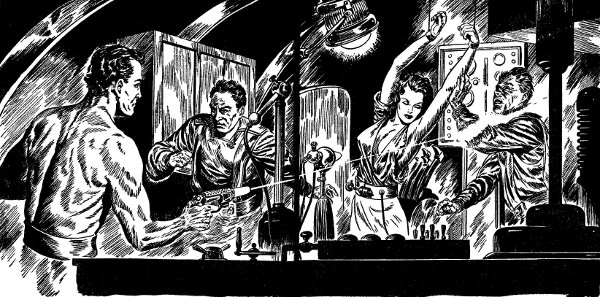
I pulled the trigger and a sizzling bolt of energy leaped forth
I fired once and there was the smell of searing flesh.
"Kresh?" I asked. He looked down at the faceless figure on the floor and shook his head.
He raised his elbows, leaving his holster exposed. I nodded to one of the crewmen and he stepped forward and removed Kresh's del gun.
"Drop it on the floor," I said. "Then tear off his insignia and lock him in the forward cabin."
It was the end of the mutiny. But I felt no joy at that. My chest pained intolerably, my shoulders sagged in exhaustion. And I had failed in my mission.
Beth was all right. I went to her and tore the electrodes from her wrists and ankles and helped her to her feet. She refused to look at me, even allowing me to untie her father by myself.
"I regret that it turned out this way," I said.
"How could it turn out any other way?" Beth demanded suddenly. "Do you think we'd trust you now?"
Off in the night a siren wailed. I listened while another siren joined the first.
"They're already looking for you," I said. "Which shows how little chance I would have had of getting to you openly. You'd better be going now."
But as I led them to the door I knew I had to make one more attempt.
"Professor Copperd, do you think there might still be hope? We of Venus can offer much to Earth."
"Maybe there is hope," he said, and he looked brighter than I had ever seen him look. "I was reaching the point where I had no faith in the future. But now, knowing that you have solved the problems which we face.... Perhaps, if the proper arrangements were made.... But you would be risking a great deal to return. And I can assure you that for a long time Venus will be safe. So you have no reason—"
"I have a good reason for coming back," I interrupted. Taking Beth by the shoulders, I swung her about to face me.
"I love you," I said. "I started out to trick you and ended by loving you."
Then her arms were about me and her lips were on mine. I felt my face wet with her tears, and I knew that my love was returned. There were still problems to face, dangers to overcome, but they didn't matter.
"It may be a year," I said. "Perhaps two years."
"I'll be waiting. I'll be standing here, waiting for you."
Now the sirens were very close and there were searchlights sweeping the fields and the woods. I watched Beth and her father walking away and then I closed the door. I should have felt sad, but I didn't. A year or two weren't much. On this planet far from my own, I was leaving my heart, and I would return one day to redeem it.


