Read Like A Writer

There are two ways to learn how to write fiction: by reading it and by writing it. Yes, you can learn lots about writing stories in workshops, in writing classes and writing groups, at writers' conferences. You can learn technique and process by reading the dozens of books like this one on fiction writing and by reading articles in writers' magazines. But the best teachers of fiction are the great works of fiction themselves. You can learn more about the structure of a short story by reading Anton Chekhov's 'Heartache' than you can in a semester of Creative Writing 101. If you read like a writer, that is, which means you have to read everything twice, at least. When you read a story or novel the first time, just let it happen. Enjoy the journey. When you've finished, you know where the story took you, and now you can go back and reread, and this time notice how the writer reached that destination. Notice the choices he made at each chapter, each sentence, each word. (Every word is a choice.) You see now how the transitions work, how a character gets across a room. All this time you're learning. You loved the central character in the story, and now you can see how the writer presented the character and rendered her worthy of your love and attention. The first reading is creative—you collaborate with the writer in making the story. The second reading is critical.


John Dufresne, from his book, The Lie That Tells A Truth: A Guide to Writing Fiction

Header

Liquid Story Binder XE by Black Obelisk Software

Disable Copy Paste

Amazon Quick Linker

Showing posts with label Amazing Stories. Show all posts

Friday, February 6, 2026

The Malignant Entity by Otis Adelbert Kline


The Malignant Entity

by

Otis Adelbert Kline

Amazing Stories, June 1926

First published in Amazing Stories, June 1926


Title page from Amazing Stories, June 1926


I TELL you, Evans," said Dr. Dorp, banging his fist on the arm of his chair for emphasis, "the science of psychology is in much the same stage of development today as were the material sciences in the dark ages."

"But surely," I objected, "the two centuries of investigation just past have yielded some fruit. It cannot be that the eminent men who have devoted the greater part of their lives' to this fascinating subject have labored in vain."

The doctor stroked his iron-gray Van Dyke meditatively.

"With a few—a very few exceptions, I'm afraid they have," he replied, "at least so far as their own deductions from observed phenomena are concerned."

"Take Sir Oliver Lodge, for example—" I began. "The conclusions of Sir Oliver will serve as an excellent example for my analogy," said the doctor. "No doubt you are familiar with the results of his years of painstaking psychical research as expounded in his books."

"I believe he has become a convert to spiritism," I replied.

"With all due respect to Sir Oliver," said the doctor, "I should say that he has rather singled out such facts as suited his purpose and assembled them as evidence to support the spiritistic theory. It may seem paradoxical to add that I believe he has always been thoroughly conscientious in his investigation and sincere in his deductions."

"I'm afraid I do not quite follow you."

"There are times in the life of every man," continued the doctor, "when emotion dethrones reason. At such crisis the most keen-witted of scientists may be blinded to truth by the overpowering influence of his own desires. Sir Oliver lost a beloved son. Only those who have suffered similar losses can appreciate the keen anguish that followed his bereavement, or sympathize with his intense longing , to communicate with Raymond. Most men are creatures of their desires.

They believe what they want to believe. Under the circumstance it was not difficult for a clever psychic to read the mind of the scientist and tell him the things he wanted to hear."

"But what of the many investigators who have not been similarly influenced?" I inquired. "Surely they must have found some basis—"

I was interrupted by the entrance of the doctor's housekeeper who announced- -

"Beggin' your pardon, sir, a gentleman to see you, sir."

"Show him in," Dr. Dorp said rather petulantly. His frown of annoyance changed to a welcoming smile of recognition at sight of the tall, bulky individual who strode through the doorway.

"How are you, Doc," roared the big man as they shook hands cordially. "Haven't bothered you for a long time, have I? Got a case for you now that will make you put on your thinking cap all right."

"Sounds interesting," replied the doctor. "Let me present an old friend of mine, Mr. Evans, who writes a story every now and then when the spirit moves him. Mr. Evans, Chief McGraw of the detective bureau. We were just discussing our mutual hobby, psychic phenomena, when you came in," he continued after we had acknowledged the introduction.

"No doubt Chief McGraw's communication is of a confidential nature—" I began, with the purpose of taking leave of my host.

"Nothing secret about it so far as Dr. Dorp and his friends are concerned," interrupted the chief. "It may be that if you are a psychologist you can offer some solution of the mystery. Of course, I don't exactly know whether it's a case for a psychologist or not. Damned curious thing, and ghastly too."

"Stay and listen if you are interested," said the doctor.

"If it has any smattering of psychology or the occult, you know my failing," I responded.

"Can't say as to that," said the chief. "It's queer enough, though-and horrible. You gentlemen have heard of Professor Townsend, I presume."

"You mean Albert Townsend, the chemist and inventor?" asked the doctor. "Assuredly. Who hasn't heard of him and his queer theories about creating life from inert matter? What has he done now?"

"I don't know whether it's something he did or something that was done to him, but anyway he's dead."

"Murdered?"

"That's the point I want you to help me clear up. I don't know. His daughter 'phoned the office this morning and asked for me. When I got on the wire I could hardly understand her, she was so hysterical. Sobbed out something about her father being gone and a human skeleton lying on the floor of his laboratory. I jumped in the car and took Hirsch, the finger- print expert out there with me. We found the frightened girl weeping in the arms of a motherly neighbor, who informed us that the laboratory was on the second floor.

"The whitened skeleton of Professor Townsend, fully clothed in garments that hung like rags on a scarecrow, lay on the floor of the laboratory,"

"You made sure, of course, that it really was the skeleton of the Professor."

"Beyond the least shadow of doubt. In the first place it was clothed in the professor's garments. His watch with his name in the back was ticking in the vest pocket. His monogrammed ring, a present from his daughter, circled a bony finger. On the bones of his right forearm were the marks of a fracture that had healed and the skull was slightly indented above the right temple. These marks resulted from an automobile accident in which the professor was injured two years ago. To make assurance doubly sure, we called in his dentist who readily identified his own work on the teeth."

"When was the professor last seen alive?"

"That is the feature that makes the affair so uncanny. He was alive, and apparently normal mentally and physically, at dinner last evening." "Most amazing!" exclaimed Dr. Dorp. "Suppose we go out—"

"Just what I was going to suggest." replied the chief. "My car is waiting outside. Would you care to accompany us, Mr. Evans?"

"He would perish from curiosity if he couldn't see the thing through now," said the doctor when I hesitated. "Come along with us, old man. If two minds are better than one, then surely three minds are superior to two."

We piled into the chief's roomy roadster and were soon speeding toward the house of mystery.


Two Mysterious Deaths


PRESENTLY the car stopped before a two-story brick house. Its upper windows, with shades half drawn, appeared to stare down at us with a look of sly cunning as if endeavoring to conceal some fearful secret.

A short chunky individual, smooth-faced and with a decidedly florid complexion, met us at the door. Chief McGraw introduced him as Hirsch, the fingerprint expert.

"All alone, Hirsch?" asked the chief, looking about as we entered the spacious living room.

"Might as well be," replied Hirsch. "Miss Townsend is in her room with a neighbor. The cook and housemaid are out in the kitchen, scared green." "Coroner been here?"

"No. He called me up about twenty minutes ago and said he had an inquest to attend to on the south side. Told me he didn't know how soon he could get here, but it would be several hours, at least." "How about the prints?"

"All the finger prints in the laboratory seem to have been made by the same person, evidently the professor."

"Hum. Better 'phone headquarters right away and have them send Rooney out. He might come in handy to guard the death room in case the coroner is late."

"All right sir. I'll call up right away."

"Now gentlemen," said the chief, turning to the doctor and me, "let us go upstairs."

We followed him up the thickly carpeted stairway and along A broad corridor at the end of which he opened a door.

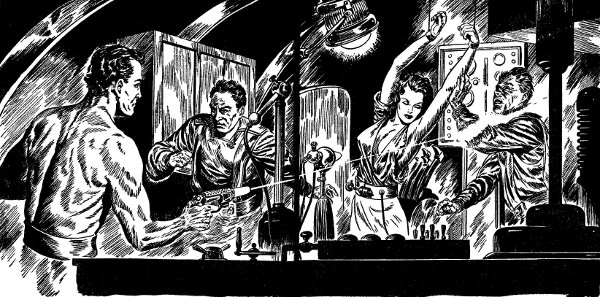
I started involuntarily at sight of the grinning, ghastly thing that lay on the floor. Not so Dr. Dorp. He knelt beside it and examined it minutely, his keen gray eyes alert for every detail. He even touched his fingers to the white forehead and prodded the shadowy depths of the empty eye sockets.

At length he rose and washed his hands at the porcelain lavatory.

"It seems incredible," he said, "that this man could have been alive yesterday."

"Just what I was thinking," responded the chief. "Those bones could not have been drier or whiter if they had bleached in the sunlight for the last ten years."

The doctor now turned his attention to the contents of the laboratory. He examined the collection of retorts, test tubes, breakers, jars, dishes and other paraphernalia spread on a porcelain-topped table set against the wall and reaching half the length of the room. The walls were shelved clear to the ceiling, and every shelf was crowded to its utmost capacity with bottles, jars and cans containing a multitude of chemicals. To these he gave but scant attention.

In the center of the immaculate white tile floor stood an open, glass-lined vat. From its height and diameter I estimated its capacity at about sixty gallons. This vat was more than a third full of a colorless, viscous liquid that gave off a queer, musty odor.

"What do you suppose that stuff is?" I asked Dr. Dorp.

"Looks like a heavy albuminous or gelatinous solution," he said. "Possibly it is some special compound the professor employed in his experiments. Mediums of this nature are often used in the cultivation of colonies of bacteria and it is possible that he intended to use it as a carrier and food for the organisms it was his ambition to create synthetically."

"Any idea what caused the death of the professor?" asked the chief.

"I have a theory," replied Dr. Dorp, "but it seems so illogical, so wildly impossible, so—er, contrary to the teachings of science that I prefer to keep it to myself for the present, at least."

A heavy tread sounded in the hallway and a moment later a blue-uniformed officer entered.

"Hello, Rooney," greeted Chief McGraw. "I want you to see that no one disturbs this room or its contents until the coroner arrives. We are going downstairs now. Keep a weather eye on things and I'll send a man to relieve you soon. If either of these gentlemen wants to come in at any time you may admit him.

"Yes, sir. I'll remember them."

We trooped down stairs. Two women were seated in the living room. Chief McGraw presented us to the younger, who proved to be the professor's daughter, Dorothy Townsend. She was a slender girl about twenty years of age with pale, regular features and a wealth of gold-brown hair. Her large, expressive eyes were red with recent weeping and her lips quivered slightly as she bowed to us in turn and introduced us to the stout, middle-aged neighbor, Mrs. Harms, who had been endeavoring to comfort her.

"Hirsch and I are going to run down to headquarters for a couple of hours," said the chief. "Would you prefer to come with us or stay here and look around?"

"I think we had better look around a bit if you don't mind," replied: the doctor.

"All right. I'm going to send a man to relieve Rooney at six. Will be along myself a little later. If you discover anything new call me up."

When the two men were gone the doctor bowed before Miss Townsend.

"May I have a few words with you in private?" he asked.

"Certainly," she replied, rising, "in Father's study if you wish."

They entered the study, which was directly off the living room, and closed the door. They must have been gone about a half hour, but it seemed like two hours to me as, fidgeting inwardly, I listened to Mrs. Harms' family history, her account of the death of her beloved husband, and minute descriptions of six operations she had undergone, each time, to use her own expression, "standing at the entrance of death's door." She assured me, also, that she knew what it was to have death in the. home. The Grim Reaper had visited her family a score of times, she averred, and only three weeks before, one of her roomers had been found dead in bed.

She prattled on with scarce a pause until the door of the study opened. I was glad when she went upstairs with Miss Townsend and left Dr. Dorp and me together.

"Come into the study," he said. "I have learned some interesting things, and it is possible that more awaits us in here."

Professor Townsend's study was neither large nor pretentious. It was obviously the retreat of a profound student as attested by the book-lined walls, many of the volumes of which were worn with much handling. The furniture consisted of a large, roll-top desk, a smaller typewriter desk on which stood a hooded machine, a filing cabinet, two office chairs and three comfortable overstuffed chairs, one beside the window, the other two placed conveniently under wall lights for reading.

A thick pile of typewritten manuscripts lay on the roll-top desk. The doctor divided them, handing me half and settling himself comfortably in one of the overstuffed chairs with the other half.

"Miss Townsend kindly brought these out of the files for me," explained the doctor. "I think it possible that they may shed some light on the mysterious cause of the death of their author. We can save time dividing the work."

"I believe I can conduct a more intelligent search if-you will give me some idea of what I am to look for," I said.

"Quite so," he agreed. "I had forgotten for the moment that you were not familiar with the details of my interview with Miss Townsend. Let me review it briefly.

"She finished school nearly a year ago, and since that time has been acting as her father's secretary, typing his manuscripts and attending to much of his voluminous correspondence.

"He had been working day and night in his effort to prove his theory that a living organism can be created from inorganic matter. During their months of close association she found him extremely irritable until one morning about three weeks ago. It appeared that his very nature had changed over night and she assumed that he had made some important discovery. She remembers the exact date owing to the fact that Mrs. Harms' roomer was found dead in bed on the night of the supposed discovery. This roomer, who was living under an alias, was found to be a notorious character known as Immune Benny, and is alleged to have committed numerous crimes, among which were several revolting murders, without ever having been convicted.

"After that night the professor's jubilant attitude kept up until death. He paid no attention to his correspondence or manuscripts and spent the greater part of his time in his laboratory, presumably experimenting with numerous live animals which he had delivered each day. His first experiments, she stated, were with mice, rats and guinea pigs. He next used cats, rabbits and small dogs, then larger dogs until, on the day before his death he had two huge mastiffs brought to the house and took them into the laboratory. None of the animals taken behind the door ever reappeared, and she quite naturally assumed that they had been the subjects of vivisection. My theory, is that he—" The doctor was interrupted by a loud rap at the study door. He rose and opened it, revealing a sturdy' uniformed policeman. A frightened housemaid peered around his huge bulk. The man seemed greatly perturbed. His voice shook as he asked—

"Where's Rooney?"

"He's on guard in the laboratory," replied the doctor. "Are you the man sent to relieve him?" "I'm Officer Burke. The maid, here, showed me to the laboratory, but Rooney ain't there. It's a horrible place. Don't blame him for leavin'."

"Yes. That skeleton on the floor isn't exactly pretty."

"That skeleton? You mean them skeletons* There was two of them, and one was dressed in a cop's uniform!"

With an exclamation of surprise and horror, the doctor threw down the manuscripts he was holding and rushed for the stairway. I followed breathlessly.


A Strange Diary


WHAT we saw in that awful room of death confirmed our wildest fears. A skeleton, with the bones whitened like those of the professor, lay on the floor facing the doorway. One bony arm was stretched across the threshold as if its owner had been attempting to drag himself from the room when struck down. A blue uniform bagged loosely over the bones, and on the feet were the heavy, hobnailed, square-toed shoes I' had noticed on Rooney's feet some time before.

The doctor squinted at the star on the breast of the recumbent figure. Then he turned to Officer Burke who had come up behind us.

"What was Rooney's number?" he asked.

"942."

"Then this is Rooney's uniform and it probably is his skeleton. 'Call up the chief and tell him what happened. This is horrible—diabolical!"

"Your theory," I said, "does this shed any light on it?"

"On the contrary," he replied, "It makes the case more baffling than ever. It seems incredible that such things can really happen. I tell you, Evans, there is some mysterious force at work here—something new and unheard of in the annals of scientific research. It is my opinion that the late Professor Townsend chanced upon some force hitherto unknown to scientists and played with it like a little child with fire until it suddenly destroyed him. The death of Officer Rooney is ample proof that this terrible force, whatever it may be, survived him.

"Now let us conjecture regarding the nature of this thing that has taken the lives of two human beings. We know that the professor's chief ambition was to create life from inert matter. All of his experiments in the laboratory were made with this object in view. All his printed works show plainly his firm belief that the thing could be accomplished, some of them going so far as to point out the processes by which he believed protoplasm, the primitive basic life substance, might be analyzed. As protoplasm is a compound of almost unlimited complexity in its physical and chemical constitution, our most skilled chemists have been unable to unravel its secrets. In fact, the further a chemist gets in his attempts at analysis the more baffling and complex he finds it to be. Being a compound composed of complex substances which are in turn composed of others still more complex, and so on, ad infinitum, its secrets are fully as inscrutable as those of the starry universe.

"The professor's first step, therefore, in this seemingly impossible undertaking, would be to analyze protoplasm. Assuming that he succeeded in reducing it to its basic elements his next problem would be to take similar elements and, through a process even more complex than the previous one, assemble and re-assemble them until they were capable of sustaining life.

"Let us suppose that he did these things. Let us assume that he has succeeded in creating protoplasm. What next? We will say that he has taken some primitive form of life for a pattern, a moneron, perhaps, the most simple type of animal, consisting of a single cell of protoplasm. There still exists a difference between the moneron and the synthetically created cell. Chemically and physically they are the same, but the moneron is alive.

"What is life? Broadly defined as we recognize it on this earth, it is a temporary union of mind and matter. There may be, and probably is another kind of life which is simply mind without matter, but we of the material world know it not. To us, mind without matter or matter without mind are equally dead. The moneron has a mind—a soul—a something that makes it a living individual. Call it what you will. The professor's cell of man-made protoplasm has not. Can you conceive of any possible way in which he could, having reached this stage, create an individual mind or soul, an essence of life that, once united with his cell of protoplasm would form an entity?"

"It seems impossible," I admitted.

"So it seems," he replied, "yet it is only on such an hypothesis that I can account for the mysterious deaths of the professor and Officer Rooney."

"But I don't see how a moneron or a creature remotely resembling one could kill and completely devour a man in less than two hours," I objected.

"Nor I," agreed the doctor. "In fact I am of the opinion that, if the professor did succeed in creating life, the result was unlike any creature large or small, now inhabiting the earth—a hideous monster, perhaps, with undreamed of powers and possibilities—an alien organism among billions of other organisms, hating them all because it has nothing in common with them—a malignant entity governed solely by the primitive desire for food and growth with only hatred of and envy for the more fortunate natural creatures around it."

"If the professor did succeed in creating or discovering such a creature," I said, "it is evidently in this house at this very moment. Unless it has the faculty of making itself invisible a thorough search should reveal its whereabouts, for having consumed two men it must be a monster of no mean proportions."

"That is true," replied the doctor, "however, we have another hypothesis that is equally worthy of our consideration if we accept the premise that the professor created a living creature. Judging from his writings he spent a considerable portion of his time studying and experimenting in microbiology. Suppose he succeeded in creating a microscopic organism, and that organism had the power to reproduce its kind. If it reproduced by fission, that is, by simply dividing itself after it had attained a certain size, the only check to its increase would be death or lack of food. The more food it could obtain that much more rapidly would it and its descendants multiply. Countless billions of such creatures might occupy this room and yet be invisible without the aid of a compound microscope. There is ample room for a swarm of such creatures numerous enough to devour a man to float in the air above our heads without revealing its presence." The words of the doctor affected me strangely. Involuntarily I looked upward, half expecting a swarm of man-eating microbes to descend and devour me. For a moment I was seized with a feeling of panic so strong I could scarcely restrain myself from leaping for the door. The fact that the sun had just set and dusky shadows were thickening in the room augmented the illusion. I crossed the floor nervously and pressed the switch beside the door. Instantly the place was flooded with blue-white light from a cluster of powerful globes depending from the middle of the ceiling.

As I was recrossing the room my eyes fell on the contents of the glass-lined tank. I stared unbelievingly for a moment, then called Dr. Dorp.

"What is it, Evans?" he asked.

"The liquid in this tank," I replied. "It has changed color. Something has turned it pink." "The effect of the artificial light, no doubt," he said, coming up beside me. Then I saw the expression of doubt on his face change to one of surprise and wonder.

"You are right," he exclaimed. "It has not only changed color but a still more remarkable transformation has taken place. When we noticed it this afternoon, the tank was a third full of the colorless liquid. This pink fluid reaches half way to the top!"


A Drawer Filled With Bones


HE tread of many feet sounded in the hall.

Chief McGraw paused in the doorway, staring down at the blue-clad skeleton on the floor, a look of horror on his face. Behind him were four policemen in uniform.

"Is—is that the skeleton of poor old Rooney?"

McGraw asked. It's too ghastly a thing to believe. "I'm afraid it is," replied Dr. Dorp.

The chief knelt and examined the star on the bagging blue coat.

"It's hellish, positively hellish," he said, rising. "Do you know what killed him?"

"We are working on a theory—" began the doctor, but was interrupted by the chief.

"Theories be damned!" he snapped. "Work on your theories if you want to. This thing has gone too far. I'm going to get some facts'." He swung on the four men behind him. "Search the house," he said. "Look sharp for anything of a suspicious nature. An infernal machine, perhaps, or a blood sucking animal. There is a man-killer of some kind, human or otherwise, hidden in this house, and it's our business to find it."

When the men. had departed he stepped over Rooney's skeleton.

"I'll search this room myself," he said.

He did, with professional thoroughness, looking for hidden panels and sounding the walls, both in the open areas and behind the shelves, for hollow spaces. Then he began opening the drawers in a tall cabinet that stood in one corner, disclosing surgical and dissecting instruments of various kinds, an indexed set of microscope slides with some extra lenses, platinum dishes; porcelain drying pans, crucibles, glass rods and tubing, pipettes, rubber tubing and stoppers, rubber gloves and aprons, and other miscellaneous laboratory paraphernalia.

The bottom drawer of the cabinet was quite large and deep. The chief cried out excitedly when he saw its contents.

"Good Lord! Look at that!" he exclaimed.

It was filled to the top with dry, white bones. "Nothing but the bones of small animals," said Dr. Dorp, picking up a skull. "This, for instance, is the skull of a dog." Then, taking up another: "Here is the skull of a rabbit. Notice the characteristic chisel-shaped teeth. This one beside it once supported the be-whiskered countenance of a common house cat."

"What do you suppose he was doing with them?" asked the chief.

"It is my belief that they were brought here to be killed and devoured by the same thing that killed the professor and Rooney."

"And that thing is—"

"At present, merely a shadowy theory, although it most certainly has an existence. There is a power in this house that is a menace to everyone under this roof—a malignant entity that destroys human beings in some mysterious manner unparalleled in the annals of science or human experience. This much we know, reasoning from effects. Reasoning from possible causes we are aware that the hobby of Professor Townsend was the endeavor to create a living thing from inorganic matter, and putting the two together it seems to me that the logical hypothesis would be that he either succeeded in creating a monster of a sort unknown to biologists, or discovered and developed unheard of powers and habits in a creature already known." "If there's such a thing in this house, believe me I'm going to find it," said the chief, stamping out of the room.

"Now that we have a few moments to ourselves," said Dr. Dorp when McGraw had departed, "let us conduct a search, or rather an inquiry on our own account. I perceive that we have a very excellent compound microscope at our disposal and am curious to examine the liquid which-has so mysteriously risen and changed color in the tank."

He took a blank slide from the cabinet drawer and a small glass rod from the table. As he was about to dip the rod in the liquid he uttered a low exclamation of surprise.

"What's up now?" I asked.

"This amazing liquid has again become transparent," he replied. "The red tint is gone."

He plunged the tip of the rod into the viscous liquid, twisted it slightly and withdrew it. Although the liquid seemed quite heavy it slipped from the end of the rod much after the manner of the white of an egg. After considerable juggling he succeeded in obtaining a small amount which he smeared on the slide. He then placed the slide in position and adjusted the microscope with a practiced hand.

"Well," I asked, after he had peered into the eyepiece for a full ten minutes, "what is the stuff, anyway?".

"Here, look for yourself," he replied.

What I saw in the field of the microscope appeared to be a mesh work or foam work of exceedingly fine bubbles or perhaps globules. Granules of different sizes' and shapes seemed imbedded in these globules and the whole was dotted at intervals with small white objects. While I watched several of these white objects seemed to dissolve and disappear. All of them apparently were endowed with life for I noticed that they expanded or contracted spasmodically and seemed endeavoring to push their way through the surrounding bubbles.

"Seems to be a sort of foam," I said, "with something alive floating in it."

"The foam, as you call it, bears a singular resemblance to the basic life principle, protoplasm, when seen under the microscope," replied the doctor.

"But those white things—" I began.

"The white things," he went on, "are the living remnants of a complex organism that has been destroyed. They are waging an unequal and hopeless battle against assimilation by the globules that surround them. These faithful guardians of the organism when alive still fight, and will continue to fight the enemy until, figuratively speaking, the last man falls."

"But what are they?" I demanded.

"Unless I am very much mistaken," he replied, "they are—"

His answer was cut short by the appearance of Chief McGraw.

"Coroner and jury are downstairs," he said tersely. "I suppose they'll want your testimony. I'll leave a couple of men on guard here if you want to come down."

"Let us go down to the study and complete our perusal of the professor's manuscripts while the jury is in session," said the doctor. "We can thus save considerable time and will be on hand when they are ready to question us."

We met Coroner Haynes and his jurors at the foot of the stairs. They were about to go up for an inspection of the laboratory and its gruesome contents.

Dr. Dorp switched on one of the reading lamps and closed the door. Then he established himself in a comfortable chair with a pile of manuscripts and I followed his example. We found essays and articles on almost every subject pertaining to the transmission or generation of life. There were papers on anatomy, bacteriology, cell-structure, microbiology and embryology. There' were treatises on evolution, spontaneous generation, and the structures and habits of micro-organisms. A forceful and extremely impressive essay set forth the astounding theory that all life was merely a form of force generated from matter. The reasoning was, of course, purely analogical. The professor's Contention, stated briefly, was that just as electricity, a force that is invisible and indefinable, is generated by the friction of particles of certain kinds of matter, so life is generated and springs into being when certain other types of matter come together in the right proportions and combinations.

"What is your opinion of this theory?" I asked Dr. Dorp.

"It is most cleverly put, but false because based on the false premise of the materialists that there are but two things in the universe, matter and force. They do not recognize the power that controls the force which moves the matter toward a fixed objective. That' power is mind. Thus, to them, all life and all mind are merely forms of force generated originally from inert matter."

"If the professor succeeded in creating a living thing from inert matter," I said, "it seems to me that he has demonstrated his proposition."

"Why?"

"Because he was experimenting with dead matter and not with mind or living creatures. There would be no mind or soul involved to inherit its being from a parent mind or soul. A new life entity would be generated, as it were, from matter which formerly contained no life."

"I think," said the doctor quietly, "you would have stated the proposition more accurately had you said that a life entity—a mind without a body—had been induced to enter the body synthetically created."

Our discourse was interrupted by Chief McGraw, who informed us that we were wanted by the coroner.


The Coroner's Jury


DR. DORP did the talking before the coroner's jury. All the way through his testimony was negative. When asked if he had any idea what killed the professor and the policeman he replied that he had several ideas, but none of them would be worth bringing before the jury without more facts to substantiate them. I could see that his purpose was to get the inquest over with as soon as possible so we might continue the investigation.

After due deliberation a verdict of "Death from cause or causes unknown," was brought in and the coroner departed with his men.

"Now that the inquest is over, what do you suggest?" McGraw asked the doctor.

"My suggestion is that we immediately destroy the liquid in the glass-lined tank in the laboratory."

"Why?"

"Because I am convinced that it is at least one. of the causes of the deaths that have taken place in this house."

"I suppose you have a good reason for your assumption."

"An excellent one, I believe. While you and your men were searching the house, Mr. Evans and I conducted a little investigation of our own. We put some of the liquid under the compound microscope and as we both saw the same things I am convinced that my eyes did not deceive me. Tell the chief what you saw, Evans."

I described the foam work, the granules and the white objects which appeared to be alive and struggling to escape.

"All Greek to me," said the chief. "What was it?"

"The foam work with its accompanying granules closely resembled protoplasm, the basic life substance."

"And the white things—"

"Were white blood corpuscles from the veins of a human being. They were the strongest of the human body cells to resist assimilation and consequently the last to succumb. The red corpuscles turned the liquid pink for a while but they had disappeared before we made our microscopic examination."

"Good Lord, why didn't you tell me this before?", demanded the chief. "Let's go up and destroy the stuff now. Those two men up there might be killed any minute."

We found the two policemen unharmed and made our plans for the destruction of the substance in the-tank. Several demijohns of acid stood under the table and the doctor selected one nearly full of sulphuric acid.

"Open the windows," he ordered. "This is going to make a horrible stench."

Then he removed the rubber stopper from the mouth of the demijohn and I helped him hoist it to the edge of the tank. The searing liquid struck the heavy fluid in the tank with a hissing sound and bored into it like hot water poured in a snow bank. The jelly-like mass quivered slightly, and pungent, nauseating fumes arose to torment our nostrils.

Then, suddenly, as if in horrible pain and awakened to the danger of its dissolution, the plasmic substance began to heave and billow toward the top of the tank with a movement suggestive of the writhing of a huge coiled serpent in its death agony. By directing the stream of acid at the various peaks that arose we endeavored to keep it all washed down to a common level. Then a dozen peaks rose simultaneously and I noticed that one was capped with a round ball in the center of which was a black spot.

"The nucleus!" cried the doctor excitedly, shifting the demijohn. "Pour it on the nucleus!"

We were too late. The thing upreared itself with amazing speed and lopped over the edge of the tank opposite us. We dropped the nearly-emptied demijohn into the tank and rushed around to intercept it, just in time to see the ball containing the black spot separate itself from the stringy mass by which it was suspended, drop to the floor and roll under the table.

An exciting chase of several minutes ensued. The thing darted, or rather, rolled from place to place with amazing rapidity. The tile floor was cracked in a dozen places by blows from the clubs of the two policemen who assisted us. At length we drove it into the corner beneath the lavatory and advanced in close formation. I had armed myself with a large spatula, the doctor gripped a heavy pestle, the two policemen had their clubs and the chief held his automatic pistol in readiness.

As we drew close we moved with extreme caution, our nerves taut, our weapons ready to strike when the thing should make its dash for liberty. We waited breathlessly, but no movement came from the corner. I prodded the space behind the water pipes with my spatula. Still no sign of the thing we were after. Then I peered behind them and saw the reason—a hole an inch in diameter in the tile floor, probably drilled in the wrong place by a careless plumber and left unfilled because it was out of sight.

When I pointed it out to Dr. Dorp he shook his head solemnly.

"The Malignant Entity has escaped," he said. "No one in this house—in this community, even—is safe until it is captured or killed."

"You don't mean to tell me that little thing we were chasing around the room could kill anybody," said the chief.

"I am not so sure that it could kill any one now that it has been reduced to the size of a golf ball, although the cytoplasm surrounding the nucleus evidently has the power of quickly dissolving and assimilating living tissues. Its growth, apparently, is only limited by the amount of food it can find."

"Maybe we'd better get the women out of the house," said the chief.

"The sooner, the better. I suggest also that you surround the place with men armed with shotguns. If that thing gets out and starts to grow I shudder to think of what may happen. Children will not be safe outside their own homes, and perhaps not even within them. Adults will be attacked as soon as the creature has attained sufficient size, and there is always the possibility that it may have the power to reproduce its kind. Organisms of this kind, as a rule, multiply with exceeding rapidity. Think of a thousand or perhaps a million such monsters roaming through the land. It is almost impossible to kill them because of the power we have just witnessed, of leaving the body, no matter how large it has grown, taking with it only enough cytoplasm to protect the nucleus and make a new start."

We were all gasping from the fumes that came out of the tank, and glad to get out of the laboratory.

When all were assembled in the living room the chief phoned headquarters for men and shotguns while Dr. Dorp and I explained what we had found to Miss Townsend.

After we had described our adventure in detail, the doctor said:

"It seems strange that your father left no records of his experiments with the monster."

"I feel quite sure that he left a record of some sort, though I have never seen it," replied Miss Townsend.

"Have you any idea where it is?"

"Perhaps in his safe in the study."

"I do not remember seeing a safe in the study." "Naturally. It is hidden. Come and I will show you where it is."

We followed her into the study and she swung back one of the bookcases which was hung on concealed hinges, revealing a small wall safe,

"Would you mind opening it for us?" asked the doctor.

She turned the dial to number twelve, then pulled the lever. It did not move. She seemed surprised, set the dial more carefully and tried again with the same result.

"It's no use, I guess," she said. "The last number of the combination is twelve. He usually turned it back to one and then it was only necessary to turn it to twelve to open it. He must have locked it last night."

"Don't you know the combination?"

"No. Father was the only one who knew that." "I wonder if you would object to our blowing the safe," he asked.

"Not if it will be of any assistance to you."

Chief McGraw, who had just finished calling headquarters, came into the room.

"Think you can get us a safe-cracker tonight, Chief?" asked the doctor.

"Get you most anything you want. What's in the safe?"

"We believe it contains some valuable information regarding the thing we were chasing a while ago." "I'll get a man out here right away," said McGraw, going once more to the phone.

Officer Burke escorted Miss Townsend, Mrs. Harms and the two servants to the Harms home, where they were to spend the night.

Shortly afterward there arrived twenty policemen armed with shotguns and carrying several dozen bulls-eye lanterns. They brought extra weapons which were distributed to all of us who remained in the house, the chief, the doctor, the four policemen and myself. Burke was to remain on guard next door.

A ring of lanterns was placed around the house and the twenty armed men were posted at intervals between them. We then divided our forces as follows: One policeman was placed on guard in the laboratory. Chief McGraw with another policeman patrolled the upper rooms and halls. The doctor and one policeman remained on the first floor and I, accompanied by a strapping young fellow named Black, who had recently been admitted to the force, did sentry duty in the basement.


Theorizing


THE Townsend basement was divided into three rooms, each lighted rather dimly by the yellow rays from an incandescent globe suspended on a short drop-cord. The furnace room and coal bins were situated at the rear end. The middle compartment contained a miscellaneous assortment of boxes, barrels, garden tools, household tools, canned fruits, empty fruit jars, bottles, and what not. The front room was used as a laundry.

Officer Black and I searched each room thoroughly, using a flash light in the dark corners and moving everything that wasn't fastened to the floor or walls. Several mice jumped out from behind boxes and barrels, but we saw no sign of the creature we were hunting.

We were peering behind the furnace when several loud squeaks came to us from the middle room.

With shotgun held in readiness, I moved stealthily toward the point from which the sound came. There, in the center of the floor almost under the yellow electric light bulb, I saw the fast disappearing body of a mouse under a mass of plasmic jelly.

My first impulse was to shoot, but on second thought, I decided to attempt to capture the thing alive if possible. Instructing Black to hold his weapon in readiness in case I failed, I unscrewed the lid from a large empty fruit jar and walked softly toward the center of the floor. I expected the thing to spring away, but to my surprise it lay almost motionless on the body of its victim. I could see streaks of bright red flowing through the jelly-like mass as blood of the mouse was drawn up for assimilation.

I clapped the mouth of the jar over the creature and still it made no effort to escape. Then, sliding a fire shovel which Black brought me, under the thing and its victim, I turned the jar right side up. It fell to the bottom of the receptacle, still clinging to the now formless mass that had once been a mouse and making no effort to escape. I put the lid in place and screwed it down tight.

"Now try to get away, you devil!" I cried, shaking the jar exultantly.

I almost dropped it a moment later as a muffled explosion jarred the building. Then I remembered Chief McGraw's safe-cracker, and hurried upstairs.

When I reached the living-room, Dr. Dorp was emerging from the study in a cloud of plaster dust. In his hand was a thick, loose-leaf book.

"I have the professor's diary," he called excitedly.

"Don't get fussed over such trifles," I replied. "Look what I've got. Caught it alive, too."

I put the jar on the table and he squinted at it for a moment. The blood- bloated monstrosity had separated its shapeless hulk from the whitened bones of its victim and was sluggishly crawling up the side of the glass.

"You caught it, sure enough," he said. "I only hope it hasn't any little sons or daughters about."

"I'll keep the house under guard for a couple of days," said Chief McGraw, who had come down to learn the result of the cracksman's labors. "If there are any more of these things around they ought to show themselves by that time."

The doctor drew a chair up to the table and eagerly scanned the pages of the diary while we watched the antics of the thing in the jar. It kept getting lighter colored all the time, and more lively. By the time the cytoplasm had become transparent it was racing around, contorting its body into all kinds of shapes—flat, oval, and round. At times it put forth pseudopods, sometimes elongating them until it resembled a small cuttle fish.

"September twenty-third was the night Immune Benny died wasn't it, Chief?" asked the doctor.

"Right. Why?"

"Then this diary tallies with Miss Townsend's testimony. Here is the professor's entry.

"'September 23, Nearly Midnight.

"'Eureka! I have succeeded. I placed a tiny drop of syntheplasm on the slide tonight as 1 have done a thousand times before, and covered it with a weak, sterile solution of gelatine.

"'I watched it steadily for a half hour but nothing happened until, suddenly, I noticed a tiny black spot forming in its center. I am positive there were no animalcules either in the syntheplasm or the solution, yet no sooner had the black spot become readily distinguishable than my speck of syntheplasm began moving about as if searching for food. Evidently it cannot subsist on gelatine.

"'I next introduced a rhizopod into the solution. -My animal slightly resembles it, but is larger and gets about much faster. I wanted to compare the two but the rhizopod was quickly devoured; Now I know what to feed it.'"

"It is growing late so I will not read all the details to you," continued the doctor. "Suffice to say that the professor discovered his synthetically created creature would feed on nothing but living creatures. He fed it so many microscopic animals the second day that it grew to a size visible to the naked eye. Then he fed it gnats, mosquitos, flies, beetles, and finally mice, when it became so large he was forced to transfer it from the small porcelain dish in which he kept it, to a much larger one.

"The thing grew at a prodigious rate of speed. Its growth seemed only limited by the amount of living creatures it was permitted to devour-. At length he was compelled to keep it in the glass-lined tank which he had been using for the culture of infusoria. Its victims were thrown into the tank alive and were quickly killed by the monster. He noticed that it was sluggish while assimilating its food, but moved with cat-like quickness when hungry. Though it had no eyes it seemed to sense the approach of food in some way and, toward the last, stretched forth pseudopods and snatched the animals from his hands.

"Yesterday the professor led two mastiffs into the room. Hardly had he closed the door of the laboratory before the monster was out of the tank.

It killed and devoured the two big dogs in less than a half hour—then crawled back sluggishly into the tank to digest its meal. Thus ends the written record of the professor's adventures with the Malignant Entity. His whitened bones on the floor of the laboratory are mute testimony of what occurred."

There was a moment of awed silence when the doctor finished his narrative. His eyes fell on the struggling thing in the glass jar.

"What are you going to do with it?" I asked.

"Come," he said, taking up the jar and starting for the basement. "I will show you."

The chief and I followed him down the basement stairs and into the furnace room. He opened the fire-door and tossed the jar on the glowing coals.

The thing raced about spasmodically for a moment in the intense heat, then fell huddled in the bottom of the jar. Suddenly, as if inflated from beneath, it puffed upward and outward, almost filling the receptacle in a shape that resembled a human head. I thought this only a figment of my imagination at first—blinked—and yet a second time. The face of a man stared back at me from behind the curved glass, eyes glowing with malevolent hatred, and lips drawn back in a snarl that revealed crooked, yellow fangs. For a moment only the vision held. The next instant the jar was empty of all save a tiny pile of white, flaky ash and the bones of the mouse.

Dr. Dorp shut the door suddenly and noisily.

"That face," I exclaimed. "Did you see it also?"

"A queer distortion of the gas-inflated protoplasm," he replied.

Chief McGraw seemed greatly perturbed. He drew a long black cigar from his pocket, lighted it and puffed nervously for a moment.

"Distortion, hell," he muttered. "It was a perfect double for the face of Immune Benny!"

Thursday, March 6, 2025

The Star by H. G. Wells


Above were the lava, hot gases and ash, and below the seething floods and the whole earth swayed and rumbled with the earthquake.


Here is an impressive story based on the inter-action of planetary bodies and of the sun upon them. A great star is seen approaching the earth. At first it is only an object of interest to the general public, but there is an astronomer on the earth, who is watching each phase and making mathematical calculations, for he knows the intimate relation of gravitation between bodies and the effect on rotating bodies of the same force from an outside source. He fears all sorts of wreckage on our earth. He warns the people, but they, as usual, discount all he says and label him mad. But he was not mad. H. G. Wells, in his own way, gives us a picturesque description of the approach of the new body through long days and nights—he tells how the earth and natural phenomena of the earth will react. Though this star never touches our sphere, the devastation and destruction wrought by it are complete and horrible. The story is correct in its astronomical aspects.


The Star 

by H. G. Wells

Author of “The War of the Worlds”, “The Time Machine”, Etc.


It was on the first day of the new year that the announcement was made, almost simultaneously from three observatories, that the motion of the planet Neptune, the outermost of all the planets that wheeled about the sun, had become erratic. Ogilvy had already called attention to a suspected retardation in its velocity in December. Such a piece of news was scarcely calculated to interest the world the greater portion of whose inhabitants were unaware of the existence of the planet Neptune, nor outside the astronomical profession did the subsequent discovery of a faint remote speck of light in the region of the perturbed planet cause any great excitement.

Scientific people, however, found the intelligence remarkable enough, even before it became known that the new body was rapidly growing larger and brighter, that its motion was quite different from the orderly progress of the planets, and that the deflection of Neptune and its satellite was becoming now of an unprecedented kind.

Few people without training in science can realize the huge isolation of the solar system. The sun with its specks of planets, its dust of planetoids, and its impalpable comets swims in vacant immensity that almost defeats the imagination. Beyond the orbit of Neptune there is space, vacant so far as human observation has penetrated, without warmth or light or sound, blank emptiness, for twenty billion times a million miles. That is the smallest estimate of the distance to be traversed before the nearest of the stars is attained. And, saving a few comets, more unsubstantial than the thinnest flame, no matter had ever to human knowledge crossed the gulf of space, until early in the twentieth century this wanderer appeared.

A vast mass of matter it was, bulky, heavy, rushing without warning out of the black mystery of the sky into the radiance of the sun. By the second day it was clearly visible to any decent instrument, as a speck with a barely sensible diameter, in the constellation Leo near Regulus. In a little while an opera glass could attain it.

On the third day of the new year the newspaper readers of two hemispheres were made aware for the first time of the real importance of this unusual apparition in the heavens. “A Planetary Collision,” one London paper headed the news, and proclaimed Duchine’s opinion that this strange new planet would probably collide with Neptune. The leader writers enlarged upon the topic. So that in most of the capitals of the world, on Jan. 3, there was an expectation, however vague, of some eminent phenomenon in the sky; and as the night followed the sunset round the globe thousands of men turned their eyes skyward to see—the old familiar stars just as they had always been.

Until it was dawn in London and Pollux setting, and the stars overhead grown pale. The winter’s dawn it was, a sickly filtering accumulation of daylight, and the light of gas and candles shone yellow in the windows to show where people were astir. But the yawning policeman saw the thing, the busy crowds in the market stopped agape, workmen going to their work betimes, milkmen, the drivers of news carts, dissipation going home jaded and pale, homeless wanderers, sentinels on their beats, and in the country, laborers trudging afield, poachers slinking home, all over the dusky quickening country it would be seen—and out at sea by seamen watching for the day—a great white star, come suddenly into the westward sky!

Brighter it was than any star in our skies; brighter than the evening star at its brightest. It still glowed out white and large, no mere twinkling spot of light but a small round clear shining disk, an hour after the day had come. And where science has not reached, men stared and feared, telling one another of the wars and pestilences that are foreshadowed by these fiery signs in the heavens. Sturdy Boers, dusky Hottentots, Gold Coast negroes, Frenchmen, Spaniards, Portuguese, stood in the glow of the sunrise watching the setting of this strange new star.

And in a hundred observatories there had been suppressed excitement, rising almost to shouting pitch, as the two remote bodies had rushed together. There had been a hurrying to and fro to gather photographic apparatus and spectroscope; to gather this appliance and that, to record the novel astonishing sight, the destruction of a world,—for it was a world, a sister planet of our earth, far greater than our earth indeed, that had so suddenly flashed into flaming death. Neptune it was, which had been struck, fairly, and squarely, by the planet from outer space and the heat of concussion had incontinently turned two solid globes into one vast mass of incandescence.

Round the world that day, two hours before the dawn, went the pallid great white star, fading only as it sank westward and the sun mounted above it. Everywhere man marveled at it, but of all those who saw it none could have marveled more than those sailors, habitual watchers of the stars, who far away at sea had heard nothing of its advent and saw it now rise like a pigmy moon and climb zenithward and hang overhead and sink westward with the passing of the night.

And when next it rose over Europe everywhere were crowds of watchers on hilly slopes, on house roofs, in open spaces, staring eastward, waiting for the rising of the new star. It rose with a white glow in front, like the glare of a white fire, and those who had seen it come into existence the night before cried out at the sight of it. “It is larger,” they cried. “It is brighter!” And, indeed, the moon a quarter full and sinking in the west was in its apparent size beyond comparison, but scarcely in all its breadth had it as much brightness now as the little circle of the strange new star.

“It is brighter!” cried the people clustering in the streets. But in the dim observatories the watchers held their breath and peered at one another. “It is nearer,” they said. “Nearer!”

And voice after voice repeated. “It is nearer,” and the clicking telegraph took that up, and it trembled along telephone wires, and in a thousand cities grimy compositors fingered the type. “It is nearer.” Men writing in offices, struck with strange realization, flung down their pens, men talking in a thousand places suddenly came upon a grotesque possibility in those words, “It is nearer.” It hurried along awakening streets, it was shouted down the frost-stilled ways of quiet villages, men who had read these things, from the throbbing tape stood in yellow-lit doorways shouting the news to the passers-by. “It is nearer.” Pretty women flushed and glittering, heard the news told jestingly between dances, and feigned an intelligent interest they did not feel. “Nearer! Indeed. How curious! How clever people must be to find out things like that!”

Lonely tramps faring through the wintry night murmured those words to comfort themselves—looking skyward. “It has need to be nearer, for the night’s as cold as charity. Don’t seem much warmth from it if it is nearer, all the same.”

“What is a new star to me?” cried the weeping woman kneeling beside her dead.

The schoolboy, rising early for his examination work, puzzled it out for himself—with the great white star shining broad and bright through the frost-flowers of his window. “Centrifugal, centripetal,” he said, with his chin on his fist. “Stop a planet in its flight, rob it of its centrifugal force, what then? Centripetal has it, and down it falls into the sun! And this——!”

“Do we come in the way? I wonder——”

The light of that day went the way of its brethren, and with the later watches of the frosty darkness rose the strange star again, And it was now so bright that the waxing moon seemed but a pale yellow ghost of itself, rising huge in the sunset hour. In a South African city a great man had married, and the streets were alight to welcome his return with his bride. “Even the skies have illuminated,” said the flatterer. Under Capricorn, two negro lovers, daring the wild beasts and evil spirits, for love of one another, crouched together in a cane brake where the fireflies hovered. “That is our star,” they whispered, and felt strangely comforted by the sweet brilliancy of its light.

The master mathematician sat in his private room and pushed the papers from him. His calculations were already finished. In a small white phial there still remained a little of the drug that had kept him awake and active for four long nights. Each day, serene, explicit, patient as ever, he had given his lecture to his students, and then had come back at once to his momentous calculation. His face was grave, a little drawn, and hectic from his drugged activity. For some time he seemed lost in thought. Then he went to the window, and the blind went up with a click. Half way up the sky, over the clustering roofs, chimneys, and steeples of the city, hung the star.

He looked at it as one might look into the eye of a brave enemy. “You may kill me,” he said after a silence, “But I can hold you—and all the universe for that matter—in the grip of this little brain. I would not change even now.”

He looked at the little phial. “There will be no need of sleep again,” he said. The next day at noon, punctual to the minute, he entered his lecture theater, put his hat on the end of the table as his habit was, and carefully selected a large piece of chalk. It was a joke among his students that he could not lecture without that piece of chalk to fumble in his fingers, and once he had been stricken to impotence by their hiding his supply. He came and looked under his gray eyebrows at the rising tiers of young fresh faces, and spoke with his accustomed studied commonness of phrasing, “Circumstances have arisen—circumstances beyond my control,” he said and paused, “which will debar me from completing the course I had designed. It would seem, gentlemen, if I may put the thing clearly and briefly, that—man has lived in vain.”

The students glanced at one another. Had they heard aright? Mad? Raised eyebrows and grinning lips there were, but one or two faces remained intent upon his calm gray-fringed face. “It will be interesting,” he was saying, “to devote this morning to an exposition, so far as I can make it clear to you, of the calculations that have led me to this conclusion. Let us assume——”

He turned toward the blackboard, meditating a diagram in the way that was usual to him. “What was that about ‘lived in vain’?” whispered one student to another. “Listen,” said the other, nodding toward the lecturer.

And presently they began to understand.

That night the star rose later, for its proper eastward motion had carried it some way across Leo toward Virgo, and its brightness was so great that the sky became a luminous blue as it rose, and every star and planet was hidden, save only Jupiter near the zenith, Capella, Aldebaran, Sirius, and the pointers of the Bear. It was white and beautiful. In many parts of the world that night a pallid halo encircled it about. It was perceptibly larger; in the clear refractive sky of the tropics it seemed as if it were nearly a quarter of the size of the moon. The frost was still on the ground in England, but the world was as brightly lit as if it were midsummer moonlight. One could see to read quite ordinary print by that cold clear light, and in the cities the lamps burnt yellow and wan.

And everywhere the world was awake that night, and throughout Christendom a somber murmur hung in the keen air over the countryside like the buzzing of the bees in the heather, and this murmurous tumult grew to a clangor in the cities. It was the tolling of the bells in a million belfry towers and steeples, summoning the people to sleep no more, to sin no more, but to gather in their churches and pray. And overhead, growing larger and brighter, as the earth rolled on its way and the night passed, rose the dazzling star.

And the streets and houses were alight in all the cities, the shipyards glared, and whatever roads led to high country were lit and crowded all night long. And in all the seas about the civilized lands ships with throbbing engines, and ships with bellying sails, crowded with men and living creatures, were standing out to ocean and the north. For already the warning of the master mathematician had been telegraphed over the world, and translated into a hundred tongues. The new planet and Neptune, locked in a fiery embrace, were whirling headlong, ever faster and faster, toward the sun. Already every second this blazing mass flew a hundred miles, and every second its terrific velocity increased. As it flew its course, it must pass a hundred million of miles wide of the earth and scarcely affect it.

But near its destined path, as yet only slightly perturbed, spun the mighty planet Jupiter and his moons sweeping splendid around the sun. Every moment now the attraction between the fiery star and the greatest of the planets grew stronger. And the result of that attraction? Inevitably Jupiter, would be deflected from its orbit to a new elliptical path, and the burning star, swung by his attraction wide of its sunward rush, would “describe a curved path” and perhaps collide with and certainly pass close to, our earth. “Earthquakes, volcanic outbreaks, cyclones, sea waves, floods, and a steady rise in temperature to I know not what limit”—so prophesied the master mathematician.

And overhead, to carry out his words, lonely and cold and livid, blazed the star of the coming doom.

To many who stared at it that night until their eyes ached, it seemed that it was visibly approaching. And that night, too, the weather changed, and the frost that had gripped all Central Europe and France and England softened towards a thaw.

But you must not imagine because I have spoken of people praying through the night and people going aboard ships and people fleeing towards mountainous country that the whole world was already in a terror because of the star. As a matter of fact, use and wont still ruled the world, and save for the talk of idle moments and the splendor of the night, nine human beings out of ten were still busy at their common occupations. In all the cities the shops, save one here and there, opened and closed at their proper hours, the doctor and the undertaker plied their trades, and workers gathered in the factories, soldiers drilled, scholars studied, lovers sought one another, thieves lurked and fled, politicians planned their schemes. The presses of the newspapers roared through the nights, and many a priest of this church and that would not open his holy building to further what he considered a foolish panic.

The newspapers insisted on the lesson of the year 1000—for then, too, people had anticipated the end. The star was no star—mere gas—a comet; and were it a star it could not possibly strike the earth. There was no precedent for such a thing. Common sense was sturdy everywhere, scornful, jesting, a little inclined to persecute the obdurate fearful. That night at 7:15 by Greenwich time the star would be at its nearest to Jupiter. Then the world would see the turn things would take. The master mathematician’s grim warnings were treated by many as so much mere elaborate self-advertisement. Common sense at last, a little heated by argument, signified its unalterable convictions by going to bed. So, too, barbarism and savagery, already tired of the novelty, went about their nightly business: and save for a howling dog here and there the beast-world left the star unheeded.

And yet, when at last the watchers in the European states saw their star rise, an hour later, it is true, but no larger than it had been the night before, there were still plenty awake to laugh at the master mathematician—to take the danger as if it had passed.

But hereafter the laughter ceased. The star grew—it grew with a terrible steadiness hour after hour, a little larger each hour, a little nearer the midnight zenith, and brighter and brighter, until it had turned night into day. Had it come straight to the earth instead of in a curved path, had it lost no velocity to Jupiter, it must have leapt the intervening gulf in a day; but as it was it took five days altogether to come by our planet. The next night it had become a third the size of the moon before it set to English eyes, and the thaw was assured.

It rose over America nearly the size of the moon, but blinding white to look at, and hot; and a breath of hot wind blew now with its rising and gathering strength, and in Virginia and Brazil and down the St. Lawrence valley it shone intermittently through a driving reek of thunder clouds, flickering violet lightning, and hail unprecedented. In Manitoba were a thaw and devastating floods. And upon the mountains of the earth the snow and ice began to melt that night, and all the rivers coming out of high country flowed thick and turbid, and soon—in their upper reaches— with swirling trees and the bodies of beasts and men. They rose steadily, steadily in the ghostly brilliance, and came trickling over their banks at last, behind the flying population of their valleys.

And along the coast of Argentina and up the South Atlantic tides were higher than they had ever been in the memory of man, and the storms drove the waters in many cases scores of miles inland, drowning whole cities. And so great grew the heat during the night that the rising of the sun was like the coming of a shadow. The earthquakes began and grew until all down America from the Arctic Circle to Cape Horn hillsides were sliding, fissures were opening, and houses and walls crumbling to destruction.

China was lit glowing white, but over Japan and Java and all the islands of eastern Asia the great star was a ball of dull red fire because of the steam and smoke and ashes the volcanoes were spouting forth to salute its coming. Above were the lava, hot gases, and ash, and below the seething floods, and the whole earth swayed and rumbled with the earthquake shocks. Soon the immemorial snows of Tibet and the Himalayas were melting and pouring down by ten million deepening converging channels upon the plains of Burma and Hindustan. The tangled summits of the Indian jungles were aflame in a thousand places, and below the hurrying waters around the stems were dark objects that struggled feebly and reflected the blood red tongues of fire. And in a ungovernable confusion a multitude of men and women fled down the broad riverways to that one last hope of men—the open sea.

Larger grew the star, and larger, hotter, and brighter with a terrible swiftness now. The tropical ocean had lost its phosphorescence, and the whirling steam rose in ghostly wreaths from the black waves that plunged incessantly, speckled with storm-tossed ships.

And then came a wonder. It seemed to those who in Europe watched for the rising of the star that the world must have ceased its rotation. In a thousand open spaces of down and upland the people who had fled thither from the floods and the falling houses and sliding slopes of hill watched for that rising in vain. Hour followed hour through a terrible suspense, and the star rose not. Once again men set their eyes upon the old constellations they had counted lost to them forever. In England it was hot and clear overhead, though the ground quivered perpetually; but in the tropics Sirius and Capella and Aldebaran showed through a veil of steam. And when at last the great star rose, near ten hours late, the sun rose close upon it, and in the center of its white heart was a disk of black.

Over Asia the star had begun to fall behind the movement of the sky, and then suddenly, as it hung over India, its light had been veiled. All the plain of India from the mouth of the Indus to the mouths of the Ganges was a shallow waste of shining water that night, out of which rose temples and palaces, mounds and hills, black with people. Every minaret was a clustering mass of people, who fell one by one into the turbid waters as heat and terror overcame them. The whole land seemed a-wailing, and suddenly there swept a shadow across that furnace of despair, and a breath of cold wind, and a gathering of clouds out of the cooling air. Men looking up, nearly blinded, at the star, and saw that black disk creeping across the light. It was the moon, coming between the star and the earth. And even as men cried to God at this respite, out of the east with a strange, inexplicable swiftness sprang the sun. And then star, sun, and moon rushed together across the heavens.

So it was that presently, to the European watchers, star and sun rose close upon each other, drove headlong for a space, and then slower, and at last came to rest, star and sun merged into one glare of flame at the zenith of the sky. The moon no longer eclipsed the star, but was lost to sight in the brilliance of the sky. And though those who were still alive regarded it for the most part with that dull stupidity that hunger, fatigue, heat, and despair engender, there were still men who could perceive the meaning of these signs. Star and earth had been at their nearest, had swung about one another, and the star had passed. Already it was receding, swifter and swifter, in the last stage of its headlong journey downward into the sun.

And then the clouds gathered, blotting out the vision of the sky; the thunder and lightning wove a garment around the world; all over the earth was such a downpour of rain as men had never seen before; and where the volcanoes flared red against the cloud canopy there descended torrents of mud. Everywhere the waters were pouring off the land, leaving mud stilted ruins, and the earth littered like a storm-worn beach with all that had floated, and the dead bodies of the men and brutes, its children.

For days the water streamed off the land, sweeping away soil and trees and houses in the way and piling huge dikes and scooping out titanic gullies over the countryside. Those were the days of darkness that followed the star and the heat. All through them, and for many weeks and months, the earthquakes continued.

But the star had passed, and men, hunger-driven and gathering courage only slowly, might creep back to their ruined cities, buried granaries, and sodden fields. Such few ships as had escaped the storms of that time came stunned and shattered and sounding their way cautiously through the new marks and shoals of once familiar ports. And as the storms subsided men perceived that everywhere the days were hotter than of yore, and the sun larger, and the moon, shrunk to a third of its size, took now fourscore days between its new and new.

But of the new brotherhood that grew presently among men, of the saving of laws and machines, of the strange change that had Iceland and Greenland the shores of Baffin’s Bay, so that the sailors coming there presently found them green and gracious, and could scarce believe their eyes, this story does not tell. Nor of the movement of mankind, now that the earth was hotter, northward and southward towards the poles of the earth. It concerns itself only with the coming and the passing of the star.

The Martian astronomers—for there are astronomers on Mars, although they are different beings from men—were naturally profoundly interested by these things. They saw them from their own standpoint, of course. “Considering the mass and temperature of the missile that was flung through our solar system into the sun,” one wrote, “it is astonishing what little damage the earth, which it missed so narrowly, has sustained. All the familiar continental markings and the masses of the seas remain intact, and indeed the only difference seems to be a shrinkage of the white discoloration (supposed to be frozen water) round either pole.” Which only shows how small the vastest of human catastrophies may seem at a distance of a few million miles.

Thursday, January 16, 2025

The Nothing Equation by Tom Godwin


The Nothing Equation

By

Tom Godwin


Word Count: 2,930

Genre: Sci-fi, Horror


Published 1957 in Amazing Stories, Vol. 32, No. 12


The cruiser vanished back into hyperspace and he was alone in the observation bubble, ten thousand light-years beyond the galaxy’s outermost sun. He looked out the windows at the gigantic sea of emptiness around him and wondered again what the danger had been that had so terrified the men before him.

Of one thing he was already certain; he would find that nothing was waiting outside the bubble to kill him. The first bubble attendant had committed suicide and the second was a mindless maniac on the Earthbound cruiser but it must have been something inside the bubble that had caused it. Or else they had imagined it all.

He went across the small room, his magnetized soles loud on the thin metal floor in the bubble’s silence. He sat down in the single chair, his weight very slight in the feeble artificial gravity, and reviewed the known facts.

The bubble was a project of Earth’s Galactic Observation Bureau, positioned there to gather data from observations that could not be made from within the galaxy. Since metallic mass affected the hypersensitive instruments the bubble had been made as small and light as possible. It was for that reason that it could accommodate only one attendant.

The Bureau had selected Horne as the bubble’s first attendant and the cruiser left him there for his six months’ period of duty. When it made its scheduled return with his replacement he was found dead from a tremendous overdose of sleeping pills. On the table was his daily-report log and his last entry, made three months before:

I haven’t attended to the instruments for a long time because it hates us and doesn’t want us here. It hates me the most of all and keeps trying to get into the bubble to kill me. I can hear it whenever I stop and listen and I know it won’t be long. I’m afraid of it and I want to be asleep when it comes. But I’ll have to make it soon because I have only twenty sleeping pills left and if—

The sentence was never finished. According to the temperature recording instruments in the bubble his body ceased radiating heat that same night.


The bubble was cleaned, fumigated, and inspected inside and out. No sign of any inimical entity or force could be found.

Silverman was Horne’s replacement. When the cruiser returned six months later bringing him, Green, to be Silverman’s replacement, Silverman was completely insane. He babbled about something that had been waiting outside the bubble to kill him but his nearest to a rational statement was to say once, when asked for the hundredth time what he had seen:

“Nothing—you can’t really see it. But you feel it watching you and you hear it trying to get in to kill you. One time I bumped the wall and—for God’s sake—take me away from it—take me back to Earth ...”

Then he had tried to hide under the captain’s desk and the ship’s doctor had led him away.

The bubble was minutely examined again and the cruiser employed every detector device it possessed to search surrounding space for light-years in all directions. Nothing was found.

When it was time for the new replacement to be transferred to the bubble he reported to Captain McDowell.

“Everything is ready, Green,” McDowell said. “You are the next one.” His shaggy gray eyebrows met in a scowl. “It would be better if they would let me select the replacement instead of them.”

He flushed with a touch of resentment and said, “The Bureau found my intelligence and initiative of thought satisfactory.”

“I know—the characteristics you don’t need. What they ought to have is somebody like one of my engine room roustabouts, too ignorant to get scared and too dumb to go nuts. Then we could get a sane report six months from now instead of the ravings of a maniac.”

“I suggest,” he said stiffly, “that you reserve judgement until that time comes, sir.”


And that was all he knew about the danger, real or imaginary, that had driven two men into insanity. He would have six months in which to find the answer. Six months minus— He looked at the chronometer and saw that twenty minutes had passed since he left the cruiser. Somehow, it seemed much longer ...

He moved to light a cigarette and his metal soles scraped the floor with the same startling loudness he had noticed before. The bubble was as silent as a tomb.

It was not much larger than a tomb; a sphere eighteen feet in diameter, made of thin sheet steel and criss-crossed outside with narrow reinforcing girders to keep the internal air pressure from rupturing it. The floor under him was six feet up from the sphere’s bottom and the space beneath held the air regenerator and waste converter units, the storage batteries and the food cabinets. The compartment in which he sat contained chair, table, a narrow cot, banks of dials, a remote-control panel for operating the instruments mounted outside the hull, a microfilm projector, and a pair of exerciser springs attached to one wall. That was all.

There was no means of communication since a hyperspace communicator would have affected the delicate instruments with its radiations but there was a small microfilm library to go with the projector so that he should be able to pass away the time pleasantly enough.

But it was not the fear of boredom that was behind the apprehension he could already feel touching at his mind. It had not been boredom that had turned Horne into a suicide and Silverman into—

Something cracked sharply behind him, like a gunshot in the stillness, and he leaped to his feet, whirling to face it.

It was only a metal reel of data tape that had dropped out of the spectrum analyzer into the storage tray.

His heart was thumping fast and his attempt to laugh at his nervousness sounded hollow and mirthless. Something inside or outside the bubble had driven two men insane with its threat and now that he was irrevocably exiled in the bubble, himself, he could no longer dismiss their fear as products of their imagination. Both of them had been rational, intelligent men, as carefully selected by the Observation Bureau as he had been.

He set in to search the bubble, overlooking nothing. When he crawled down into the lower compartment he hesitated then opened the longest blade of his knife before searching among the dark recesses down there. He found nothing, not even a speck of dust.

Back in his chair again he began to doubt his first conviction. Perhaps there really had been some kind of an invisible force or entity outside the bubble. Both Horne and Silverman had said that “it” had tried to get in to kill them.

They had been very definite about that part.


There were six windows around the bubble’s walls, set there to enable the attendant to see all the outside-mounted instruments and dials. He went to them to look out, one by one, and from all of them he saw the same vast emptiness that surrounded him. The galaxy—his galaxy—was so far away that its stars were like dust. In the other directions the empty gulf was so wide that galaxies and clusters of galaxies were tiny, feeble specks of light shining across it.

All around him was a void so huge that galaxies were only specks in it....

Who could know what forces or dangers might be waiting out there?

A light blinked, reminding him it was time to attend to his duties. The job required an hour and he was nervous and not yet hungry when he had finished. He went to the exerciser springs on the wall and performed a work-out that left him tired and sweating but which, at least, gave him a small appetite.

The day passed, and the next. He made another search of the bubble’s interior with the same results as before. He felt almost sure, then, that there was nothing in the bubble with him. He established a routine of work, pastime and sleep that made the first week pass fairly comfortably but for the gnawing worry in his mind that something invisible was lurking just outside the windows.

Then one day he accidentally kicked the wall with his metal shoe tip.

It made a sound like that from kicking a tight-stretched section of tin and it seemed to him it gave a little from the impact, as tin would do. He realized for the first time how thin it was—how deadly, dangerously thin.

According to the specifications he had read it was only one-sixteenth of an inch thick. It was as thin as cardboard.

He sat down with pencil and paper and began calculating. The bubble had a surface area of 146,500 square inches and the internal air pressure was fourteen pounds to the square inch. Which meant that the thin metal skin contained a total pressure of 2,051,000 pounds.

Two million pounds.

The bubble in which he sat was a bomb, waiting to explode the instant any section of the thin metal weakened.

It was supposed to be an alloy so extremely strong that it had a high safety factor but he could not believe that any metal so thin could be so strong. It was all right for engineers sitting safely on Earth to speak of high safety factors but his life depended upon the fragile wall not cracking. It made a lot of difference.


The next day he thought he felt the hook to which the exerciser spring was attached crack loose from where it was welded to the wall. He inspected the base of the hook closely and there seemed to be a fine, hairline fracture appearing around it.


He held his ear to it, listening for any sound of a leak. It was not leaking yet but it could commence doing so at any time. He looked out the windows at the illimitable void that was waiting to absorb his pitiful little supply of air and he thought of the days he had hauled and jerked at the springs with all his strength, not realizing the damage he was doing.

There was a sick feeling in his stomach for the rest of the day and he returned again and again to examine the hairline around the hook.

The next day he discovered an even more serious threat: the thin skin of the bubble had been spot-welded to the outside reinforcing girders.

Such welding often created hard, brittle spots that would soon crystallize from continued movement—and there was a slight temperature difference in the bubble between his working and sleeping hours that would daily produce a contraction and expansion of the skin. Especially when he used the little cooking burner.

He quit using the burner for any purpose and began a daily inspection of every square inch of the bubble’s walls, marking with white chalk all the welding spots that appeared to be definitely weakened. Each day he found more to mark and soon the little white circles were scattered across the walls wherever he looked.

When he was not working at examining the walls he could feel the windows watching him, like staring eyes. Out of self defense he would have to go to them and stare back at the emptiness.

Space was alien; coldly, deadly, alien. He was a tiny spark of life in a hostile sea of Nothing and there was no one to help him. The Nothing outside was waiting day and night for the most infinitesimal leak or crack in the walls; the Nothing that had been waiting out there since time without beginning and would wait for time without end.

Sometimes he would touch his finger to the wall and think, Death is out there, only one-sixteenth of an inch away. His first fears became a black and terrible conviction: the bubble could not continue to resist the attack for long. It had already lasted longer than it should have. Two million pounds of pressure wanted out and all the sucking Nothing of intergalactic space wanted in. And only a thin skin of metal, rotten with brittle welding spots, stood between them.

It wanted in—the Nothing wanted in. He knew, then, that Horne and Silverman had not been insane. It wanted in and someday it would get in. When it did it would explode him and jerk out his guts and lungs. Not until that happened, not until the Nothing filled the bubble and enclosed his hideous, turned-inside-out body would it ever be content ...


He had long since quit wearing the magnetized shoes, afraid the vibration of them would weaken the bubble still more. And he began noticing sections where the bubble did not seem to be perfectly concave, as though the rolling mill had pressed the metal too thin in places and it was swelling out like an over-inflated balloon.

He could not remember when he had last attended to the instruments. Nothing was important but the danger that surrounded him. He knew the danger was rapidly increasing because whenever he pressed his ear to the wall he could hear the almost inaudible tickings and vibrations as the bubble’s skin contracted or expanded and the Nothing tapped and searched with its empty fingers for a flaw or crack that it could tear into a leak.

But the windows were far the worst, with the Nothing staring in at him day and night. There was no escape from it. He could feel it watching him, malignant and gloating, even when he hid his eyes in his hands.

The time came when he could stand it no longer. The cot had a blanket and he used that together with all his spare clothes to make a tent stretching from the table to the first instrument panel. When he crawled under it he found that the lower half of one window could still see him. He used the clothes he was wearing to finish the job and it was much better then, hiding there in the concealing darkness where the Nothing could not see him.

He did not mind going naked—the temperature regulators in the bubble never let it get too cold.

He had no conception of time from then on. He emerged only when necessary to bring more food into his tent. He could still hear the Nothing tapping and sucking in its ceaseless search for a flaw and he made such emergences as brief as possible, wishing that he did not have to come out at all. Maybe if he could hide in his tent for a long time and never make a sound it would get tired and go away ...

Sometimes he thought of the cruiser and wished they would come for him but most of the time he thought of the thing that was outside, trying to get in to kill him. When the strain became too great he would draw himself up in the position he had once occupied in his mother’s womb and pretend he had never left Earth. It was easier there.

But always, before very long, the bubble would tick or whisper and he would freeze in terror, thinking, This time it’s coming in ...


Then one day, suddenly, two men were peering under his tent at him.

One of them said, “My God—again!” and he wondered what he meant. But they were very nice to him and helped him put on his clothes. Later, in the cruiser, everything was hazy and they kept asking him what he was afraid of.

“What was it—what did you find?”

He tried hard to think so he could explain it. “It was—it was Nothing.”

“What were you and Horne and Silverman afraid of—what was it?” the voice demanded insistently.

“I told you,” he said. “Nothing.”

They stared at him and the haziness cleared a little as he saw they did not understand. He wanted them to believe him because what he told them was so very true.

“It wanted to kill us. Please—can’t you believe me? It was waiting outside the bubble to kill us.”

But they kept staring and he knew they didn’t believe him. They didn’t want to believe him ...

Everything turned hazy again and he started to cry. He was glad when the doctor took his hand to lead him away ...

The bubble was carefully inspected, inside and out, and nothing was found. When it was time for Green’s replacement to be transferred to it Larkin reported to Captain McDowell.

“Everything is ready, Larkin,” McDowell said. “You’re the next one. I wish we knew what the danger is.” He scowled. “I still think one of my roustabouts from the engine room might give us a sane report six months from now instead of the babblings we’ll get from you.”

He felt his face flush and he said stiffly, “I suggest, sir, that you not jump to conclusions until that time comes.”


The cruiser vanished back into hyperspace and he was alone inside the observation bubble, ten thousand light-years beyond the galaxy’s outermost sun. He looked out the windows at the gigantic sea of emptiness around him and wondered again what the danger had been that had so terrified the men before him.

Of one thing he was already certain; he would find that nothing was waiting outside the bubble to kill him ...