Read Like A Writer

There are two ways to learn how to write fiction: by reading it and by writing it. Yes, you can learn lots about writing stories in workshops, in writing classes and writing groups, at writers' conferences. You can learn technique and process by reading the dozens of books like this one on fiction writing and by reading articles in writers' magazines. But the best teachers of fiction are the great works of fiction themselves. You can learn more about the structure of a short story by reading Anton Chekhov's 'Heartache' than you can in a semester of Creative Writing 101. If you read like a writer, that is, which means you have to read everything twice, at least. When you read a story or novel the first time, just let it happen. Enjoy the journey. When you've finished, you know where the story took you, and now you can go back and reread, and this time notice how the writer reached that destination. Notice the choices he made at each chapter, each sentence, each word. (Every word is a choice.) You see now how the transitions work, how a character gets across a room. All this time you're learning. You loved the central character in the story, and now you can see how the writer presented the character and rendered her worthy of your love and attention. The first reading is creative—you collaborate with the writer in making the story. The second reading is critical.


John Dufresne, from his book, The Lie That Tells A Truth: A Guide to Writing Fiction

Header

Disable Copy Paste

Amazon Quick Linker

Showing posts with label Science Fiction. Show all posts

Thursday, April 16, 2026

Age of anxiety by Robert Silverberg


"Age of Anxiety" by Robert Silverberg is a science fiction novel written during the mid-20th century. The narrative explores the themes of choice, maturity, and the impact of a society reliant on drugs that alleviate anxiety. Set in a futuristic world where children are administered an unworry drug to shield them from the burdens of adult life, the story centers around the protagonist, Larry, as he approaches a critical juncture on his seventeenth birthday: the decision to either embrace adulthood with its inherent anxieties or retreat into a perpetual state of unworry. The story follows Larry as he navigates his first days of newfound awareness, grappling with the daunting choice presented by a robonurse on his birthday. Faced with three capsules symbolizing different paths—returning to the bliss of childhood, suppressing his fears with continuing the unworry drug, or confronting the complexities of adulthood—Larry embarks on a journey through the City and the Playground. He meets various characters along the way who compel him to question his understanding of anxiety and responsibility. Ultimately, Larry discovers that his ability to worry and his struggle with decisions signify his readiness for maturity, leading him to accept the challenges of adult life with newfound confidence. This profound exploration of the human condition raises questions about the cost of happiness and the true nature of growth.


Age of Anxiety

By ROBERT SILVERBERG

Illustrated by SCHOENHERR

"Choose!" said the robonurse.
"Choose!" echoed his entire world.
But either choice was impossible!

[Transcriber's Note: This etext was produced from
Infinity June 1957.
Extensive research did not uncover any evidence that
the U.S. copyright on this publication was renewed.]


That morning, when Larry awoke, the robonurse was standing at the foot of his bed, smiling benignly. It made no attempt to help him into his housecoat and give him his morning unworry capsule. Instead it waited, poised delicately on its humming treads, making no motion toward him.

"I'm awake," Larry said sourly. "Why aren't you functioning?" He paused, frowning slightly, and added, "And where's my capsule?"

"This morning is different," said the robonurse. "This is your birthday, young man!" It clicked twice, hissed, and rolled forward at last, holding Larry's capsule-box in its grips. The box flew open as the robot approached Larry's bed, and the boy saw, within its gleaming interior, three capsules—one the usual light blue, the other two a harsh green and a bright yellow respectively.

"What's this?"

"Choose," the robonurse said inexorably.

The trigger-word echoed in the room for an instant. "Choose," the robot said again, and the repetition unlocked a chain of synapses, unleashed data hypnotically buried in Larry's mind years before, opened doors and brightened dark corridors.

Choose. The terrifying word held promise of conflict, pain, anxiety. Larry's fingers quivered with terror for a moment; his hand hovered over the capsule-box, wavered for a long second of indecision, while a glistening bead of sweat rolled down his smooth face.

His hand grazed the light-blue capsule, the capsule that could end the sudden nightmare forever. He fingered its glossy surface for a moment, then shook his head and touched the bright yellow one. A shudder of fear ran through him as he did so, and he swept up the green capsule hurriedly and swallowed it.

"Okay. I've chosen," he said weakly.

The robonurse, still smiling, closed the capsule-box and rolled away. It replaced the box on its shelf and said, "You've chosen, Larry—but all you've chosen is postponement of final decision."

"I know." His voice was dry. "I—I'm not ready yet. But at least I took a step forward. I didn't take the unworry drug."

"True enough," the robonurse said. "You can still go in either direction—back to the unworry of childhood, or on to the full anxiety of adult life."

"Let me think," Larry said. "That's why I took the middle capsule. To think this out."

"Yes, let him think!" Larry glanced up and saw the stooped figure of his father at the door of the bedroom. The robonurse scuttled away hummingly, and Larry swung around in bed. His father's face, wrinkle-etched, baggy-eyed, and despairing, stared intently at him.

The tired face broke into a feeble grin. "So you've arrived at the Age of Anxiety at last, Larry! Welcome—welcome to adulthood!"


Behind Larry lay an entire seventeen-year lifetime of unworrying—and behind that lay the three centuries since Koletsky's development of the unworry drug.

It was tasteless, easily manufactured, inexpensive, and—despite its marvelous properties—not permanently habit-forming. Adults under the influence of the unworry drug found themselves free from anxiety, from nagging doubts about the future, from any need to worry or grow ulcers or to plan and think ahead. Koletsky's drug made them completely irresponsible.

Naturally, the drug was highly popular among a certain group of adults with low psychic resistance to panaceas of this sort, and for a while the unworry drug was a considerable source of worry to those still clear-eyed enough to look ahead. Hundreds of thousands of people a year were yielding to the synthetic bliss of the unworry drug, returning to childhood's uninvolvement with the world.

Naturally, one of the remaining worriers invented an anti-unworry drug—and with that, a new social alignment came into being. The new tablet provided gradual weaning from the unworry drug; it took four years for the treatment to be completed, but once so treated a person could never bring himself to touch the Koletsky drug to his lips again. There was an inflexible guarantee against back-sliding built into the bonded hydrocarbons of the drug.

This second discovery left the world in possession of two remarkable phenomena: a soothing drug and its antidote, both of 100% efficiency. A new solution now presented itself—a solution whose details were simple and obvious.

Give the drug to children. Let them live in a carefree paradise of unworry until the age of seventeen—at which time, apply the four-year withdrawal treatment. At twenty-one, they were ready to step into the adult world, unmarked by the horrors of childhood and equipped to face maturity with a calm, if somewhat blank mind.

At the age of seventeen, then, a choice: forward or backward. One out of every ten elected to remain in the synthetic dream-world forever, thereby removing themselves from a world in which they probably would not have been fit to contend. It was an efficient screening process, eliminating those dreamers who would not have withstood the grind, who would have retreated from reality anyway, would have slipped into neurotic fancies. The remaining ninety per cent chose maturity and reality—and anxiety.

The light-blue capsule was the way back to dreamland; the bright yellow one, the first step in withdrawal. The third capsule was the one most frequently chosen. It was a delayer; its effect, neither positive nor negative, was to allow its taker's hormones to remain suspended during the period of choice.

"I've got three days, don't I, Dad?" The terms of the situation, implanted in each child's mind long before he could possibly understand the meanings of the words, now stood out sharply in Larry's mind.

Larry's father nodded. "You took the green one?"

"Yes. Was that wrong?"

"It's what I did when I was your age," the older man said. "It's the only sensible thing to do. Yes, you have three days to make up your mind. You can go on taking the unworry capsules for the rest of your life—or you can begin withdrawing. You'll have to decide that for yourself."

Something fluttery throbbed in the pit of Larry's stomach. It was the first sign of worry, the first agony of decision-making. He remained calm; despite his lifelong use of Koletsky's drug, its peculiar properties were such that he felt no need of it now.

Yet—how did he choose? In three days, how? Uneasily, he wiggled his feet against the cool, yielding surface of the floor for a moment, left the bed, crossed the room, threw open the door. Across the hall, the robonurse was ministering to his younger brother. The sleepy-eyed eight-year-old was sitting up in bed while the pseudomother washed and dressed him.

Larry smiled. His brother's face was calm, relaxed, confident-looking.

"The lucky devil," he said out loud. "He's got nine years of happiness left."

"You can have the rest of your lifetime, son."

Larry turned. His father's voice was flat, without any hint of emotion or any trace of value-judgment.

"I know," Larry said. "One way—or the other."


Later that first day, he dressed and left the house. He crossed the pedestrian-walk that led from his block to the next, feeling curiously impermanent in his between-status status.

The pedestrian-walk was empty except for a wandering vendor struggling along under a load of bubble-toys. Larry doubled his pace and caught up with the man, a short, long-nosed individual with worry-creases furrowing his thin face.

"Hello, son. Got your bubble-ship yet?" He held forth the inflatable vehicle and smiled—a forced, slick smile that faded when the vendor noticed the luminescent armband that told of Larry's status. "Oh—a Changer," the vendor said. "I guess you wouldn't be interested in a bubble-ship, then."

"I guess not." Larry took the toy from the vendor's hand anyway, and examined it. "You make these yourself?"

"Oh, no, not at all. I get them from the Distributory." The vendor scowled and shook his head. "They keep cutting down my allotment all the time. I don't know how I'll stay in business."

"Why? Won't there always be a market?"

"There must be something new out," the vendor said gloomily. "The young ones just aren't interested in bubble-toys these days. Things were good last year, but—" he frowned dismally—"they're getting worse all the time."

"Sorry to hear that," Larry sympathized. He felt vaguely disturbed—the bubble-toys were vastly popular among his friends, and it was upsetting to learn that the vendor was doing so badly. "I wish I could do something for you."

"Don't worry about me, son. You've got your own problems now." The vendor smiled bleakly at him and turned off the pedestrian-walk into the side-road that led to the Playground, leaving Larry alone.

Those were strange words, he thought. He revolved them in his mind, getting used to their feel. You've got your own problems. He looked around, at the neat, clean suburb with its attractive little ten-story units and carefully-spaced splotches of green garden, and shook his head. Problems. To be or not to be. It was a line from an old play he had found taped in his father's library.

The play had made no sense to him at the time, but now it troubled him. He made a mental note to ask his father about it, some time in the next two days, and walked on. He wanted to see as much as he could of the adult world, before it was time to decide which he preferred.


The City was a maze of connected buildings, redoubled avenues, tangled byways and confusing signs. Larry stood in the heart of the business district, watching the grownups zoom past him, each walking alone, face set determinedly as he pursued some private mission.

"Move along, boy," someone said roughly. Larry glanced around, saw a man in uniform scowling at him. The scowl softened into something like pity as the man noticed the badge of Larry's status. Hastily, Larry walked on, moving deeper into the web of the City.
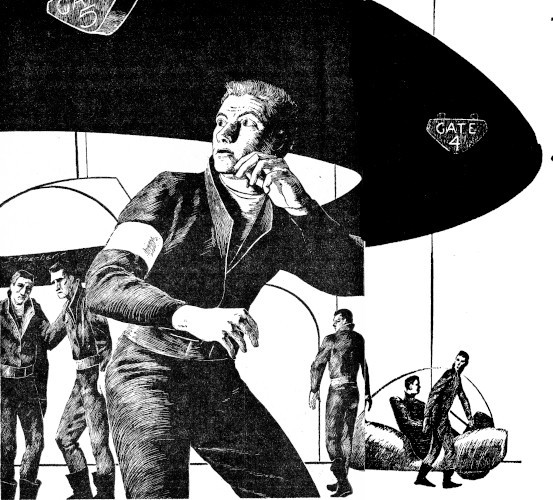
He had never been here before. The City was someplace where fathers went during the day, during the pleasant hours of school and Playground, and from which fathers came, grimy and irritable, in the evening. Larry had never considered going to the City before. Now it was necessary.

He had no particular destination in mind. But after seventeen years in the unworrying world, he would simply have to investigate the world of anxiety before making up his mind.

A car buzzed by suddenly, and he leaped to one side. Out here in the City, cars ran right next to the pedestrian-walks, not on flying skyways above them. Larry hugged the side of a building for a moment, recovering his calm.

Calm. Stay calm. Make a cool, objective appraisal.

But how?

Nine out of ten people picked this world. Larry ran his fingers over the rough brick of the building, and felt the tension beginning to curdle his stomach. Nine out of ten. Am I the tenth? Am I going to decide to go back to a lifetime of unworry?

It seemed so. This dirty, hypertense, overcrowded place seemed boundlessly undesirable. The choice was obvious.

But still....

He shook his head. After a moment of complete unthought, he let go of the side of the building and took a few hesitant steps forward. He was really frightened now. Suddenly, he wanted to be home, wanted to know again the smooth placidity of an unworried day.

He started to walk faster, then to run. After half a block, he stopped, suddenly.

Where am I running?

He didn't know. He felt trapped, hemmed in, overwhelmed by despair.

So this is the City? Sorry, I don't care for it.

"You're all alone, aren't you?" said a sudden voice from behind him. "It's not wise, on your first day off the drug."

Larry turned. The man behind him was tall and narrow-shouldered, with the pinched, baggy face of a grownup and a wide, sly smile. "Yes, I'm all alone," he said.

"I thought so. I can tell a Changer when I see one, even without the armband."

Larry glanced down at his arm quickly and saw that the identifying armband was gone. Somehow, somewhere, he must have ripped it off. He looked at the stranger, and in a hoarse voice asked, "What do you want?"

"A companion for a drink," the stranger said affably. "Care to join me?"

"No—I—all right," Larry said with a firmness that surprised himself. "Let's go have a drink."


The alcohol stung his mouth, and the flavoring in the drink tasted rancid, but he put the whole thing down and looked across the table at the stranger.

"I don't much like that drink," he said.

"Not surprising." The other grinned. "It's one of our favorites."

"Our?"

"City people, I mean. Ulcer people. We gobble the stuff up. Not surprising you don't like it."

Larry touched his forefingers lightly together. "I don't think I'd ever like it, no matter how long I tried to get used to it."

"Oh?" The stranger's left eyebrow rose slightly. "Never?"

Larry shook his head. "Or the rest of the City, for that matter." He sighed. "I don't think I'm the City type. I think I'm going to give the whole thing up and go back home. The City isn't for me."

"Have another drink," the stranger said. "Go on—I'll pay. It'll take your mind off your problems."

"There's a capsule that'll do it a lot more efficiently," Larry said. "I don't need bad-tasting drinks to ease my mind."

"You're definitely cashing in your chips, then?"

"What?"

"I mean, you're definitely choosing Koletsky for life, eh?"

Larry paused a while, letting the images of the City filter through his mind again. Finally he nodded. "I think so. I really do."

"Two full days more—and you've made up your mind?" The stranger shook his head. "That'll never do, son. You'll have to think more deeply."

"How deep do I have to think?"

"Tell me what anxiety is," the stranger countered.

Taken aback by the sudden and seemingly irrelevant question, Larry blinked. "Anxiety? Why—worry, isn't it? Fear? Ulcers and headaches?"

The stranger shook his head slowly and dialed another drink. "Anxiety is the feeling that things are too good, that you're riding for a fall," he said carefully. "It's a sense of things about to get worse."

Larry remembered the bubble-vendor and nodded. "But they have to be pretty good to start with, don't they?"

"Right. You've got to have something pretty good—and be worried that you're going to lose it. Then you fight to keep it. Challenge—response. That's anxiety. Fear's something different. Then you creep into the corner and shake. Or you hang onto the side of a wall."

"I think I'll take another drink," Larry said thoughtfully.

"You get what I mean? Anxiety pushes and prods you, but it doesn't make you shrivel. You've got to be strong to stand up under it. That's how our world works."

"So?"

"You haven't experienced any real anxiety yet, boy. Just fear—and you're reacting out of fear. You can't judge your response to something if you're really responding to something else."

Larry frowned and gulped his drink. It tasted a little better, this time, though only imperceptibly so. "You mean I'm deciding too quickly, then? That I ought to look around the City a little longer?"

"Yes and no," the stranger said. "You're deciding much too quickly—yes. But looking around the City won't do. No; go back home."

"Home?"

"Home. Go back to your Playground. Look there. Then decide."

Larry nodded slowly. "Sure," he said. "Sure—that's it." He felt the tension drain out of him. "I think I'll have one more drink before I go."


The Playground was crowded on the second day of Larry's three-day period. Small children played happily near the shimmering wading pond, older ones gathered for games in the playing-field farther on, and, far in the distance, a group of permanent unworriers sat complacently in the sun, neither thinking nor moving. Humming robonurses threaded here and there through the Playground, seeing to it that no one got into any trouble. They were necessary, of course—because the unworried children would have no fear of leaping from a tree head-first or walking into the path of a speeding baseball.

Larry stood at the edge of the Playground, leaning against the confining fence, watching. His friends were there—the boys he had played with only two days before, still happily occupied with their games and their bubble-toys. Walking carefully, in order not to be seen, he skirted the side of the playing area and headed for the green fields where the Permanents were.

There were about a hundred of them, of all ages. Larry recognized a former playmate of his—a boy of about nineteen, now—and there were older men, too, some well along in middle age. They sat quietly, unmoving, most of them, smiling pleasantly.
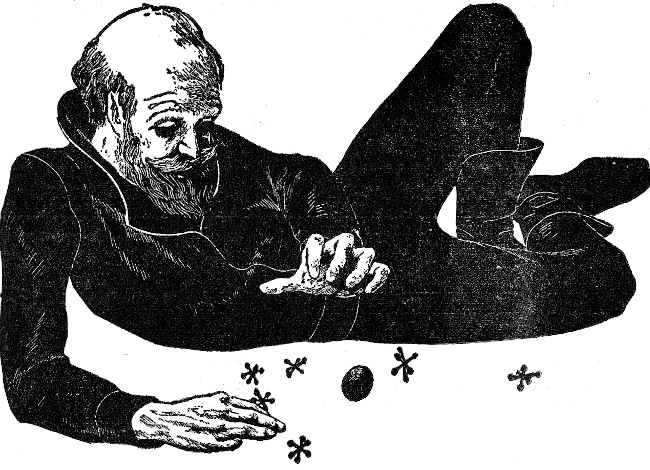
Larry entered the field and walked to the nearest bench.

"Mind if I join you?"

The man on the bench grinned. "Not at all. Sit right down, friend."

Larry sat. "You're a Permanent, aren't you?" he asked suddenly.

A shadow seemed to cross the man's face. "Yes," he said slowly. "Yes, I'm a Permanent. Who are you?"

"I'm Changing," Larry said.

"Oh."

The Permanent studied him idly for a moment or two, then leaned back and closed his eyes. "It's nice here," he said. "The sun's warm."

Larry frowned. "What do you do when it rains?"

"We go indoors," the Permanent said.

"Look! I think it's starting to rain now!" Larry pointed at the bright, cloudless sky. "There'll be a terrible thunderstorm any minute!"

"The robonurses should be here, then."

"Yes!" Larry said. "Where are they? Why aren't they here?"

"They'll be here," the Permanent said blandly.

"I don't think so. I don't think they're coming. They're going to let you get wet."

The Permanent shrugged. "They wouldn't do that," he said.

"Of course not," a new voice said.

Larry glanced up, startled. The copper-alloy face of a robonurse looked down at him. He goggled confusedly.

The robonurse's grips seized his shoulders gently. "You'll have to leave here, boy. We can't have you disturbing these people."

Larry stood up. "All right," he said. "I'll go." He had seen all he needed to see.


The stranger in the City had been right, Larry thought, as he made his way back to his home. The place to look had been in the Playground. He had seen something even more frightening than the City.

His father was waiting for him as he entered.

"Well?"

Larry sat down heavily in a pneumochair and knit his hands together. "I've seen the Playground," he said. "Yesterday the City, today the Playground. What's left to see?"

"You've seen it all, son."

Larry studied his father's pale, harried face for a moment. "I thought the City was pretty horrible. I decided yesterday I'd become a Permanent."

"I know. Your Watcher told me."

"Watcher?"

"You know—the man who took you in for drinks. You don't think I'd let you go into the City alone, do you?"

Larry smiled. "I thought it was too neat, the way he met me and sent me back. But—but—"

He looked up helplessly at his father. "Today I saw the Playground, Dad. And I don't know what to do." His voice trailed off indistinctly.

"What's the trouble, son?"

"Tomorrow I have to make my choice. Well, the Playground seems to be out—they turn into vegetables there—but am I ready for the City?"

"I don't understand, Larry."

"I was sickened by the place." He leaned forward and said, "Dad, why are children raised on the unworry drug?"

"We try to spare you," his father said. "Seventeen years of tranquility—it's good, isn't it?"

"Not when it ends. It's the worst possible preparation for a life in your world, Dad. I'm not ready for it—and I never will be! My childhood hasn't taught me how to worry!"

Suddenly, his father began to chuckle, first deep in his stomach, then high up in his throat, a ratchety, rasping laugh.

"What's the matter?" Larry asked angrily. "What's so funny?"

"You say you don't know how to worry? Why, you're practically an expert at it!"

"What do you mean by that?"

"Suppose you tell me what you've been thinking of, the past two days. Everything."

Larry stood up, walked to the door. The robonurse was waiting in the next room, patient, unmoving. After a moment, he turned to his father. "Well—I've been thinking that I don't like the City. That I'm afraid I wasn't properly prepared for it. That I think raising me on the unworry drug robbed me of any chance I'd have to learn to stand the strains of City life. That even so I don't like the Playground either, and I'm caught between." He checked each item off on his fingers. "That—"

"That's enough, Larry. You've analyzed it nicely."

Slowly, the truth opened out before him and an embarrassed grin widened on his face. Resistance to strain could be acquired overnight—by nine out of ten. Nine out of ten didn't need a long, grueling childhood to prepare them for adulthood; the tenth would never grow up anyway.

"I've been worrying," he said. "I'm the worrying kind. I've been worrying since yesterday, and I didn't even know it!"

His father nodded. Larry took the capsule-box from its shelf, opened it, stared at the three different kinds of capsule inside. "There never really was any choice after all, was there?"

"No. Your choice was made yesterday morning. If you didn't have the stuff for City life, you'd have grabbed for the unworry capsule the second you saw it. But you didn't. You stopped to make a decision—and won your citizenship right then and there. You proved it to us—and by fighting with yourself over the decision you thought you still had to make, you proved it to yourself."

Larry's smile spread. "Sure. The ability to worry is the measure of successful City life," he said. "And I'm a regular worry wart already." The excitement of the past two days still thumped in his stomach—and it was only the beginning. "I belong here. Why—it won't be long before I'll get my first ulcer!"

His father was radiant with paternal pride. "Welcome to your heritage, son—the heritage of the civilized man. You've got the makings of a first-rate citizen!"


Monday, April 13, 2026

After Some Tomorrow by Mack Reynolds


AFTER SOME TOMORROW

BY MACK REYNOLDS

Alan's plan might save the
race from extinction—but he
was the clan's only husband
and had to be protected from
his own folly....

[Transcriber's Note: This etext was produced from
Worlds of If Science Fiction, June 1956.
Extensive research did not uncover any evidence that
the U.S. copyright on this publication was renewed.]


Before the first shots rang out, Alan had been sitting with some twenty young people of the Wolf clan in a grove of aspen approximately half way between the fields and the citadel on the hill-top. He had been teaching them myth-legend and, as usual, the girls were bored and unbelieving, the boys open mouthed.

He realized, even as he spoke, that the telling had changed even since his own youth. As a boy of ten, before it was definitely known whether or not he was a sterilie, he had sat at the feet of the Turtle clan's husband as open mouthed as those who sat at his feet now. But the telling was different. Now, had he spoken openly of when men bore weapons and women lived at home with the children, he would have crossed the boundaries of decency. It hadn't been so in his own youth, but then, when he was a boy, they had been one generation nearer to the old days, which weren't so far back after all.

Helen complained, "This is so silly, Alan. Why don't you tell us something about ... well, about hunting, or true fighting?"

He looked at her. Could this be a daughter of his? Tall for her fourteen years and straight, clear of eye, aggressive and brooking of no nonsense. The old books told of the femininity of women, but....

The shots went bang, bang, bang, from below, faint in the half mile or more of distance. And then bang, bang again and several booms from the new muzzle loading muskets.

Helen was on her feet first, her eyes flashing. Instantly she was in command. "Alan," she snapped. "Quick, to the citadel. All of you boys, hurry! To the citadel!"

She whirled to her older classmates. "Ruth, Margo, Jenny, Paula. Get stones, sharp stones. You younger girls go with Alan. See if you can help at the citadel. We'll come last. Hurry Alan."

Alan was already off, herding the boys before him. Possibly all of them were sterilies and so wouldn't count. But you never knew.

As they climbed the hill, he looked back over his shoulder. Down in the fields he could see the workers scattering for their weapons and for cover. One stumbled and was down. In the distance he couldn't make out whether she had fallen accidentally or been wounded. Further beyond the fields he could see the smoke from a half dozen or more places where the shots had originated. It didn't seem to be an attack in force.

Not far up the hill from the field workers, on a overhanging boulder in a lookout position, he could make out Vivian, the scout chief. She sat, seemingly in unconcerned ease, one elbow supported on a knee as her telescoped rifle went crack, crack, crack. If he knew Vivian there was more than one casualty among the raiders.

Who could it be this time? Deer from the south, Coyote or Horse from the east? Possibly Eagles, Crows or Dogs from Denver way. The clan couldn't stand much more of this pressure. It was the third raid in six months. They couldn't stand it and put in a crop, nor could the drain on the arsenal be maintained. He had heard that the Turtle clan, near Colorado Springs, the clan of his birth, had got to the point where they were using bows and arrows even for defense. If so, it wouldn't be long before they would be losing their husband.

He was puffing somewhat by the time they reached the citadel. Helen and her four girls were coming much more slowly, watching the progress of the fight below them, keeping their eyes peeled for a possible break through of individual enemies. The stones in their hands were pathetically brave.

The rounded citadel building, stone built, loopholed for rifles, loomed before them. He swung open the door and hurried inside.

"Hello, honey," a strange voice said pseudo-pleasantly. "Hey, you're kind of cute."

Alan's eyes went from the two figures before him, automatic rifles cuddled under their arms, to the two Wolf clan sentries collapsed in their own blood on the floor. They had paid for lack of vigilance with their lives.

He could see that the strangers were of different clans by their kilts, one a Horse the other a Crow. This would mean two clans had united in order to raid the Wolves and that, in turn, would mean the Wolves were outnumbered as much as two to one.

"Relax, darling," the second one said, a lewd quality in her voice. "Nothing's going to happen to you." Her eyes took in the dozen boys ranging in age from five to twelve. "Look like a bunch of sterilies to me," she sneered. "Get them up above, and those girls too. You stay here where we can watch you, honey."

The Crow went to a small window, stared down below. "Wanda is holding them pretty well but they're beginning to work their way back in this direction." She laughed harshly. "These Wolves never could fight."

Her companion fingered the Bren gun which lay on the heavy table top in the round room's center. Aside from four equally heavily constructed chairs the table was the large room's sole furniture. While Alan was ushering the boys and younger girls up to the second floor where they would be safe, the Horse said musingly, "We could turn this loose on them even at this distance."

The Crow shook her head. "No. It'll be better to wait until they're closer. Besides, by that time Peggy and her group'll be coming up from the arroyo. There won't be a Wolf left half an hour from now."

Alan, his stomach empty, stared out the loophole nearest him.

One of the women said, grinning, "You better get away from there, honey. Make you sick. That's a mighty pretty suit you've got on. Make it yourself?"

"No," Alan said. As a matter of fact one of the sterilies had made it.

She laughed. "Well, don't be so uppity. You're going to have to learn how to be nice to me, you know."

Both of them laughed, but Alan said nothing. He wondered how long the women of these clans had been without a husband.

Down below he could make out the progress of the fighting and then realized the battle plan of the aggressors. They must have planned it for months, waiting until the season was such that practically the whole Wolf clan, and particularly the fighters, would be at work in the fields. They'd sent these two scouts, probably their best warriors, to take the citadel by stealth. Only two of them, more would have been conspicuous.

They had then, with a limited force, opened fire on the field workers, pinning them down temporarily.

Meanwhile, the main body was ascending the arroyo to the left, completely hidden from the defending forces although they would have been in open sight from above had the citadel remained uncaptured.

Alan could see plainly what the next fifteen minutes would mean. The Wolf clan would draw back on the citadel, Vivian and her younger warriors bringing up the rear. When they broke into the clear and started the last dash for the safety of their fortress, they would be in the open and at the mercy of the crossfire from arroyo and citadel.

If only these two had failed in their attempt to....

The Crow woman said, "Look at this. Five young brats with stones in their hands. What do you say?"

It was Helen and her four girls.

Alan said, "They're only children! You can't...."

"You be quiet, sweetheart. We can't be bothered with you."

The Horse said, "Two years from now they'll all be warriors. Here, let me turn this on them."

Alan closed his eyes and he wanted to retch as he heard the automatic rifle speak out in five short bursts. In spite of himself he opened them again. Helen, his first born, Paula, his second. Ruth, Margo and Jenny, all his children. They were crumbled like rag dolls, fifty feet from the citadel door.

Now he was able to tell himself that he should have called out a warning. One or two of them, at least, might have escaped. Might have escaped to warn the approaching fighters of the trap behind them. Tradition had been too strong within him, the tradition that a man did not interfere in the business of the warriors, that war was a thing apart.

Jenny's body moved, stirred again, and she tried to drag herself away. Little Jenny, twelve years old. The rifle spat just once again and she slumped forward and remained quiet.

"Little bitch," the Crow woman said.

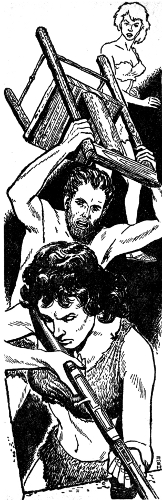
The heavy chair was in his hands and high above his head, he had brought it down on her before the rage of his hate had allowed him to think of what he was doing. The chair splintered but there was still a good half of it in his hands when he spun on the Horse woman. She stepped back, her eyes wide in disbelief. As her companion went down, the side of her face and her scalp welling blood, the Horse at first brought up her rifle and then, in despair, tried to reverse it to use its butt as a club.


She was stumbling backward, trying to get out of the way of his improvised weapon, when her heel caught on the body of one of the fallen Wolf sentries. She tried to catch herself, her eyes still staring horrified disbelief, even as he caught her over the head, and then once again. He beat her, beat her hysterically, until he knew she must be dead.

He worked now in a mental vacuum, all but unconsciously. He ran to the stair bottom and called, "Come down," his voice was shrill. "Alice, Tommy, all of you."


They came, hesitantly, and when they saw the shambles of the room stared at him with as much disbelief as had the enemy women. He pointed a finger at the oldest of the girls. "Alice," he said, "you've been given instruction by the warriors. How is the Bren gun fired?"

The eleven year old bug eyed at him. "But you're a husband, Alan...."

"How is it fired?" he shrilled. "Unless you tell me, there will be no Wolf clan left!"

He lugged the heavy gun to the window, mounted it there as he had seen the women do in practice.

"Tommy," he said to a thirteen year old boy. "Quick, get me a pan of ammunition."

"I can't," Tommy all but wailed.

"Get it!"

"I can't. It's ... it's unmanly!" Tommy melted into a sea of tears, utterly confused.

"Maureen," Alan snapped, cooler now. "Get me a pan of ammunition for the Bren gun. Quickly. Alice, show me how the gun is charged."

Alice was at his side, trying to explain. He would have let her take over had she been larger, but he knew she couldn't handle the bucking of the weapon. Maureen had returned with the ammunition, slipped it expertly into place. She too had had instructions in the gun's operation.

Alan ran his eyes down the arroyo. There were possibly forty of them, Horses and Crows—well armed, he could see. Less than a quarter of them had the new muzzle loaders being resorted to by many as ammunition stocks for the old arms became increasingly rare. The others had ancient arms, rifles, both military and sport, one or two tommy guns.

He waited another three or four minutes, one eye cocked on the progress of the running battle below. Vivian, the scout chief, had dropped back to take over command of the younger warriors. She was probably beginning to smell a rat. The intensity of fire wasn't such as to suggest a large body of enemy.

The women in the arroyo were placed now as he wanted them. He forced himself to keep his eyes open as he pressed the trigger.

Blat, blat, blat.

The gun spoke, kicking high the dust and gravel before the Horse and Crow warriors advancing up the arroyo.

They stopped, startled. The citadel was supposedly in their hands.

They reversed themselves and scurried back to get out of their exposed position.

He touched the trigger again. Blat, blat, blat. The heavy slugs tore up the arroyo wall behind them, they could retreat no further without running into his fire.

They stopped, confused.

Alan said, "Maureen, get another pan of ammunition. I'll have to hold them there until Vivian comes up. Alice, run down to the matriarch and tell her about the warriors in the arroyo. Quickly, now."

Little Alice said sourly, "A husband shouldn't interfere in warrior affairs," but she went.


When Vivian strode into the citadel she had her sniper rifle slung over her back and was admiring a tommy gun she had taken from one of the captured Horses. "Perfect," she said, stroking the stock. "Perfect shape. And they seem to have worlds of ammunition too. Must have made some kind of deal with the Denver clans."

Her eyes swept the room and her mouth turned down in sour amusement. The Horse woman was dead and the Crow had by now been marched off to take her place with the other prisoners who were being held in the stone corral.

"What warriors," she said contemptuously. "A man overcomes two of them. Two of them, mind you." She looked at Alan, the reaction was upon him now and he was white faced and couldn't keep his hands from trembling. "What a cutie you turned out to be. Who ever heard of such a thing?"

Alan said, defensively, "They didn't expect it. I took them unawares."

Vivian laughed aloud, her even white teeth sparkling in the redness of her lips. She was tall, shapely, a twenty-five year old goddess in her Wolf clan kilts. "I'll bet you did, sweetie."

One of the other warriors entered from behind Vivian, looked at the dead Horse woman and shuddered. "What a way to die, not even able to defend yourself." She said to Vivian worriedly, "They've got an awful lot of equipment, chief."

Vivian said, "Well, what're you worrying about, Jean? We have it now."

The girl said, "They have three tommy guns, four automatic rifles, twenty grenades and forty sticks of dynamite."

Vivian was impatient. "They had them, now they're ours. It's good, not bad."

Jean said doggedly, "These raids are coming more and more often. We've lost ten fighters in less than a year. And each time they come at us they're better equipped and there're more of them." She looked over at Alan. "If it hadn't been for this ... this queer way things worked out, they'd have our husband now and we'd be done for."

"Well, it didn't happen that way," Vivian said abruptly, "and we still have our husband and we're going to keep him. This wasn't a bad action at all. They killed three of us, we've got more than forty of them."

"Not three, eight," Jean said. "You forget the five girls. In another couple of years they'd have been warriors. And besides, what difference does it make if we've got forty of them? There're always more of them where they came from. There must be a thousand women toward Denver without a husband between them."

Vivian quieted. "Let's hope they don't all decide on Alan at once," she said. "I wonder if the Turtles are having the same trouble."

"They're having more," Alan said. He had lowered himself wearily into one of the chairs.

The two warriors looked at him. "How do you know, sweetie?" Vivian asked him.

"I was talking to Warren, a few weeks ago. He's husband of the Turtle clan now, they traded him from the Foxes. Both clans were getting too interbred...."

"Get to the point, honey," Jean said, embarrassed at this man talk.

"The Turtles are having more trouble than we are. They have a stronger natural fortress at the center of their farm lands, but they've had so many raids that their arsenal is depleted and half their warriors dead or wounded. They're getting desperate."

"That's too bad," Vivian muttered. "They make good neighbors."

Jean said, "The matriarch told me to let you know there'd be a meeting this afternoon in the assembly hall. Clan meeting, all present."

"What about?" Vivian said, her attention going back to the beauty of her captured weapon again.

"About the prisoners. We've got to decide what to do with them."

"Do with them? We'll push them over the side of the canyon. Nobody thought we'd waste bullets on them did they?"

Alan said, mildly, "The question has come up whether we ought to destroy them at all."

Vivian looked at him in gentle annoyance. "Sweetie," she said, "don't bother your handsome head with these things. You've had enough excitement to last a nice looking fellow like you a lifetime."

Jean said, echoing her chief's disgust, "Anyway, that's what the meeting is about. Alan, here, has been talking to the matriarch and she's agreed to bring it up for discussion."

Vivian said nastily, "Sally is beginning to lose her grip. If there's anything a clan needs it's a strong matriarch."

"A wise matriarch," Alan amended, knowing he shouldn't.

Vivian stared at him for a moment, then threw her head back and laughed. "I'm going to have to spank your bottom one of these days," she told him. "You get awfully sassy for a man."


As chairman, Alan had a voice but not a vote in the meetings of the Wolf clan. He sometimes wondered at the institution which had come down from pre-bomb days. Why was it necessary to have a chairman. Of course, myth-legend had it that men were once just as numerous and active in society's economic (and even martial!) life as were women. But that was myth-legend. It all had a basis in reality, perhaps, but some of it was undoubtedly stretched all but to the breaking point.

Of course if all men had been fertile in the old days. But if you started with if, as a beginning point, you could go as far as you wished in any direction.

He called the meeting to order in the assembly hall which stood possibly a hundred feet below the citadel in one direction, another hundred from the stone corral which housed their prisoners, in the other. The Wolf clan was present in its entirety with the exception of children under ten and except for four scouts who were holding the prisoners. As chairman, Alan sat on the dais flanked by Sally, the matriarch, 35 years of age, tall, Junoesque, on one side and by Vivian the scout chief, on the other.

Before them sat, first, the active warrior-workers, some thirty-five of them. Second, the older women, less than a score. Further back were the sterilies, possibly twenty of these and quite young, only within recent memory had they been allowed to become part of the clan, in the past they had been driven away or killed. Further back still were the children above ten but too young to join the ranks of either warrior-workers or sterilies.

Alan called the meeting to order, quieted them somewhat and then invited the matriarch to take the floor.

Sally stood and looked out over her clan, the dignity of her presence silencing them where Alan's plea had not.

She said, "We have two matters to bring to our attention. First, I believe the clan should make it clear to Alan, our husband, that such interference in the affairs of women is utterly out of the question. I am speaking of his unmanly activities in the raid this morning."

There were mumblings of approval throughout the hall.

Alan came to his feet, his face bewildered. "But, Sally, what else could I do? If I hadn't overcome the enemy warriors and turned the Bren gun on the others you would all be gone now. Possibly none of you would have survived."

Sally quieted him with a chill look. "Let me repeat what is well known to every member of the clan. We consist of less than sixty women, a few more than thirty-five of whom are active. There are twenty sterilies and twenty-five or so children. And one husband. A few more than one hundred in all."

Her voice slowed and lowered for the sake of emphasis. "All of our women—except for two or three—might die and the clan would live on. The sterilies certainly might all die, and the clan live on. Even the children could all die and the clan live on. But if our husband dies, the clan dies. The greatest responsibility of every member of any clan is to protect the husband. Under no circumstances is he to be endangered. You know this, it should not have to be brought to your attention."

There was a strong murmur of assent from those seated before them.

Alan said, "But, Sally, I saved your lives! And if I hadn't, I would have been captured by the Crows and Horses and you would have lost me at any rate."

This was hard for Sally Wolf, but she said, "Then, at least, they would have had you. If you had died, in your foolhardiness, you would have been gone for all of us. Alan, two clans, husbandless clans, united in this attempt to capture you from us. While we fought to protect our husband, the life of our clan, we hold no rancor against them. In their position, we would have done the same. Much rather would we see you taken by them, than to see you dead. Even though the Wolf clan might die, the race must go on." She added, but not very believably, "If they had captured you, perhaps we could have, in our turn, captured a husband from some other clan."

"The reason we probably couldn't," Vivian said mildly, "is that since we've turned to agriculture and settled, our numbers have dropped off by half. We had more than sixty warriors while we were hunter-foragers."

"That's enough, Vivian," Sally snapped. "The question isn't being discussed this afternoon."

"Ought to be," somebody whispered down in front.

"Order," Alan said. He knew it was a growing belief in the clan that giving up the nomadic life had been a mistake. From raiders, they had become the raided.

Sally said, "The second order of business is the disposal of the Horse and Crow prisoners captured in the action today."

Vivian said, "We can't afford to waste valuable ammunition. I say shove them into the canyon."

Most of those seated in the hall approved of that. Some were puzzled of face, wondering why the matter hadn't been left simply in the scout chief's hands.

Sally said, dryly, "I haven't formed an opinion myself. However, our chairman has some words to say."

Vivian looked at Alan as though he was a precocious child. She shook her head. "You cutie, you. You're getting bigger and bigger for your britches every day."

Two or three of the warriors echoed her by chuckling fondly.

Alan said nothing to that, needing to maintain what dignity and prestige he could muster.

He stood and faced them and waited for their silence before saying, "You feminine members of the clan are too busy with work and with defense to pursue some of the studies for which we men find time."

Vivian murmured, "You ain't just a whistlin', honey. But we don't mind. You do what you want with your time, honey."

He tried to smile politely, but went on. "It has come to the point where few women read to any extent and most learning has fallen into the hands of the men—few as we are."

Sally said impatiently, "What has this got to do with the prisoners, Alan dear?"

It would seem that he had ignored her when he said, "I have been discussing the matter with Warren of the Turtle clan and two or three other men with whom I occasionally come in contact. At the rate the race is going, there will be no men left at all in another few generations."

There was quiet in the long hall. Deathly quiet.

Sally said, "How ... how do you mean, dear?"

"I mean our present system can't go on. It isn't working."

"Of course it's working," Vivian snapped. "Here we are aren't we? It's always worked, it always will. Here's the clan. You're our husband. After we've had you for twenty years, we'll trade you to another clan for their husband—prevents interbreeding. If you have a fertile son, the clan will either split, each half taking one husband, or we'll trade him off for land, or guns, or whatever else is valuable. Of course, it works."

He shook his head, stubbornly. "Things are changing. For a generation or two after bomb day, we were in chaos. By time things cleared we were divided as we are now, in clans. However, we were still largely able to exist on the canned goods, the animals, left over from the old days. There was food and guns for all and only a few of the men were sterilies."

Vivian began to say something again, but he shook a hand negatively at her, pleading for silence. "No, I'm not talking about myth-legend now. Warren's great-grandfather, whom he knew as a boy, remembers when there were four times or more the number of men we have today and when the sterilies were very few."

Vivian said impatiently, "What's this got to do with the prisoners? There they are. We can kill them or let them go. If we let them go, they'll be coming back, six months from now, to take another crack at us. Alan is cute as a button, but I don't think he should meddle in women's affairs."

But most of them were silent. They looked up at him, waiting for him to go on.

"I suppose," Sally said, "that you're coming to a point, dear?"

He nodded, his face tight. "I'm coming to the point. The point is that we've got to change the basis of clan society. This isn't working any more—if it ever did. There's such a thing as planned breeding ..." it had been hard to say this, and the younger women in the audience, in particular, tittered "... and we're going to have to think in terms of it."

Sally had flushed. She said now, "A certain dignity is expected at a clan meeting, Alan dear. But just what did you mean?"

Vivian said, "This is nonsense, I'm leaving," and she was up from the speaker's table and away. Two or three of her younger girls looked after, scowling, but they didn't follow her out of the hall.

"I mean," Alan said doggedly, "that one of those Crow women has been the mother of two fertile men. To my knowledge she is the only woman within hundreds of miles this can be said about. We men have been keeping records of such things."

Sally was as mystified as the rest of the clan.

Alan said, "I say bring these women into the clan. Unite with the Turtles and the Burros so that we'll have three clans, five counting the Horses and Crows. Then we'll have enough strength to fight off the forager-hunters, and we'll have enough men to experiment in selective breeding."

Half of the hall was on its feet in a roar.

"Share you with these ... these desert rats who just raided us, who killed eight of our clan?" Sally snapped, flabbergasted.

He stood his ground. "Yes. I'll repeat, one of those Crow women has borne two fertile men children. We can't afford to kill her. For all we know, she might have a dozen more. This haphazard method of a single husband for a whole clan must be replaced...."

The hall broke down into chaos again.

Sally held up a commanding hand for silence. She said, "And if we share you with another forty or fifty women, to what extent will the rest of us have any husband at all?"

He pointed out the sterilies, seated silently in the back. "It would be healthier if you gave up some of this superior contempt you hold for sterile males and accept their companionship. Although they cannot be fathers, they can be mates otherwise. As it is, how much true companionship do you secure from me—any of you? Less than once a month do you see me more than from a distance."

"Mate with sterilies?" someone gasped from the front row.

"Yes," Alan snapped back. "And let fertile men be used expressly for attempting to produce additional fertile men. Confound it, can't you warriors realize what I'm saying? I have reports that there is a woman among the Crows who has borne two fertile male children. Have you ever heard of any such phenomenon before? Do you realize that in the fifteen years I have been the husband of this clan, we have not had even one fertile man child born? Do you realize that in the past twenty years there has been born not one fertile man child in the Turtle clan? Only one in the Burro clan?"

He had them in the palm of his hand now.

"What—what does the Turtle clan think of this plan of yours?" Sally said.

"I was talking to Warren just the other day. He thinks he can win their approval. We can also probably talk the Burros into it. They're growing desperate. Their husband is nearly sixty years old and has produced only one fertile male child, which was later captured in a raid by the Denver foragers."

Sally said, "And we'd have to share you with all these, and with our prisoners as well?"

"Yes, in an attempt to breed fertile men back into the race."

Sally turned to the assembled clan.

A heavy explosion, room-shaking in its violence, all but threw them to the floor. Half a dozen of the younger warriors scurried to the windows, guns at the ready.

In the distance, from the outside, there was the chatter of a machine gun, then individual pistol shots.

"The corral," Jean the scout said, her lips going back over her teeth.

Vivian came sauntering back into the assembly hall, patting the stock of her new tommy gun appreciately. "Works like a charm," she said. "That dynamite we captured was fresh too. Blew 'em to smithereens. Only had to finish off half a dozen."

Alan said, agonizingly, "Vivian! You didn't ... the prisoners?"

She grinned at him. "Alan, you're as cute as a button, but you don't know anything about women's affairs. Now you be a honey and go back to taking care of the children."

The Addicts by William Morrison


The Addicts

By WILLIAM MORRISON

Illustrated by ED. ALEXANDER

[Transcriber's Note: This etext was produced from
Galaxy Science Fiction January 1952.
Extensive research did not uncover any evidence that
the U.S. copyright on this publication was renewed.]


Wives always try to cure husbands of
bad habits, even on lonely asteroids!


You must understand that Palmer loved his wife as much as ever, or he would never have thought of his simple little scheme at all. It was entirely for her own good, as he had told himself a dozen times in the past day. And with that he stilled whatever qualms of conscience he might otherwise have had. He didn't think of himself as being something of a murderer.

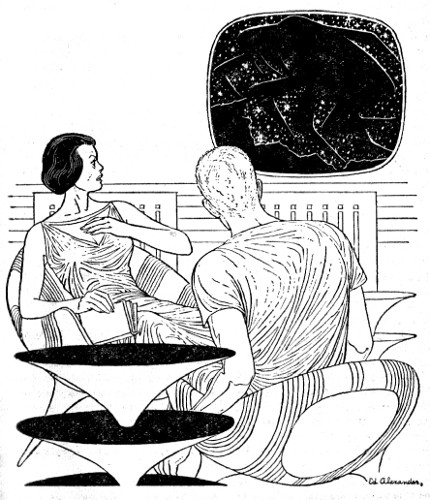
She was sitting at the artificial fireplace, a cheerful relic of ancient days, reading just as peacefully as if she had been back home on Mars, instead of on this desolate outpost of space. She had adjusted quickly to the loneliness and the strangeness of this life—to the absence of friends, the need for conserving air, the strange feeling of an artificial gravity that varied slightly at the whim of impurities in the station fuel. To everything, in fact, but her husband.

She seemed to sense his eyes on her, for she looked up and smiled. "Feeling all right, dear?" she asked.

"Naturally. How about you?"

"As well as can be expected."

"Not very good, then."

She didn't reply, and he thought, She hates to admit it, but she really envies me. Well, I'll fix it so that she needn't any more. And he stared through the thick, transparent metal window at the beauty of the stars, their light undimmed by dust or atmosphere.

The stories told about the wretchedness of the lighthouse keepers who lived on asteroids didn't apply at all to this particular bit of cosmic rock. Life here had been wonderful, incredibly satisfying. At least it had been that way for him. And now it would be the same way for his wife as well.

He would have denied it hotly if you had accused him of finding her repulsive. But to certain drunks, the sober man or woman is an offense, and Palmer was much more than a drunk. He was a marak addict, and in the eyes of the marak fiends, all things and all people were wonderful, except those who did not share their taste for the drug. The latter were miserable, depraved creatures, practically subhuman.

Of course that was not the way most of them put it. Certainly it was not the way Palmer did. He regarded his wife, he told himself, as an unfortunate individual whom he loved very much, one whom it was his duty to make happy. That her new-found happiness would also hasten her death was merely an unfortunate coincidence. She was sure to die anyway, before long, so why not have her live out her last days in the peace and contentment that only marak could bring?

Louise herself would have had an answer to that, if he had ever put the question to her. He was careful never to do so.

She laid the book aside and looked up at him again. She said, "Jim, darling, do you think you could get the television set working again?"

"Not without a mesotron rectifier."

"Even the radio would be a comfort."

"It wouldn't do any good, any way. Too much static from both Mars and Earth this time of year."

That was the beauty of the marak, he thought. It changed his mood, and left him calm and in full command of his faculties, able to handle any problem that came up. He himself, of course, missed neither the radio nor the television, and he never touched the fine library of micro-books. He didn't need them.

A shadow flitted by outside the thick window, blotting out for a moment the blaze of stars. It was the shadow of death, as he knew, and he was able to smile even at that. Even death was wonderful. When it finally came, it would find him happy. He would not shudder away from it, as he saw Louise doing now at the sight of the ominous shadow.

He smiled at his wife again, remembering the six years they had lived together. It had been a short married life, but—again the word suggested itself to him—a wonderful one. There had been only one quarrel of importance, in the second year, and after that they had got along perfectly. And then, two years ago, he had begun to take marak, and after that he couldn't have quarreled with anyone. It was a paragon among drugs, and it was one of the mysteries of his existence that anybody should object to his using it.

Louise had tried to argue with him after she had found out, but he had turned every exchange of views into a peaceful discussion, which from his side, at least, was brimming over with good humor. He had even been good-humored when she tried to slip the antidote into his food. It was this attitude of his that had so often left her baffled and enraged, and he had a good chuckle out of that, too. Imagine a wife getting angry because her husband was too good-natured.

But she was never going to get angry again. He would see to that. Not after tonight. A big change was going to take place in her life.

She had picked up another book, and for the moment he pitied her. He knew that she wasn't interested in any books. She was merely restless, looking for something to do with herself, seeking some method of killing time before the shadows outside killed it for her for good and all. She couldn't understand his being so peaceful and contented, doing nothing at all.

She threw the second book down and snarled—yes, that was the word, "You're such a fool, Jim! You sit there, smug and sure of yourself, your mind blank, just waiting—waiting for them to kill you and me. And you seem actually happy when I mention it."

"I'm happy at anything and everything, dear."

"At the thought of dying too?"

"Living or dying—it doesn't make any difference. Whatever happens, I'm incapable of being unhappy."

"If it weren't for the drug, we'd both live. You'd think of a way to kill them before they killed us."

"There is no way."

"There must be. You just can't think of it while the drug has you in its grip."

"The drug doesn't have you, dear." He asked without sarcasm, "Why don't you think of a way?"

"Because I lack the training you have. Because I don't have the scientific knowledge, and all the equipment scattered around means nothing to me."

"There's nothing to be done."

Her fists clenched. "If you weren't under the influence of the drug—"

"You know that it doesn't affect the ability to think. Tests have shown that."

"Tests conducted by addicts themselves!"

"The fact that they can conduct the tests should be proof enough that there's nothing wrong with their minds."

"But there is!" she shouted. "I can see it in you. Oh, I know that you can still add and subtract, and you can draw lines under two words which mean the same thing, but that isn't really thinking. Real thinking means the ability to tackle real problems—hard problems that you can't handle merely with paper and pencil. It means having the incentive to use your brain for a long time at a stretch. And that's what the drug has ruined. It has taken away all your incentive."

"I still go about my duties."

"Not as well as you used to, and even at that, only because they've become a habit. Just as you talk to me, because I've become a habit. If you'd let me give you the antidote—"

He chuckled at the absurdity of her suggestion. Once an addict had been cured, he could not become addicted again. The antidote acted to produce a permanent immunization against the effects of the drug. It was the realization of this fact that made addicts fight so hard against any attempt to cure them. And she thought that she could convince him by argument!

He said, "You talk of not being able to think!"

"I know," she replied hotly. "I'm the one who blunders. I'm the fool, for arguing with you, when I realize that it's impossible to convince a marak addict."

"That's it," he nodded, and chuckled again. But that wasn't quite it. For he was also chuckling at his plan. She had thought him unable to tackle a real problem. Well, he would tackle one tonight. Then she would simply adopt his point of view, and she would no longer be unhappy. After she had accepted the solution he had provided, she would wonder how she could ever have opposed him.

He fell into one of his dozes and hardly noticed her glaring at him. When he came out of it at last, it was to hear her say, "We have to stay alive as long as possible. For the sake of the lighthouse."

"Of course, my dear. I don't dispute that at all."

"And the longer we stay alive, the more chance there is that some ship will pick us up."

"Oh, no, there's no chance at all," he asserted cheerfully. "You know that as well as I do. No use deceiving yourself, my love."

That, he observed to himself, was the way of non-addicts. They couldn't look facts in the face. They had to cling to a blind and silly optimism which no facts justified.

He knew that there was no hope. He was able to review the facts calmly, judiciously, to see the inevitability of their dying—and to take pleasure even in that.

He reviewed them for her now. "Let us see, sweetheart, whether I've lost my ability to analyze a situation. We're here with our pretty little lighthouse in the middle of a group of asteroids between Mars and Earth. Ships have been wrecked here, and our task is to prevent further wrecks. The lighthouse sends out a standard high-frequency beam whose intensity and phase permit astrogators to estimate their distance and direction from us. Ordinarily, there's nothing for us to do. But on the rare occasions when the beam fails—"

"That will be the end."

"On those occasions," he continued, unruffled by her interruption, "I am supposed to leave my cosy little shelter, so thoughtfully equipped with all the comforts of Earth or Mars, and make repairs as rapidly as possible. Under the usual conditions, lighthousekeeping is a boring task. In fact, it has been known to drive people insane. That's why it's generally assigned to happily married couples like us, who are accustomed to living quietly, without excitement."

"And that," she added bitterly, "is why even happily married couples are usually relieved after one year."

"But, darling," he said, his tone cheerful, "you mustn't blame anyone. Who would have expected that a maverick meteor would come at us and displace us from our orbit? And who would have expected that the meteor would have collided first with the outer asteroids, and picked up a cargo of—those?"

He gestured toward the window, where a shadow had momentarily paused. By the light that shone through, he could see that the creature was relatively harmless-looking. It had what appeared to be a round, humorous face whose unhumorous intentions would be revealed only at the moment of the kill. The seeming face was actually featureless, for it was not a face at all. It had neither eyes, nor nose, nor mouth. The effect of features was given by the odd blend of colors. Almost escaping notice because of their unusual position and their dull brown hue were the stomach fangs, in neat rows which could be extended and retracted like those of a snake.


He noticed that Louise had shuddered again, and said, in the manner of a man making conversation, "Interesting, aren't they? They're rock breathers, you know. They need very little oxygen, and they extract that from the silicates and other oxygen-containing compounds of the rock."

"Don't talk about them."

"All right, if you don't want me to. But about us—you see, my dear, no one expected us to be lost. And even if the Lighthouse Service has started to look for us, it'll take a long time to find us."

"We have food, water, air. If not for those beasts, we'd last until a rescue ship appeared."

"But even a rescue ship wouldn't be able to reach us unless we kept the beam going. So far, we've been lucky. It's really functioned remarkably well. But sooner or later it'll go out of order, and then I'll have to go out and fix it. You agree to that, don't you, Louise, dear?"

She nodded. She said quietly, "The beam must be kept in order."

"That's when the creatures will get me," he said, almost with satisfaction. "I may kill one or two of them, although the way I feel toward everything, I hate to kill anything at all. But you know, sweetheart, that there are more than a dozen of them altogether, and it's clumsy shooting in a spacesuit at beasts which move as swiftly as they do."

"And if you don't succeed in fixing what's wrong, if they get you—" She broke down suddenly and began to cry.

He looked at her with compassion, and smoothed her hair. And yet, under the influence of the drug, he enjoyed even her crying. It was, as he never tired of repeating to himself and to her a wonderful drug. Under its spell, a man—or a woman—could really enjoy life.

Tonight she would begin to enjoy life along with him.


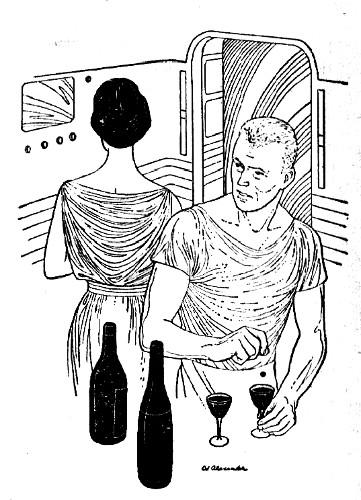
Their chronometer functioned perfectly, and they still regulated their living habits by it, using Greenwich Earth time. At seven in the evening they sat down to a fine meal. Knowing that tomorrow they might die, Louise had decided that tonight they would eat and drink as well as they could, and she had selected a Christmas special. She had merely to pull a lever, and the food had slid into the oven, to be cooked at once by an intense beam of high-frequency radiation. Jim himself had chosen the wine and the brandy—one of the peculiarities of the marak was that it did not affect the actual enjoyment of alcoholic drinks in the slightest, and one of the sights of the Solar System was to see an addict who was also drunk.

But it was a rare sight, for the marak itself created such a pervading sensation of well-being that it often acted as a cure for alcoholism. Once an alcoholic had experienced its effect, he had no need to get drunk to forget his troubles. He enjoyed his troubles instead, and drank the alcohol for its own sake, for its ability to provide a slightly different sensation, and not for its ability to release him from an unhappy world.

So tonight Palmer drank moderately, taking just enough, as it seemed to him, to stimulate his brain. And he did what he now realized he should have done long ago. Unobserved, he placed a tablet of marak in his own wineglass and one in Louise's. The slight bitterness of taste would be hardly perceptible. And after that Louise would be an addict too.

That was the way the marak worked. There was nothing mysterious about the craving. It was simply that once you had experienced how delightful it was, you wouldn't do without it.

The tablet he had taken that morning was losing its effect, but he felt so pleased at what he was doing that he didn't mind even that. For the next half hour he would enjoy himself simply by looking at Louise, and thinking that now at last they would be united again, no longer kept apart by her silly ideas about doing something to save themselves. And then the drug would take effect, and they would feel themselves lifted to the stars together, never to come down to this substitute for Earth again until the beam failed, and they went out together to make the repairs, and the shadows closed in on them.

He had made sure that Louise had her back to him when he dropped the tablet into her glass, and he saw that she suspected nothing. She drank her wine, he noticed, without even commenting on the taste. He felt a sudden impulse to kiss her, and, somewhat to her surprise, he did so. Then he sat down again and went on with the dinner.


He waited.

An hour later he knew that he had made her happy. She was laughing as she hadn't laughed for a long time. She laughed at the humorous things he said, at the flattering way he raised his glass to her, even at what she saw through the window. Sometimes it seemed to him that she was laughing at nothing at all.

He tried to think of how he had reacted the first time he had taken the drug. He hadn't been quite so aggressively cheerful, not quite so—hysterical. But then, the drug didn't have exactly the same effect on everyone. She wasn't as well balanced as he had been. The important thing was that she was happy.

Curiously enough, he himself wasn't happy at all.

It took about five seconds for the thought to become clear to him, five seconds in which he passed from dull amazement to an enraged and horrified comprehension. He sprang to his feet, overturning the table at which they still sat. And he saw that she wasn't surprised at all, that she still stared at him with a secret satisfaction.

"You've cured me!" he cried. "You've fed me the antidote!"

And he began to curse. He remembered the other time she had tried it, the time when he had been on the alert, and had easily detected the strange metallic taste of the stuff. He had spat it out, and under the influence of the drug from which she had hoped to save him, he had laughed at her.

Now he was unable to laugh. He had been so intent on feeding the tablet to her that he had forgotten to guard himself, and he had been caught. He was normal now—her idea of being normal—and he would never again know the wonderful feeling the drug gave. He began to realize his situation on this horrible lonely asteroid. He cast a glance at the window and at what must be waiting outside, and it was his turn to shudder.

He noticed that she was still smiling.

He said bitterly, "You're the addict now and I'm cured."

She stopped smiling and said quietly, "Jim, listen to me. You're wrong, completely wrong. I didn't give you the antidote, and you didn't give me the drug."

"I put it in your wineglass myself."

She shook her head. "That was a tablet I substituted for yours. It's an anti-virus dose from our medicine chest. You took one of the same things. That's why you feel so depressed. You're not under the influence of the drug any more."

He took a deep breath. "But I'm not cured?"

"No. I knew that I wouldn't be able to slip you the antidote. The taste is too strong. Later you'll be able to start taking the drug again. That is, if you want to, after experiencing for a time what it is to be normal. But not now. You have to keep your head clear. You have to think of something to save us."

"But there's nothing to think of!" he shouted angrily. "I told you that the drug doesn't affect the intelligence!"

"I still don't believe you. If you'd only exert yourself, use your mind—"

He said savagely, "I'm not going to bother. Give me those marak tablets."

She backed away from him. "I thought you might want them. I took no chances. I threw them out."

"Out there?" A horrified and incredulous look was on his face. "You mean that I'm stuck here without them? Louise, you fool, there's no help for us! The other way, at least, we'd have died happy. But now—"

He stared out the window. The shadows were there in full force. Not one now, but two, three—he counted half a dozen. It was almost as if they knew that the end had come.

They had reason to be happy, he thought with despair. And perhaps— he shrank back from the thought, but it forced itself into his mind—perhaps, now that all happiness had gone, and wretchedness had taken its place, he might as well end everything. There would be no days to spend torturing himself in anticipation of a horrible death.

Louise exclaimed suddenly, "Jim, look! They're frolicking!"

He looked. The beasts certainly were gay. One of them leaped from the airless surface of the asteroid and sailed over its fellow. He had never seen them do that before. Usually they clung to the rocky surface. Another was spinning around oddly, as if it had lost its sense of balance.

Louise said, "They've swallowed the tablets! Over a hundred doses—enough to drug every beast on the asteroid!"

For a moment Palmer stared at the gamboling alien drug addicts. Then he put on his spacesuit and took his gun, and, without the slightest danger to himself, went out and shot them one by one. He noted, with a kind of grim envy, that they died happy.